

A UAE trade license is not just a formality. It determines who can lawfully contract, invoice, hire staff, open bank accounts, clear goods through customs, and in many cases, which regulator you answer to.
That is why founders sometimes ask whether they need a license partner: an already-licensed UAE entity that can legally “sit in front” of an activity (or certain parts of it) while you build, test, or transition into your own structure.
Used correctly, a license partner can be a practical market-entry tool. Used incorrectly, it can create unenforceable contracts, banking failures, tax exposure, and regulatory risk.
What “license partner” means in the UAE (and what it does not)
In practice, “license partner” is not a single defined legal category across the UAE. It is a commercial concept that usually means one of the following:
- A UAE entity with the required activity on its license acts as the contracting party (prime contractor, reseller, importer of record, local operator) and delivers part of the work itself, while subcontracting defined components to you.
- A UAE entity provides a compliant umbrella for a limited period while you incorporate, obtain approvals, or reach a stage where your own license is justified.
What it should not mean is “renting” someone else’s license while you operate as if you are licensed. That model often breaks at the first serious friction point: a disputed invoice, a compliance review at a bank, a VAT question, or a regulator asking who is actually providing the service.
A license partner is also different from:
- A company formation agent or PRO service provider (they help you get your own license).
- A nominee shareholder or nominee director arrangement (which raises separate governance and substance issues).
- A local service agent (LSA) concept used in some professional licensing contexts.
If your goal is simply to choose the right entity and jurisdiction, start with your structure fundamentals. Alldren’s guide to company structure basics for UAE businesses is a useful baseline.
When you genuinely need a license partner in the UAE
The right question is not “Can I find a license partner?” It is “Which part of my activity must be performed by an entity that is already licensed, approved, or locally present?”
1) Your activity is regulated or approval-gated
Some activities cannot be performed simply by holding any trade license. They require additional approvals, specific regulators, or a licensed local operator.
A license partner can make sense when:
- The regulator’s approval timeline is longer than your commercial timeline.
- The activity requires a locally licensed operator that will remain responsible for compliance.
- You need to operate under an entity that already has the correct approvals in place.
Examples vary by emirate and regulator, but approval-gated categories often include financial services, certain crypto-asset service activities, healthcare services, education and training in regulated categories, recruitment and manpower-related services, insurance-related activities, and other sectors where the “license” is only one layer of the permissioning stack.
The key point: in regulated sectors, the legal entity in front of the regulator must typically be the entity in front of the customer. If you cannot align those, you are building future disputes into your operating model.
2) You must invoice as a company for enterprise clients (and you are not ready to incorporate)
A common real-world trigger is commercial rather than regulatory: the client will not pay personal invoices, will not onboard a natural person as a vendor, or needs a corporate counterparty with a trade license, VAT position, and contractual liability.
Alldren has covered this shift in depth in why Western corporate clients now refuse to pay UAE freelancer personal invoices.
In those cases, a license partner can be used as a prime contracting entity (or reseller) that invoices the client and contracts with you for delivery. This is most defensible when:
- The license partner has a real operational role.
- The agreements clearly allocate deliverables, liability, and IP.
- The client understands who is responsible for what.
If the arrangement is simply “we invoice, you do everything,” you should assume it will be challenged eventually (by a bank, a counterparty, a tax authority abroad, or during due diligence).
3) You need a local importer of record or distributor to move goods
If you are selling physical products into the UAE, the entity that clears goods, holds inventory, issues local invoices, and handles returns often needs to be properly licensed for trading and may need to deal with customs, warehousing, and product compliance.
A license partner is commonly used here as:
- Importer of record
- Local distributor / reseller
- Marketplace seller of record
This is often more robust than “renting a license” because the partner is performing a substantive commercial function (import, storage, resale, after-sales) that matches the paperwork.
4) You need a short bridge while your own UAE entity is being formed
Sometimes the timing mismatch is genuine: you have a contract window, tender deadline, or customer start date that does not align with incorporation and onboarding timelines.
A bridge can be reasonable if:
- It is explicitly temporary.
- You have a defined migration plan (contract novation, new invoices, new onboarding once your entity is live).
- You keep clean records from day one so revenue, costs, and responsibilities can be separated.
If you are still on a flexi-desk or virtual address model, note that banking standards are tightening in 2026. Alldren explains why in when a flexi-desk is not enough: UAE corporate banking address requirements in 2026.
When a license partner is the wrong solution (and what it signals)
A license partner is often used to solve problems that are actually structural.
You are trying to avoid having your own compliant operating entity
If you are operating long-term, taking material revenue, hiring people, signing contracts, and building enterprise relationships, “operating under someone else’s license” is rarely stable.
It can fail in predictable ways:
- Contract enforceability and disputes: the party on the invoice may not be the party actually delivering.
- Banking and AML/KYB reviews: banks increasingly expect the operational narrative to match the legal and documentary footprint.
- VAT and e-invoicing alignment: invoicing identity matters, especially as digital reporting expectations rise.
- UBO and compliance filings: frequent changes in who benefits economically can trigger reporting and governance obligations.
You are unintentionally creating governance and tax residency risk
If you are the true decision-maker while another entity is used as a front, you may also create “shadow director” or control-related issues, which can be relevant in foreign tax residency assessments and substance reviews.
For context on why “front boards” can fail, see Alldren’s article on shadow director risk and what UAE substance actually requires.
You actually need visas, banking, and long-term operational substance
A license partner rarely solves the core needs of an operating business:
- Your own employee visas and establishment card
- Your own corporate bank account (in your entity’s name)
- A credible operating footprint for compliance
If those are your requirements, you usually need your own company, correctly structured for your activity and revenue flows.
A practical decision framework
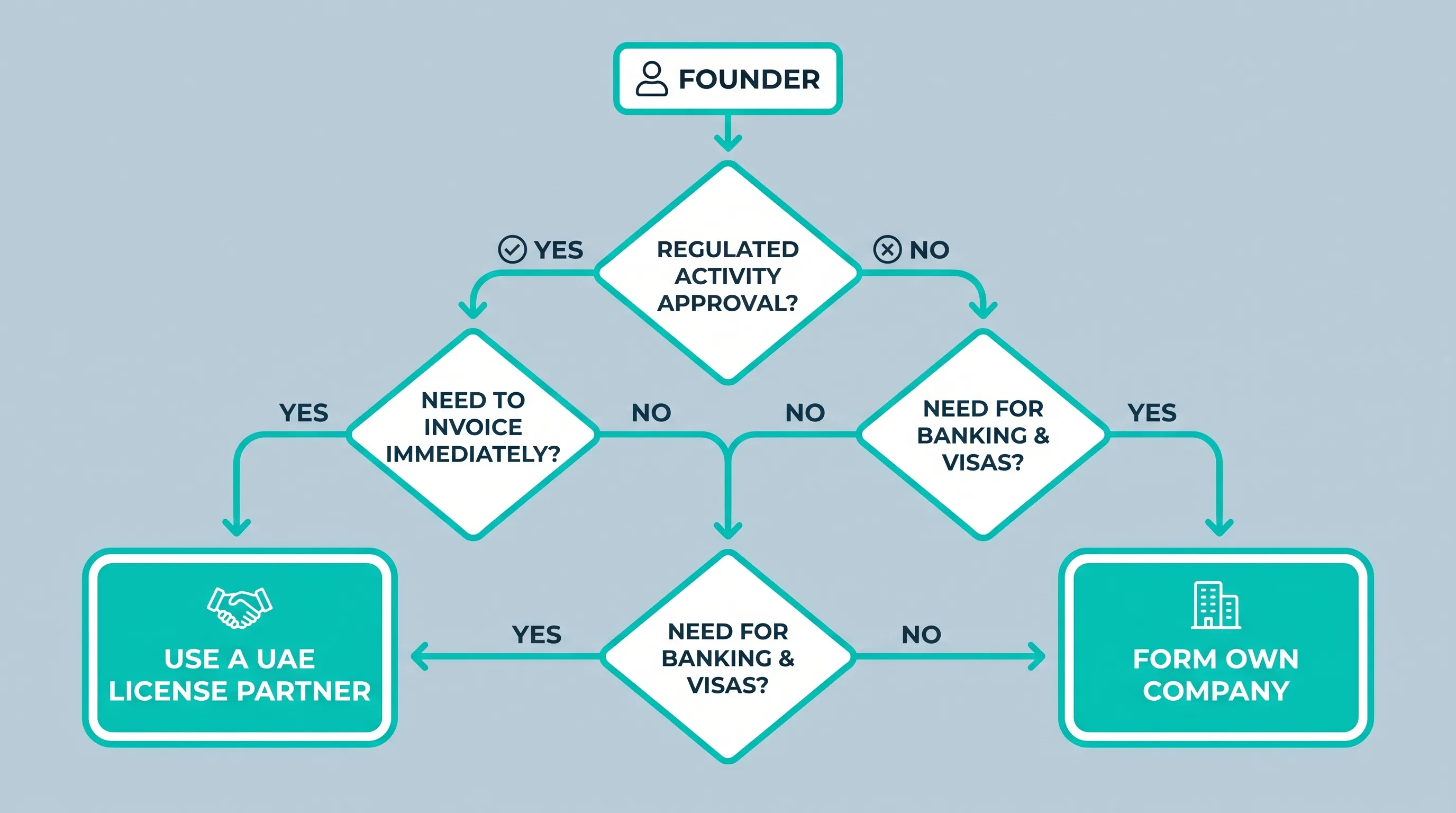
Use this as a quick filter before you spend time negotiating partner terms.
| Question | If “Yes” | If “No” |
|---|---|---|
| Does the activity require approvals or a regulated operator that you cannot obtain in time? | A license partner may be a valid bridge or operating model. | Form your own entity and license for your exact activity. |
| Does the partner genuinely deliver a commercial function (prime contractor, importer, distributor)? | Partner model can be defensible if contracts match reality. | High risk of “license renting” profile. |
| Do you need visas, banking, or long-term presence under your own name? | Prioritise your own entity, partner only as a short bridge. | A partner may cover limited contracting needs temporarily. |
| Is your client willing to contract directly with your future UAE entity once formed? | Create a migration plan (novation, new onboarding). | Consider whether the client is actually seeking a local accountable operator. |
How to structure a license partner arrangement so it survives scrutiny
If you decide a license partner is appropriate, the relationship must be designed so the paperwork matches the operational truth.
Align the contracting party, invoicing party, and responsible party
A common failure mode is:
- Partner invoices the client.
- You deliver the work.
- The client believes you are the real supplier.
If there is a dispute, the client may refuse to pay, claim misrepresentation, or demand the “real supplier” contract directly. Banks and auditors also dislike misalignment.
A stronger model is:
- The license partner is the prime contractor or reseller.
- Your role is defined as subcontractor or service provider.
- Liability allocation is explicit.
- The client understands the chain.
Put the compliance obligations in writing
At minimum, ensure the agreement answers:
- Who performs KYC on the end customer (if relevant)?
- Who owns customer data and IP created?
- Who is responsible for regulatory filings tied to the activity?
- Who bears the cost and risk of compliance failures?
Build a clean exit and migration path
If the license partner is a bridge, bake the transition into the commercial terms:
- A target date or trigger event for novation to your entity
- Treatment of ongoing subscriptions, warranties, and support
- Ownership and assignment of IP, domains, customer contracts
This avoids being “held hostage” later when you are ready to move.
Due diligence checklist for choosing a UAE license partner
Before you rely on another entity’s license, verify the basics as if you were onboarding a critical supplier.
- Confirm the partner’s trade license is valid, current, and includes the specific activity needed.
- Verify who the authorised signatories are and whether they can legally bind the company.
- Ask how the partner handles AML/KYB, UBO updates, and compliance recordkeeping.
- Check whether the partner can support practical necessities (banking, invoicing, customer onboarding) in a way that matches the operating reality.
- Stress-test the dispute scenario: if the end client sues, who is on the hook, and where is that written?
If the partner is reluctant to show basic corporate documents, or pushes you toward “off-books” workarounds, treat that as a stop sign.
Where Alldren fits (and what to do next)
In many cases, “I need a license partner” is a symptom of a deeper structuring question: you need to contract and invoice correctly today, without compromising banking, tax, and compliance tomorrow.
Alldren supports founders and corporate clients with:
- Company setup and structuring (free zone, mainland, offshore where appropriate)
- Ongoing compliance management and corporate governance
- Bank account opening support and substance planning
- Bookkeeping and tax registration support
- Residency visa processing
If you are weighing a partner model against forming your own UAE entity, the most efficient approach is usually to map your revenue flows, contracting needs, and regulator touchpoints first, then select the structure that matches.
Frequently Asked Questions
Is a license partner the same as “renting a trade license” in the UAE? No. A legitimate license partner arrangement is typically a prime contractor, reseller, importer, or regulated operator that performs a real function. “License renting” is using someone’s license as a front while you operate as if licensed, which is high risk.
Can I invoice UAE or international clients without my own UAE company if I use a license partner? Potentially, if the partner is the contracting and invoicing party and your role is properly documented as subcontractor. The arrangement must match the commercial reality, especially for enterprise vendor onboarding and compliance checks.
When should I stop using a license partner and set up my own UAE entity? When you need your own banking, visas, long-term contracting continuity, or when revenue and operational complexity justify direct control. If the arrangement is no longer a short bridge, it is usually time to formalise your own structure.
Does a license partner solve UAE bank account opening? Not for your business. It may allow the partner to receive funds into their account, but that creates dependency and misalignment risks. If you need banking in your own name, you generally need your own entity with credible substance.
What is the biggest red flag in a license partner arrangement? When the partner will invoice and “cover” the activity, but has no operational role, no compliance process, and cannot clearly explain how the arrangement stays aligned with licensing and contractual responsibility.
Talk to Alldren about a compliant operating plan
If you are considering a license partner because you need to invoice quickly, operate in an approval-gated sector, or enter the UAE market without getting stuck in the wrong structure, Alldren can help you build a defensible plan.
Start with a structuring review and next-step roadmap via Alldren.


