

Choosing a business company structure is one of the few early decisions that can quietly shape everything that follows: your legal risk, who can sign contracts, how profits move, how easy banking is, and what compliance looks like a year from now.
In the UAE, the “right” structure is rarely about what’s trendy. It is about matching your activity, risk profile, where you will trade, and growth plans to a legal form and licensing jurisdiction that will still make sense when you scale.
What “business company structure” really means (in practice)
When founders say “company structure,” they often mean one thing, but there are usually four layers involved:
- Legal form (for example, LLC, branch, sole establishment).
- Jurisdiction and licensing (mainland vs free zone, plus the specific licensing authority).
- Ownership and governance (shareholders, directors, signing authority, shareholder agreements).
- Operational and compliance setup (accounting, tax registrations, substance expectations for banking, and ongoing filings).
The best business company structure is the one where these layers align with your real operations, not the one that looks simplest on day one.
The most common company structures used in the UAE (high level)
Below are the structures most businesses consider when entering or operating in the UAE. Exact availability and requirements depend on the emirate, licensing authority, and business activity.
| Structure | Typically best for | Key considerations (not exhaustive) |
|---|---|---|
| Mainland LLC | Businesses trading directly in the UAE market, signing local contracts, serving UAE clients at scale | Licensing rules vary by activity, office/lease requirements may apply, more flexibility for onshore operations |
| Free zone company (often FZ-LLC / FZE style forms) | International trade, regional HQs, service companies with cross-border clients, certain UAE operations depending on rules | Scope of doing business “onshore” depends on the free zone framework and activity, compliance and office options vary by zone |
| Branch of a foreign company | Established foreign companies that want a UAE presence without a separate subsidiary | Branch is legally an extension of the parent, liability and governance follow parent structure, approval steps can be more document-heavy |
| Sole establishment / sole proprietorship | Individual-led professional activities in some cases | Less separation between individual and business risk compared to limited liability structures (always confirm for your activity) |
| Holding company / SPV-style structure | Asset holding, IP, group structuring, ring-fencing risk across subsidiaries | Must be designed around governance, intercompany agreements, banking expectations, and tax/compliance implications |
If you are choosing among these, your goal is not to pick the “best” structure generally. It is to pick the best structure for your risk, revenue model, and operating footprint.
A practical framework: 8 questions that lead you to the right structure
1) What is your activity, and is it regulated?
Start with your exact activity wording, not a vague category.
- “Consulting” can mean management consulting, marketing, engineering, financial advisory, or something regulated.
- “Trading” can mean general trading, specific product categories, import-export, or e-commerce.
Licensing authorities classify activities differently, and requirements can change based on whether you are regulated, handling client funds, operating in healthcare, education, crypto, financial services, and so on.
If you choose a structure first and only then try to fit the activity into it, you risk rework, restrictions, or delays.
2) How much liability protection do you need?
A core reason many founders choose an LLC-style structure is to separate business obligations from personal exposure (subject to law, guarantees, and conduct).
Ask:
- Could you face contractual claims (deliverables, project delays, warranties)?
- Could you face product liability (physical goods, importation)?
- Will you sign leases, hire staff, or borrow?
In practice, banking and commercial reality also matter. Even with limited liability, founders commonly sign personal guarantees for leases or financing, so the structure must be paired with good contracting and governance.
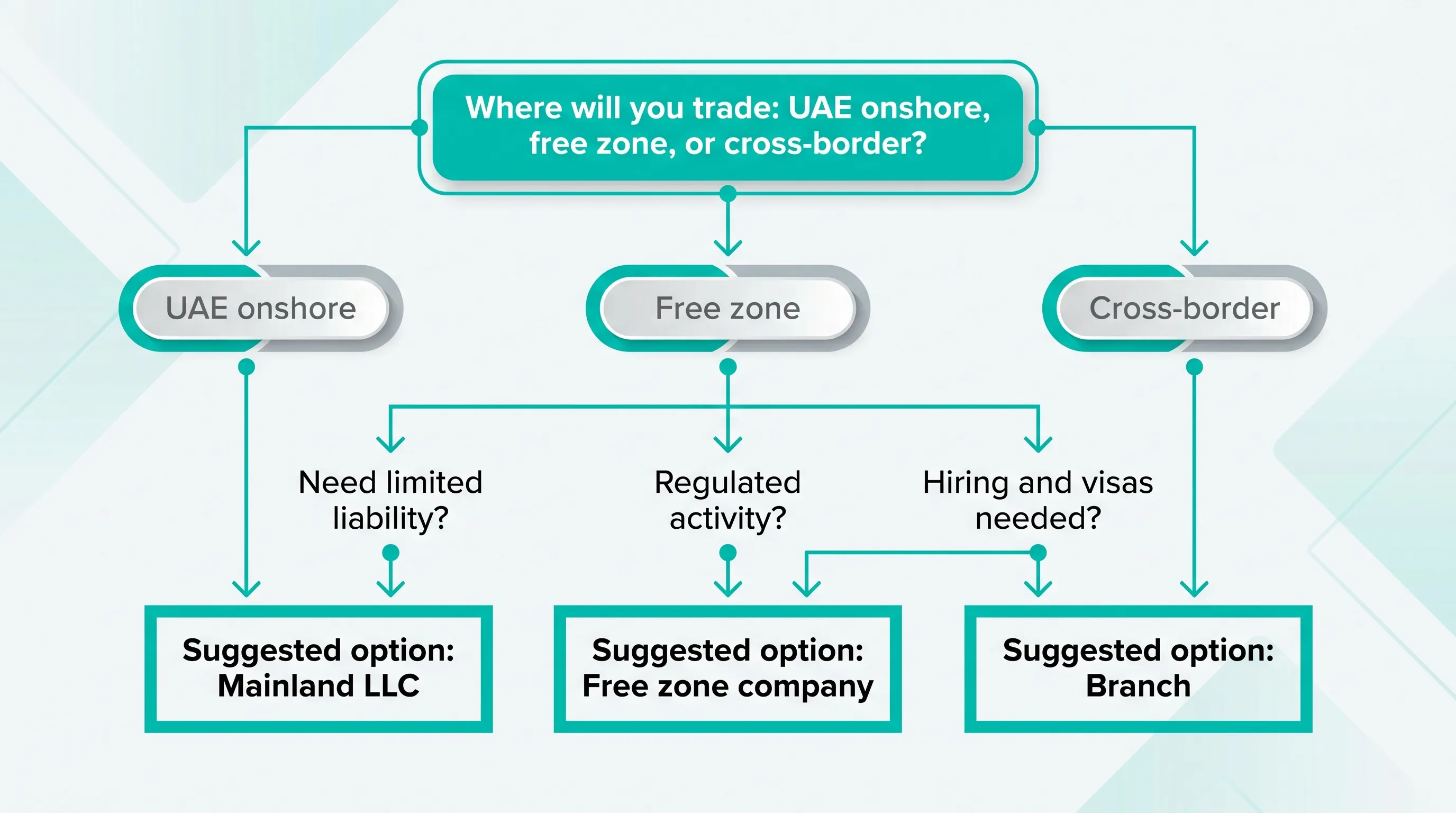
3) Where will you actually do business (UAE onshore, free zone, cross-border)?
This is often the deciding factor.
- If you plan to serve UAE customers directly, sign local contracts frequently, open a shop, or bid for certain tenders, you generally want a structure that supports smooth onshore operations.
- If your work is mostly cross-border services, international trade, or a regional headquarters function, a free zone company may align well.
There is no one-line rule that fits every free zone or every activity, so treat “mainland vs free zone” as a compliance and operating model decision, not just a cost decision.
4) What ownership and control outcomes do you need?
Most founders care about:
- 100 percent ownership where available
- clear signing authority
- clean cap table for investors
- protection for minority shareholders
The UAE has evolved significantly on foreign ownership across many activities, but requirements still vary by activity and licensing authority. The practical step is to map:
- Who owns shares (and in what percentages)
- Who is the manager or director
- Who holds bank signing authority
- What happens on death, incapacity, divorce, or shareholder disputes
If you are using nominee arrangements for governance or privacy reasons, get specialist advice. You still must comply with beneficial ownership and KYC expectations.
5) How will corporate tax and VAT apply to you?
Since corporate tax is now part of the UAE landscape, structuring should include tax reality from day one, not as an afterthought.
Key points to plan around:
- UAE Corporate Tax applies under the federal regime, with rules and definitions set by the Ministry of Finance and implemented through the Federal Tax Authority. Start with official guidance: UAE Ministry of Finance, Corporate Tax.
- VAT may apply if you cross registration thresholds and make taxable supplies. Reference: Federal Tax Authority (VAT).
What this means structurally:
- Your legal form affects how you document revenue, expenses, and intra-group payments.
- A holding structure can be useful, but only when governance, substance, and intercompany agreements are properly designed.
- “I will deal with tax later” can become expensive if your first year creates messy books or inconsistent contracting.
Important: tax outcomes depend on facts, elections, and detailed rules, so this should be reviewed with qualified advisors for your specific case.
6) Will you need a UAE bank account quickly, and what will the bank expect?
For most businesses, banking is where “paper structure” meets reality.
Banks typically focus on:
- clarity of ownership (UBO information)
- nature of business and source of funds
- expected countries of operation
- contracts, invoices, and counterparties
- office presence and substance indicators
A structure that looks perfect on a diagram can still struggle if the story is unclear, the activity is high risk, or documents do not match operations.
If banking speed matters, design the structure and documentation pack with KYC in mind from the beginning.
7) Do you plan to hire, sponsor visas, or relocate yourself?
If your plan includes:
- hiring employees in the UAE
- obtaining residency visas (for founders or staff)
- leasing offices or warehousing
then choose a structure and licensing authority that matches your expected headcount, office requirements, and immigration pathway.
Because visa and labor processes are operationally tied to licensing and establishment cards, it is better to design them together, rather than “adding visas later.”
8) What is your 24-month plan: fundraising, exit, expansion, or a steady cash business?
Your next phase should influence today’s structure.
- Venture-backed path often needs a clean cap table, clear governance, and predictable reporting.
- Regional expansion may benefit from a holding structure that can own multiple operating entities.
- Asset protection goals may justify ring-fencing activities into separate entities.
If you expect a transaction (investment, acquisition, shareholder restructuring), you want a structure that is due diligence-friendly and not dependent on informal arrangements.
Common scenarios (and what to consider)
Scenario A: Service business with international clients
If you sell services primarily outside the UAE (or to a narrow set of UAE clients) you will likely prioritize:
- straightforward contracting and invoicing
- banking compatibility with your client geographies
- ability to sponsor visas for founders
- compliance that stays light but reliable
A free zone company is often considered in this scenario, but the correct choice depends on activity classification, client location, and operational needs.
Scenario B: E-commerce selling to UAE consumers
If you are selling into the UAE market, consider:
- how you will import, store, and distribute goods
- whether you need local delivery partners, warehousing, or a physical presence
- VAT registration planning (where applicable)
Your structure needs to support practical onshore operations, not just online sales.
Scenario C: Foreign company opening a UAE office
A branch can be compelling when you want alignment with the parent and do not need a separate subsidiary cap table.
Key considerations include:
- parent company document legalization and approvals
- who will be authorized signatory in the UAE
- whether contracts and liabilities should sit with the parent or a separate entity
Scenario D: Holding assets or running multiple business lines
If you plan to hold IP, real estate, or own multiple operating entities, a holding approach may help you:
- separate risk across activities
- prepare for partnerships or partial exits
- centralize governance
This only works well when the group structure is supported by proper corporate governance, intercompany documentation, and accounting discipline.
Mistakes that cause expensive rework
Choosing based on cost alone
Setup cost matters, but the wrong structure can create ongoing cost through:
- re-licensing and re-approvals
- banking delays
- compliance catch-up
- restrictions on doing business where you actually have customers
Picking an activity that does not match reality
Misaligned activities can affect contracts, invoicing, banking comfort, and regulatory exposure. Choose the activity based on your real operations and medium-term roadmap.
Ignoring governance until a dispute happens
Even small businesses benefit from basic governance hygiene:
- shareholder agreements where needed
- clear signing authority
- documented decision-making
It is much cheaper to set this up at incorporation than after relationships change.
Treating bookkeeping as optional
Good bookkeeping is not just compliance, it is operational control. It supports tax filings, banking reviews, investor diligence, and profit visibility.
How Alldren supports the right structure (without guesswork)
Alldren’s approach is built for founders and operators who want a structure that is defensible, bankable, and scalable, not just “fast.” Based on the information you shared (activity, where you will trade, ownership, and near-term plans), Alldren can help you:
- select an appropriate UAE company setup and structuring route
- align the licensing pathway with operations
- plan for ongoing compliance management and corporate governance
- support bank account opening and residency visa processing
- set up bookkeeping and tax registration workflows where relevant
To discuss your best-fit business company structure, you can start at Alldren.
Frequently Asked Questions
What is the best business company structure in the UAE? The best structure depends on your activity, where you will trade (onshore vs cross-border), liability needs, banking, and hiring or visa plans. There is no universal best option.
Is a free zone company always cheaper or easier than a mainland LLC? Not always. Free zones can be efficient for certain models, but restrictions, banking expectations, office requirements, and how you serve UAE customers can change the overall effort and cost.
Can I change my UAE company structure later? Often yes, but it can involve approvals, re-licensing, contract updates, banking changes, and operational disruption. It is usually better to design for your next 12 to 24 months upfront.
Do I need to think about corporate tax when choosing a structure? Yes. Corporate tax and VAT implications influence accounting, contracting, group structures, and compliance workload. Use official guidance as a baseline and get professional advice for your facts.
Will my company structure affect bank account opening? Yes. Banks review ownership, activity, expected transaction flows, and substance. A clear, coherent structure and documentation pack can materially improve the process.
Next step: get a structure designed around your actual business
If you want a business company structure that matches how you will operate in the UAE, and stands up to banking and compliance scrutiny, speak with Alldren’s senior experts via alldren.com.


