

Setting up in the UAE starts with a deceptively simple question: what exactly will your company do? Your answer determines the corporate license you can apply for, which authorities you deal with, whether you can invoice certain clients, hire staff, open bank accounts smoothly, and stay compliant as you grow.
This guide breaks down the main corporate licenses in the UAE, when each one applies, and how to choose between mainland and free zone licensing so your legal setup actually fits your day-to-day operations.
What is a corporate license in the UAE?
A UAE corporate license is the government authorization that allows a legal entity to conduct specific business activities. In practice, your license defines:
- The permitted activities (sometimes very narrowly)
- The issuing authority (a mainland economic department or a free zone authority)
- Any special approvals required (for regulated sectors)
- Your operational scope (for example, local trading, cross border services, manufacturing)
Because licensing is activity-based, two companies with similar names can face very different compliance and banking requirements if their licensed activities differ.
The main corporate license types (and what they’re for)
While naming conventions can vary by emirate and jurisdiction, most UAE setups fall under a few common license categories.
Commercial license
A commercial license typically covers buying and selling goods, trading, import and export, distribution, general trading, and certain marketplace models.
This is often the best fit if you:
- Sell physical products (local or international)
- Trade commodities or merchandise
- Operate wholesale or distribution
- Run a retail business (where permitted by jurisdiction)
Professional license
A professional license generally covers services delivered through expertise, skills, and labor rather than the sale of goods.
Common examples include:
- Management consulting and advisory (where permitted)
- Marketing and design services
- Software development and IT services
- Training, education related services (often regulated)
- Engineering and technical services (often regulated)
Professional licensing can still involve invoicing clients and hiring staff, but the underlying activity is service-based.
Industrial license
An industrial license applies to manufacturing, processing, production, and industrial assembly. It usually brings extra requirements, such as facility approvals, environmental or civil defense requirements, and in some cases additional ministry involvement.
This is relevant if you:
- Manufacture or assemble products in the UAE
- Operate a factory, workshop, or processing facility
- Need warehouse and production space tied to licensed operations
Tourism (or travel and tourism) license
A tourism license is designed for travel and hospitality related activities, such as travel agencies, tour operators, and certain booking or tourism services. These activities often require additional approvals.
Activity specific and regulated licenses (important note)
Some sectors are regulated and may require additional approvals beyond the standard corporate license, depending on the activity and jurisdiction, for example:
- Financial services and certain investment activities
- Insurance related activities
- Healthcare and medical services
- Education and training in regulated categories
- Real estate brokerage or property related activities
If you operate in a regulated space, you should validate requirements early to avoid delays or costly restructuring.
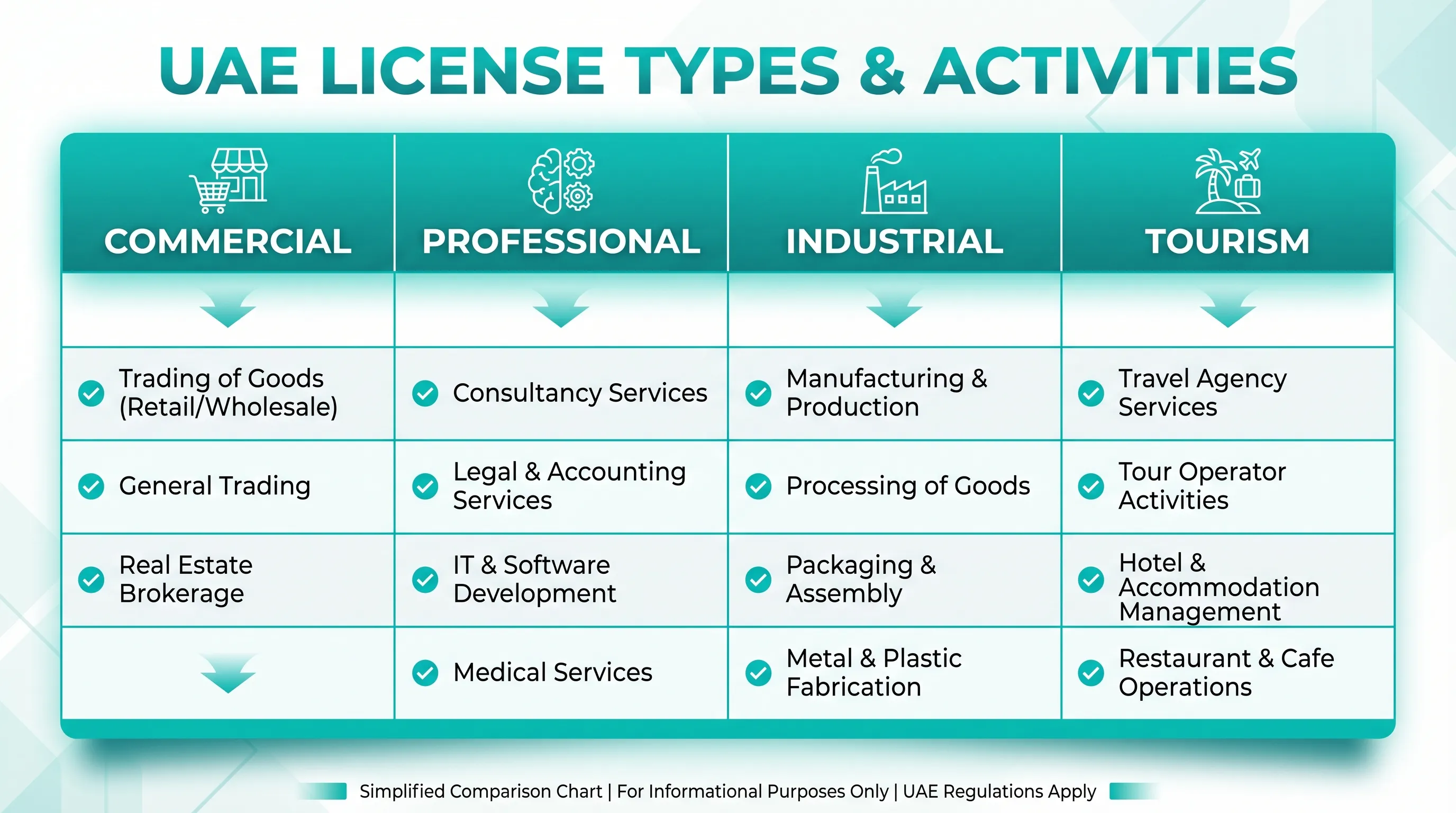
Quick comparison table: license type vs typical activities
| UAE license type | Typical fit | Notes to watch |
|---|---|---|
| Commercial | Trading, import/export, distribution, retail (where allowed) | May require specific activity wording, product restrictions, customs considerations |
| Professional | Consulting, IT services, design, marketing, technical services | Some professions need qualifications, external approvals, or specific legal forms |
| Industrial | Manufacturing, processing, production | Facility approvals, additional compliance, inspections, and sometimes extra authority involvement |
| Tourism | Travel agency, tour operator, tourism services | Often requires additional approvals and sector specific compliance |
Mainland vs free zone licensing: what changes in practice?
After choosing the license type, the second decision is where to license: mainland (onshore) or a free zone. This choice affects where you can operate, how you contract, and what compliance steps apply.
Mainland (onshore)
A mainland license is issued by the relevant emirate’s economic department (for example, Dubai’s Department of Economy and Tourism, Abu Dhabi’s ADDED). Mainland companies are often chosen when you:
- Need to serve the local UAE market broadly
- Plan to rent office space in the emirate under mainland rules
- Work with certain government or semi-government counterparties (requirements vary)
Free zone
A free zone license is issued by a specific free zone authority. Free zones are popular for international business models, service companies, holding structures, and trading models that do not require broad local retail presence.
Free zones typically offer their own operational frameworks, facility options, and administrative processes, but the exact permissions depend on the free zone and activity.
Offshore (where relevant)
“Offshore” is often used to describe entities primarily meant for holding assets or international activities and typically not intended for operational business inside the UAE market. Offshore structures are highly fact-dependent, so they should be assessed carefully against your business goals (especially banking, substance, and compliance expectations).
Mainland vs free zone: decision table
| Topic | Mainland license | Free zone license |
|---|---|---|
| Primary issuer | Emirate economic department | Free zone authority |
| Best for | Broad local operations, certain in-country contracting | International models, zone-based operations, certain service and trading setups |
| Facility options | Mainland offices, warehouses, shops (subject to rules) | Free zone offices, flexi desks, warehouses (varies by zone) |
| Local market access | Typically broader | Depends on model, may require structuring for certain local activities |
| Compliance style | Emirate level requirements plus federal compliance | Free zone rules plus federal compliance |
For official starting points, see the UAE government portal u.ae and the Ministry of Economy resources.
How to choose the right corporate license for your activity (a practical framework)
If you want to avoid rework later, choose your license by working backwards from real operations, not from a generic label like “consulting” or “trading.”
1) Describe what you do in plain language
Write one paragraph answering:
- What do you sell (goods, services, both)?
- Where are your customers (UAE, GCC, global)?
- How do you deliver (online, in person, shipments, on-site work)?
- Do you need staff visas and office space?
This makes it easier to map your business to the correct licensed activities.
2) List your revenue streams, not just your “main” business
Many licensing problems come from secondary revenue, for example:
- A software company that also provides paid training
- A consultancy that also resells tools or hardware
- A trading business that also installs or maintains equipment
You may need multiple activities under one license, or a structure that separates risk and compliance.
3) Identify whether you are regulated
If you touch a regulated field, confirm early whether extra approvals apply. It is common for banking, compliance checks, and even contracting to depend on whether your activity is classified as regulated.
Depending on the activity and location, regulators and sector authorities may be involved (for example, financial services regulators in specific financial free zones, or sector authorities for healthcare and education). Requirements change and differ by jurisdiction, so treat this step as essential.
4) Choose jurisdiction based on operating reality
Ask:
- Do you need broad UAE market access, local premises, or local retail?
- Will you mainly invoice overseas clients?
- Do you need warehousing and imports?
- Do your counterparties require a particular jurisdiction?
The “best” jurisdiction is the one that supports your contracting flow and compliance obligations with minimal friction.
5) Consider banking and compliance expectations upfront
Bank account opening is not just a checklist item. Banks typically assess the coherence of your setup, including:
- Whether the licensed activity matches the transaction profile
- Ownership structure and UBO clarity
- Source of funds and expected counterparties
- Substance indicators (premises, staff, contracts, invoices)
A license that does not reflect your true activity can lead to delays, enhanced due diligence, or operational limitations.
Common mistakes when selecting a UAE corporate license
Choosing a vague activity description
Overly broad wording can be rejected, or it can create mismatches later when you need approvals or banking support. Aim for activities that are accurate and defensible.
Selecting a jurisdiction before validating the activity
Not every free zone supports every activity in the same way, and not every mainland setup is operationally efficient for every model. Validate the activity options first.
Underestimating add-on approvals
If your activity requires external approvals, timelines and documentation can change significantly. Plan for it early.
Trying to combine incompatible activities
Some activities do not mix well on a single license (or create extra compliance). In those cases, a tailored structure may be safer and cleaner.
What you typically need to apply (high level)
Specific requirements vary, but licensing processes commonly involve:
- Proposed company name and business description
- Shareholder and management documents (KYC)
- Defined activities and jurisdiction selection
- Office or facility arrangement (depending on rules)
- Any external approvals if the activity is regulated
If your setup includes VAT registration, you will also want to reference the UAE Federal Tax Authority guidance to stay aligned with tax compliance requirements (FTA).
When expert guidance makes a measurable difference
Many founders only discover licensing constraints after they:
- Start negotiating with a bank
- Sign a major client that requires specific contracting ability
- Need visas for key hires
- Expand into a regulated line of business
If you want your licensing choice to support growth, it helps to design your corporate structure around operational reality, compliance, and future scalability from day one.
Frequently Asked Questions
What are corporate licenses in the UAE? Corporate licenses are official permissions issued by a mainland economic department or a free zone authority that specify what business activities a UAE entity is allowed to conduct.
Is a commercial license or professional license better for my business? Neither is universally better. A commercial license generally fits trading and product sales, while a professional license fits service-based activities. The right choice depends on what you actually sell and how you deliver it.
Can I do multiple activities under one UAE license? Often yes, but only if the activities are permitted together by the issuing authority and do not trigger incompatible regulatory requirements. It is important to confirm the exact activity list before applying.
Do free zone licenses allow me to sell to mainland UAE customers? It depends on the business model, activity, and jurisdiction. Some setups can serve mainland clients under specific conditions, while others may require additional structuring. Confirm this before you commit.
Do I need extra approvals for regulated activities? Yes, in many cases. Activities in areas like financial services, healthcare, education, and certain professional services can require additional approvals from relevant authorities.
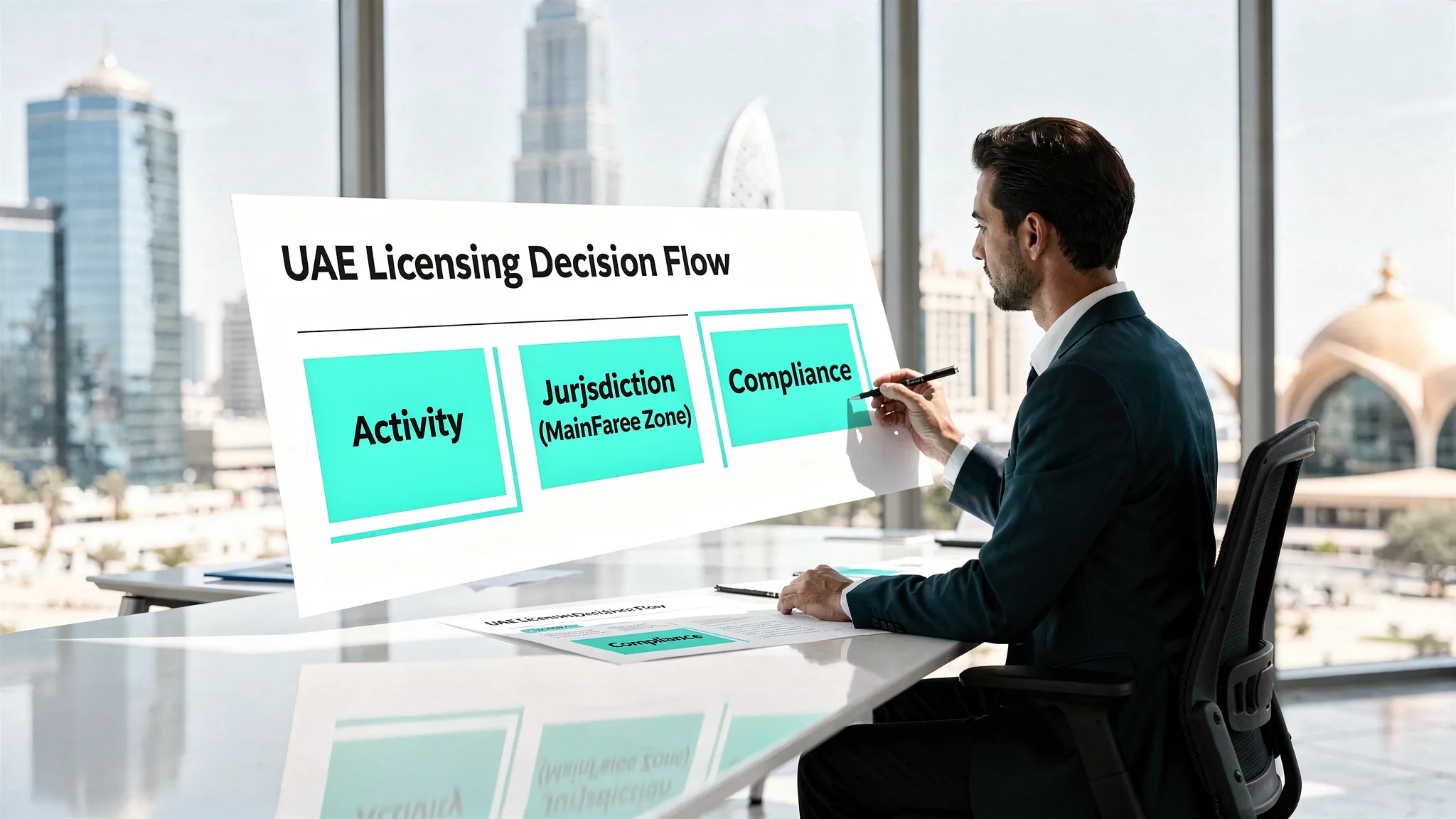
Get the right UAE license, without costly rework
If you are choosing between corporate licenses in the UAE and want a setup that matches your real activity, contracting needs, and compliance obligations, Alldren can help you structure it correctly from the start. Alldren provides expert-led company setup and structuring, ongoing compliance management, bank account opening support, visa processing, and corporate governance services with transparent, upfront pricing.
Explore options at Alldren and speak with a senior expert about the license and jurisdiction that best fits your activity.


