

Choosing the right legal structure in the UAE is not just a paperwork exercise, it affects who can own shares, how you sign contracts, what your bank asks for, and how you stay compliant after incorporation. For many founders, the LLC UAE route is the default choice because it offers limited liability, flexibility for most commercial activities, and (in many cases) 100% foreign ownership on the mainland following legal reforms.
This guide explains how an LLC works in the UAE, what the ownership rules look like in practice, and the typical setup steps so you can plan your launch with fewer surprises.
What is an LLC in the UAE?
An LLC (Limited Liability Company) is a company where the business has its own legal personality and shareholders’ liability is generally limited to their share capital contribution.
In practical terms, an LLC UAE structure is commonly used when you want to:
- Trade goods or services with clients across the UAE (especially on the mainland)
- Sign local contracts and lease premises under the company name
- Employ staff and sponsor UAE residence visas
- Keep governance relatively straightforward (compared to public joint stock structures)
LLCs exist in both contexts:
- Mainland LLCs (licensed by an emirate’s Department of Economy and Tourism or equivalent)
- Free zone LLC-style entities (often called FZ-LLC or “Free Zone Limited Liability Company”, governed by a free zone authority)
The underlying concept is similar (limited liability), but the operating permissions, regulators, and compliance workflows differ.
Mainland LLC vs free zone company: which “LLC UAE” do you mean?
People often search “LLC UAE” when they really mean one of two things: a mainland LLC, or a free zone LLC (FZ-LLC). They are not interchangeable.
Here is a high-level comparison to help you frame the decision.
| Topic | Mainland LLC (UAE) | Free zone company (FZ-LLC or equivalent) |
|---|---|---|
| Regulator | Emirate-level licensing authority (DED/DET or similar) | Free zone authority |
| Where you can trade | Generally across the UAE market | Primarily within the free zone and internationally (local UAE trading often needs a compliant route such as a distributor or additional approvals) |
| Office requirement | Commonly required (rules vary by emirate and activity) | Often flexi-desk options exist (varies by free zone) |
| Visas | Yes, subject to eligibility | Yes, subject to free zone rules |
| Perception for local tenders | Often preferred for onshore contracting | Can work, but depends on client requirements |
If your business model relies on selling directly to UAE customers, bidding for onshore contracts, or operating from a physical premises in the city, a mainland LLC is often the most direct route. If your model is international, digital-first, or you want a free zone ecosystem, a free zone company may be more suitable.
LLC UAE ownership rules (and why “100% foreign-owned” can still be nuanced)
1) Is 100% foreign ownership allowed for a mainland LLC?
In many sectors, yes. The UAE has reformed company ownership rules so that many mainland activities can be 100% foreign-owned.
However, it is not a universal rule for every activity. Some activities can still be subject to special requirements.
A good starting point for legal context is the UAE Ministry of Economy’s information on company regulation and the Commercial Companies framework: UAE Ministry of Economy.
2) “Strategic impact” activities may have additional conditions
Certain activities can be treated as “strategic impact” activities, where shareholding, board composition, or other conditions may apply. The exact list and implementation can depend on the emirate and the competent authority.
Because of this, ownership planning should always begin with:
- Your exact licensed activity description (not just your marketing description)
- The emirate where you will incorporate
- Any sector regulator requirements (for example, financial services, insurance, healthcare, education)
3) Ultimate Beneficial Owner (UBO) disclosure is standard
Even if a company is 100% foreign-owned, UAE corporate compliance typically requires disclosure of the Ultimate Beneficial Owner(s) and maintaining relevant registers.
Reference and guidance are commonly published via the Ministry of Economy: UBO information and compliance resources.
4) Using nominees: legal and risk considerations
Some founders consider nominee arrangements (for privacy, governance, or operational reasons). This can be legitimate when structured correctly, but it must be handled carefully to avoid:
- Misaligned control vs responsibility (who signs, who is liable, who manages)
- Banking friction (banks assess transparency, control, and source of funds)
- Compliance issues (UBO accuracy, corporate governance expectations)
If you are considering nominee director services, treat it as a governance design problem, not a paperwork shortcut.
How LLC UAE governance usually works
While details vary by authority, most LLCs are built around a few core elements.
Memorandum of Association (MOA)
The MOA is the constitutional document that typically covers:
- Shareholders and shareholding percentages
- Business activities (as licensed)
- Share capital terms (and whether capital is paid-up or stated)
- Management provisions (manager(s), powers, restrictions)
- Profit distribution and decision thresholds
Manager(s) and signatory powers
Many LLCs appoint one or more managers. What matters operationally is not just the appointment, but the signing authority and any limitations.
Banks and counterparties often ask for:
- A copy of the license and incorporation documents
- A board or shareholder resolution authorizing account opening and signatories
- Clarification of who can sign alone vs jointly
Shareholders’ agreements (recommended for multi-owner companies)
A shareholders’ agreement is not always legally required, but often valuable when there are multiple owners, investors, or a passive shareholder. It can define:
- Reserved matters (decisions requiring unanimous approval)
- Founder vesting or exit rules
- Non-compete and confidentiality
- Deadlock resolution
Share capital, liability, and what “limited” really protects
Capital: minimums are not one-size-fits-all
You will see conflicting advice online about “minimum capital” for an LLC UAE. The reality is:
- Some authorities do not impose a practical paid-up minimum for many standard activities.
- Some activities (or some free zones) may set stated capital, paid-up capital, or specific thresholds.
Treat capital as both a compliance and credibility tool. For certain sectors, capital expectations can show up later during bank account onboarding or tender qualification.
Limited liability: strong protection, but not absolute
Limited liability is a major benefit of an LLC, but it does not eliminate all personal exposure. Common situations that can create risk include:
- Personal guarantees to banks or landlords
- Breaches of director/manager duties or fraud
- Non-compliance that triggers penalties or license issues
Tax and compliance basics for LLC UAE companies (2026 context)
The UAE is widely viewed as business-friendly, but compliance is no longer optional or informal. A few pillars matter for most LLCs.
UAE Corporate Tax
The UAE introduced federal corporate tax effective for financial years starting on or after 1 June 2023. The Ministry of Finance provides the official overview: UAE Ministry of Finance, Corporate Tax.
At a high level for many businesses:
- 0% on taxable income up to AED 375,000
- 9% on taxable income above AED 375,000
Your actual outcome depends on your accounting, classification, and whether any incentives or special regimes apply.
VAT (Value Added Tax)
VAT in the UAE is administered by the Federal Tax Authority. Standard VAT rate is 5%, and registration depends on thresholds and business facts. Official reference: UAE Federal Tax Authority.
Accounting and ongoing filings
Even small LLCs should plan early for:
- Bookkeeping from day one (bank-ready, tax-ready records)
- License renewals and any activity-specific approvals
- UBO register maintenance and corporate governance hygiene
If you treat compliance as a “later” problem, it often turns into delays (banking, renewals, visas) at the worst possible time.
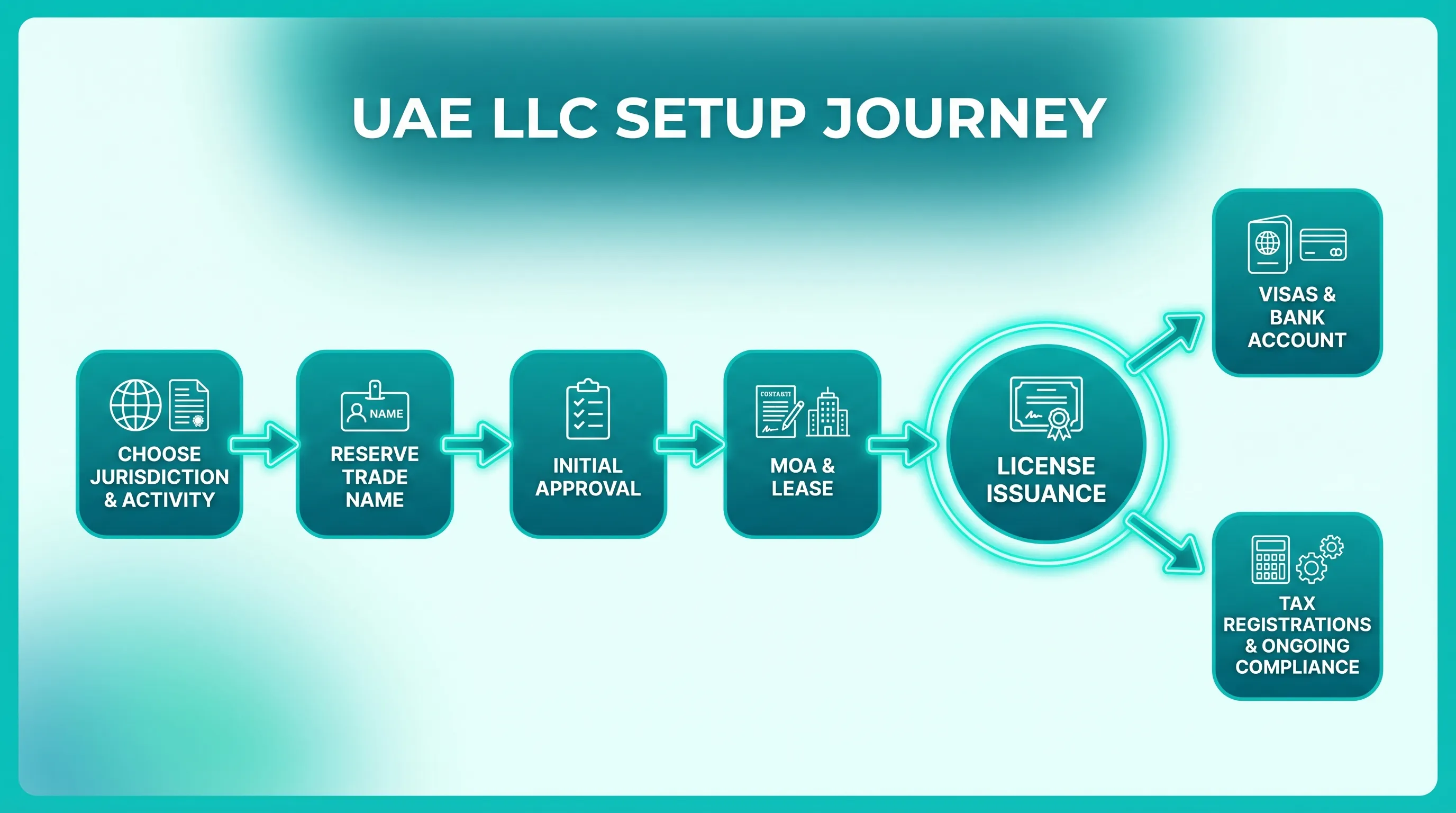
LLC UAE setup steps (typical end-to-end workflow)
Exact procedures vary by emirate and by whether you choose mainland or free zone, but the logic is consistent. Below is a practical, planning-oriented sequence.
Step 1: Define your activity (as the licensing authority defines it)
Your activity selection drives:
- Whether 100% foreign ownership is available
- Which regulator approvals are needed
- Which documents will be requested later by banks
Avoid choosing a “close enough” activity name. A mismatch between what you do and what you are licensed to do is a common reason for banking and compliance friction.
Step 2: Choose the jurisdiction (mainland or a specific free zone)
Decide based on:
- Target customers (onshore UAE vs international)
- Visa needs (how many, how soon)
- Office requirements and cost
- Sector ecosystem (some free zones are industry-focused)
Step 3: Plan the ownership and control model
Before any application is filed, align internally on:
- Shareholding percentages
- Who will be the manager(s)
- Who will be the bank signatory
- Whether you need nominee arrangements (and how you will keep UBO reporting accurate)
Step 4: Reserve the trade name and get initial approval
This step typically confirms that:
- The name is acceptable and available
- The authority is open to licensing the activity under your proposed structure
Initial approval is not the same as a final license, but it is a key gate.
Step 5: Draft and execute incorporation documents (MOA and resolutions)
At this stage you generally finalize:
- The MOA
- Shareholder and manager appointments
- Any required signatures and notarization/attestation steps
If there are foreign corporate shareholders, you may need legalized documents from the home jurisdiction. Plan lead time.
Step 6: Secure premises (when required)
Many mainland LLCs must show a compliant lease for licensing. Free zones may offer different workspace options depending on their rules.
Premises is not only about licensing, it can also affect:
- Visa quota eligibility
- Bank comfort with your operating footprint
Step 7: Receive the trade license and complete registration
Once approved, you receive your license and can typically proceed to operational setup.
After licensing, you should also set up a governance folder that is always ready for banks, auditors, and counterparties (license, MOA, registers, resolutions, IDs, proof of address, etc.).
Step 8: Immigration setup and residence visas (if needed)
If you will sponsor yourself or employees, you will generally go through:
- Establishment registration with the relevant immigration and labor channels
- Entry permit (if applicable), medical, Emirates ID
- Visa stamping or residence issuance steps as per current process
The exact sequencing varies, but it should be built into your launch timeline.
Step 9: Bank account opening
Banking is often the most underestimated step. Banks commonly perform detailed KYC and may ask for:
- A clear business model explanation
- Contracts or invoices (or pipeline evidence)
- Source of funds and source of wealth documents
- Ownership and UBO transparency
A well-prepared file and a structure that makes sense for your activity can dramatically reduce back-and-forth.
Step 10: Tax registrations and ongoing compliance operations
Once you are operational, set up:
- Corporate tax readiness (accounting, policies, filing calendar)
- VAT registration if required
- Bookkeeping cadence and document control
Typical timeline (what is realistic, and what varies)
No one can promise a single “standard” timeline for an LLC UAE because it depends on approvals, document readiness, and banking. Still, ranges help you plan.
| Phase | What it includes | Common range (planning estimate) |
|---|---|---|
| Pre-setup planning | Activity, jurisdiction, shareholders, document prep | 2 to 10 business days |
| Licensing process | Name reservation, initial approval, MOA, lease, license issuance | 5 to 20 business days |
| Immigration and visas | Establishment setup, entry permit, medical, Emirates ID | 2 to 6 weeks |
| Bank account opening | KYC review, compliance checks, onboarding | 2 to 8+ weeks |
Use this as a planning baseline, not a guarantee. Complex ownership, regulated activities, incomplete documents, or unclear business models can extend timelines.
Common mistakes when setting up an LLC in the UAE
Choosing the wrong activity to “make it easier”
This often backfires later during banking, invoicing, insurance, and client onboarding. Align the license with reality.
Underestimating ongoing compliance
Founders may focus on incorporation and ignore renewals, governance, bookkeeping, and tax readiness. In 2026, those are core operating requirements, not optional admin.
Building a structure that looks unusual to banks
Banks do not just review documents, they assess whether the structure matches the business purpose and risk profile. Over-complicated holding chains or unclear control can delay onboarding.
Not documenting decision-making and signatory powers
Even small LLCs benefit from clean resolutions and clear authority limits. It reduces internal disputes and speeds up external counterparties’ checks.
When an LLC UAE structure might not be the best fit
An LLC is flexible, but it is not always optimal. Depending on what you do, you might consider alternatives such as:
- A branch (if you are expanding an existing foreign company)
- A professional license structure (for certain service-based activities)
- A free zone entity (if you are mostly international and want a free zone ecosystem)
The right answer depends on your activity, customers, hiring plan, and tax and compliance posture.
Frequently Asked Questions
Can a foreigner own 100% of an LLC in the UAE? Yes for many activities, including on the mainland, but some regulated or “strategic impact” activities can have additional conditions. Always confirm using your exact activity and emirate.
What is the difference between a mainland LLC and a free zone FZ-LLC? A mainland LLC generally allows direct trading across the UAE market, while a free zone company is primarily designed for free zone operations and international business (local UAE trade can require specific arrangements).
Do I need an office to set up an LLC in the UAE? Often yes for mainland LLCs, depending on the emirate and activity. Many free zones offer flexible workspace options, but requirements vary by free zone.
How much share capital is required for an LLC UAE? It depends on the licensing authority and the activity. Some setups have no practical paid-up minimum for standard activities, while certain sectors or free zones impose capital requirements.
How long does it take to set up an LLC in the UAE? Licensing can be relatively quick once documents are ready, but visas and bank account opening often take longer. A realistic plan should include time for compliance checks and document legalization if needed.
Set up your LLC UAE the right way (structure first, paperwork second)
If you want your LLC to be easy to bank, easy to renew, and built to scale, the structure needs to be engineered around ownership rules, licensing realities, and compliance from day one.
Alldren provides expert-led, transparent corporate services for establishing and managing companies in the UAE, including company setup and structuring, ongoing compliance, bank account opening support, UAE residency visa processing, and bookkeeping and tax registration.
Explore your options with Alldren at alldren.com.


