

Building a company in the UAE can be fast, but doing it right is rarely “fast and cheap.” The founders who scale smoothly usually treat UAE setup as an engineering exercise: you design the legal structure around your commercial reality (customers, contracts, hiring plan, tax exposure, banking profile), then you implement it with clean documentation and ongoing compliance.
This guide walks through the decisions that matter most so you can build a company in the UAE with fewer surprises, fewer reworks, and a structure that stays bankable and compliant as you grow.
Start with the end in mind (because the UAE has multiple “right answers”)
Before you pick a Free Zone because it looks convenient, define what “success” looks like 6 to 24 months after incorporation. In practice, these early answers determine your jurisdiction, license type, office requirements, and compliance workload.
Ask:
- Where will revenue be generated? UAE onshore clients, international clients, or both?
- Will you need a UAE residency visa for yourself or your team?
- Do you need a local commercial premises (warehouse, clinic, shopfront) or will remote work be acceptable?
- Will you invoice UAE entities that require specific contracting rules (government, regulated sectors, large corporates)?
- Will you need banking quickly (local bank account, merchant acquiring, multi-currency flows)?
Here’s a practical way to map goals to implications:
| Goal | What it changes | What you should clarify early |
|---|---|---|
| Sell to UAE mainland customers | Contracting and licensing constraints | Where customers are located, where work is performed |
| Hire locally in the UAE | Visas, payroll, HR compliance | Headcount plan, job roles, start dates |
| Raise capital later | Governance and cap table readiness | Share classes (if needed), shareholder agreement approach |
| Hold assets or IP | Structuring and intercompany contracts | IP ownership, licensing, revenue flows |
| Operate a regulated activity | Approvals and timelines | Which regulator applies, documentation requirements |
Choose the right jurisdiction: Mainland vs Free Zone vs offshore (and when each fits)
The UAE gives you multiple routes to incorporate. The “best” route depends on how you will operate, not only on setup cost.
Mainland (onshore)
Mainland companies are typically used when you plan to actively trade in the local market at scale, contract broadly with UAE entities, open physical locations, or run certain activities that fit naturally onshore.
Mainland can also be the cleanest option when your business model requires maximum operational flexibility across the UAE.
Free Zone
Free Zones are popular for international trading, holding, services, and startups, especially when you want streamlined setup options and clear administrative processes.
Free Zones can be a great fit when:
- Your customers are primarily outside the UAE.
- Your activity is well covered by the Free Zone’s license categories.
- Your operational footprint can match the Free Zone rules (including office or flexi-desk arrangements where applicable).
Offshore
Offshore entities are generally used for holding and structuring purposes rather than active local operations. If your plan includes hiring in the UAE, leasing premises, or running day-to-day trading locally, offshore is usually not the right tool.
A simple comparison:
| Option | Often best for | Watch-outs |
|---|---|---|
| Mainland | Broad UAE market access, operational flexibility | Activity restrictions and approvals vary by emirate and sector |
| Free Zone | International business, startups, holding, services | Limitations can apply when contracting “onshore” depending on model |
| Offshore | Holding and structuring | Not designed for active local operations or hiring |
If you are unsure, treat jurisdiction selection as a design decision. Picking the wrong one can lead to a costly “migration” later.
Get the activity and license right (this is where many reworks start)
In the UAE, your licensed activities and license type determine what you can legally do, how you can invoice, what approvals you may need, and sometimes what your bank will ask for.
Common causes of delays include:
- Selecting an activity that does not match how you will actually earn revenue.
- Underestimating external approvals for regulated sectors.
- Using generic descriptions that trigger extra bank questions later.
You want your license scope to be:
- Accurate (describes real revenue-generating work)
- Defensible (supports contracts, invoices, and KYC)
- Future-proof (covers near-term expansion without being so broad it raises compliance red flags)
If you operate in regulated fields (for example, financial services, healthcare, education, or certain professional services), confirm the regulator requirements up front. “We’ll fix it later” is one of the most expensive approaches in the UAE.
Engineer your structure (shareholding, governance, and liability) like an adult business
A company is more than a license. The structural choices you make at setup affect liability, control, bankability, taxes, and future investment.
Key design choices include:
- Who owns what, and why (individual shareholders vs a holding vehicle)
- Decision-making rules (director powers, reserved matters, signing authorities)
- Ultimate Beneficial Owner (UBO) disclosures and documentation readiness
- Nominee arrangements (if needed), implemented with proper governance and clear agreements
If you expect multiple shareholders, it’s usually worth aligning early on:
- Profit distribution rules
- Founder vesting or exit terms (where relevant)
- Who controls banking access and contract signing
Doing this early reduces future disputes and makes compliance and banking smoother.
For background on UBO concepts and corporate transparency requirements, start with the UAE Ministry of Economy guidance and official updates (requirements can evolve): see the UAE Ministry of Economy for reference.
Don’t budget only for setup, budget for operating compliance
The UAE is business-friendly, but it is not “set-and-forget.” Your recurring obligations may include renewals, accounting, tax filings, governance upkeep, and record-keeping.
Plan for recurring items such as:
- License renewals and establishment card (where applicable)
- Immigration and visa management (for founders and staff)
- Bookkeeping and financial statements
- Corporate tax compliance
- VAT compliance (if you register)
- Contract templates and corporate governance upkeep
For tax orientation straight from the source, review the UAE Federal Tax Authority resources on VAT and Corporate Tax.
Banking: build a “KYC-ready” company from day one
Bank account opening in the UAE is often the most underestimated part of building a company. Banks and regulated payment providers typically look for consistency across your:
- Activity and license scope
- Shareholder and director profiles
- Source of funds and expected transaction flows
- Contracts, invoices, or pipeline evidence
- Physical presence indicators (office lease, staff, local phone, website, etc. depending on model)
Two practical tips that reduce friction:
- Align your paperwork: your pitch deck, website, invoices, and license should describe the same business.
- Avoid ambiguity in flows: be clear about who pays you, from where, for what, and how you deliver.
This is also where working with an advisor who supports bank account opening can materially reduce timelines, because the “right way” is often about packaging and sequencing, not just submitting forms.
Compliance in 2026: what “running clean” typically includes
In 2026, most UAE businesses need to think about compliance in a few buckets. Requirements vary by entity type, activity, and emirate, so treat this as a checklist to validate, not a one-size rule.
| Compliance area | Why it matters | Typical owner |
|---|---|---|
| Corporate tax | Registration, filings, maintaining records | Finance, accountant, tax advisor |
| VAT (if applicable) | Correct invoicing and returns | Finance, accountant |
| UBO and company registers | Corporate transparency and governance | Company secretary, compliance |
| Accounting and bookkeeping | Bankability, tax, management decisions | Accountant, finance |
| License and immigration renewals | Ability to operate and sponsor visas | Admin, PRO, corporate services provider |
One common mistake is treating bookkeeping as a back-office chore. In the UAE, clean books are part of your compliance posture, and they can directly impact tax readiness and bank confidence.
Build the business, not just the entity: operational readiness that earns trust
Once you incorporate, you still need to operate like a credible, local-ready company.
That includes:
- Contracts that match UAE practice (payment terms, governing law, scope clarity)
- A customer support process appropriate to your sector
- Vendor management, service level commitments, and documentation
- Insurance where relevant
If you are building a service business, it helps to study operators who win on reliability and process. For example, a company like Sun City Garage Doors demonstrates how same-day service positioning, clear quoting, and operational transparency can become a growth engine. The lesson for UAE founders is universal: compliance and licensing get you in the market, but operational trust is what keeps you there.
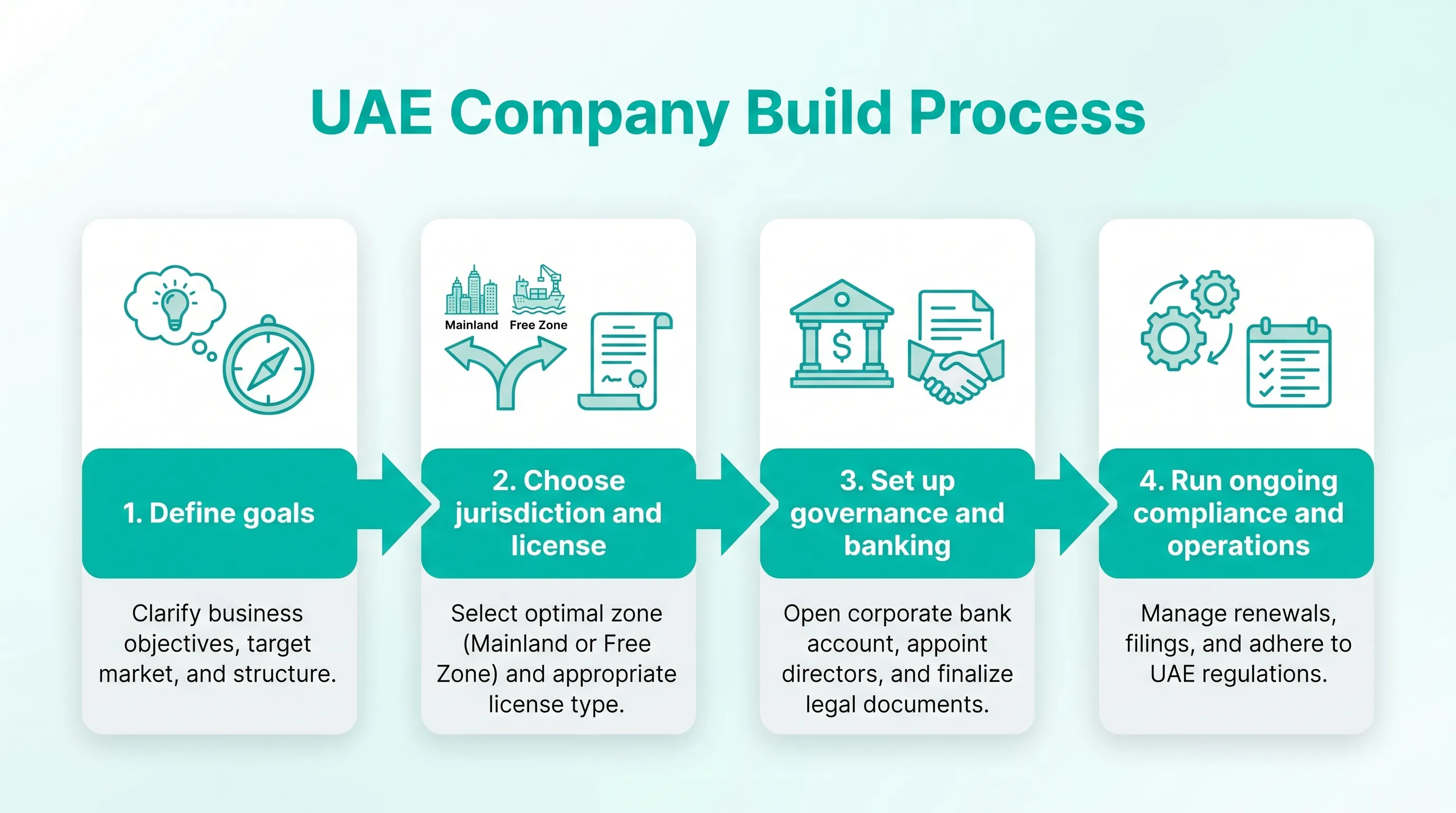
A practical “right way” build sequence (use this as your internal checklist)
Most setup problems come from doing steps in the wrong order. A clean sequence typically looks like this:
- Define customers, revenue flows, hiring plan, and whether you need visas.
- Select jurisdiction (Mainland or Free Zone) based on operations, not marketing.
- Confirm activity and licensing requirements (including any external approvals).
- Design shareholding and governance (including UBO readiness and signing authorities).
- Incorporate with documentation consistent with your actual business model.
- Prepare a KYC pack for banking (profiles, expected flows, contracts, website, pitch).
- Implement bookkeeping, tax registration planning, and a compliance calendar.
This approach is slower only on paper. In reality, it reduces rework, prevents banking stalls, and protects you as you scale.
Frequently Asked Questions
Can foreigners build a company in the UAE and own 100% of it? In many cases, yes. Ownership rules depend on the jurisdiction, activity, and licensing framework, so confirm based on your exact business model.
Is a Free Zone always the best option to start? Not always. Free Zones can be excellent, but if your business needs broad onshore contracting flexibility, specific regulated approvals, or a certain operating footprint, a mainland setup may fit better.
How long does it take to build a company in the UAE? Timelines vary by jurisdiction, activity, document readiness, and whether external approvals are required. Banking and visas can also be on the critical path.
Do I need a physical office to set up in the UAE? Requirements depend on jurisdiction and license type. Some setups allow flexible workspace options, while others require a lease suitable for your activity.
What are the most common mistakes founders make during UAE setup? Choosing the wrong jurisdiction for the go-to-market plan, picking an inaccurate activity, underpreparing for bank KYC, and ignoring ongoing compliance (tax, bookkeeping, renewals).
Will I need bookkeeping and tax support even if my company is small? Usually, yes. Even lean companies benefit from clean bookkeeping and a tax-ready record trail, especially for banking confidence and future scaling.
Build your UAE company with expert-led structuring and transparent support
If you want to build a company in the UAE the right way, the fastest path is usually a well-engineered structure, correct licensing, and a compliance plan you can actually sustain.
Alldren provides expert-led, transparent corporate services for UAE company setup and structuring, ongoing compliance management, corporate governance support, bank account opening assistance, residency visa processing, and bookkeeping and tax registration support. If you want direct access to senior expertise and upfront clarity, explore how Alldren can support your setup at alldren.com.


