

A company’s corporate structure can feel like legal jargon until something goes wrong, a shareholder dispute, a tax filing, a banking review, a lawsuit, or a founder’s unexpected incapacity. At that point, the “structure” determines who can sign, who is liable, who controls the bank account, and what regulators will expect to see.
This guide explains the corporate structure of a company in plain English, using practical examples you can apply whether you run a one-person consultancy or a multi-entity group.
What does “corporate structure of a company” actually mean?
People use the phrase in two different ways, and it helps to separate them:
- Legal (corporate) structure: the legal entities you use (for example, an LLC, a branch, a holding company with subsidiaries) and how they are owned.
- Organizational structure: how responsibilities and reporting lines work inside the business (for example, CEO, finance lead, operations team).
In real life, these overlap. A clean legal structure makes it easier to implement a clean organizational structure, especially around signing authority, banking, and governance.
The three layers every corporate structure needs
Most corporate structures can be understood as three layers: ownership, control, and operations.
1) Ownership (who benefits)
Ownership answers: Who ultimately gets the profits and the value?
Depending on the entity type, owners might be called:
- Shareholders
- Members
- Partners
Ownership is also where you see concepts like share classes (different economic rights) and beneficial ownership (who ultimately owns or controls, even if shares are held through another vehicle).
2) Control (who makes decisions)
Control answers: Who has the legal power to act for the company?
This is usually handled by:
- Directors (board of directors, manager, or equivalent)
- Authorized signatories (people approved to sign contracts, open bank accounts, manage day-to-day commitments)
A common misunderstanding is assuming ownership automatically means control. In many well-designed structures, an owner can be insulated from day-to-day decision-making, or decision-making can be shared with checks and balances.
3) Operations (who does the work)
Operations answers: Which entity hires, invoices, holds licenses, and takes on risk?
This matters because the entity that signs contracts and invoices clients is the entity that generally attracts:
- commercial liability
- regulatory exposure
- accounting and tax filings
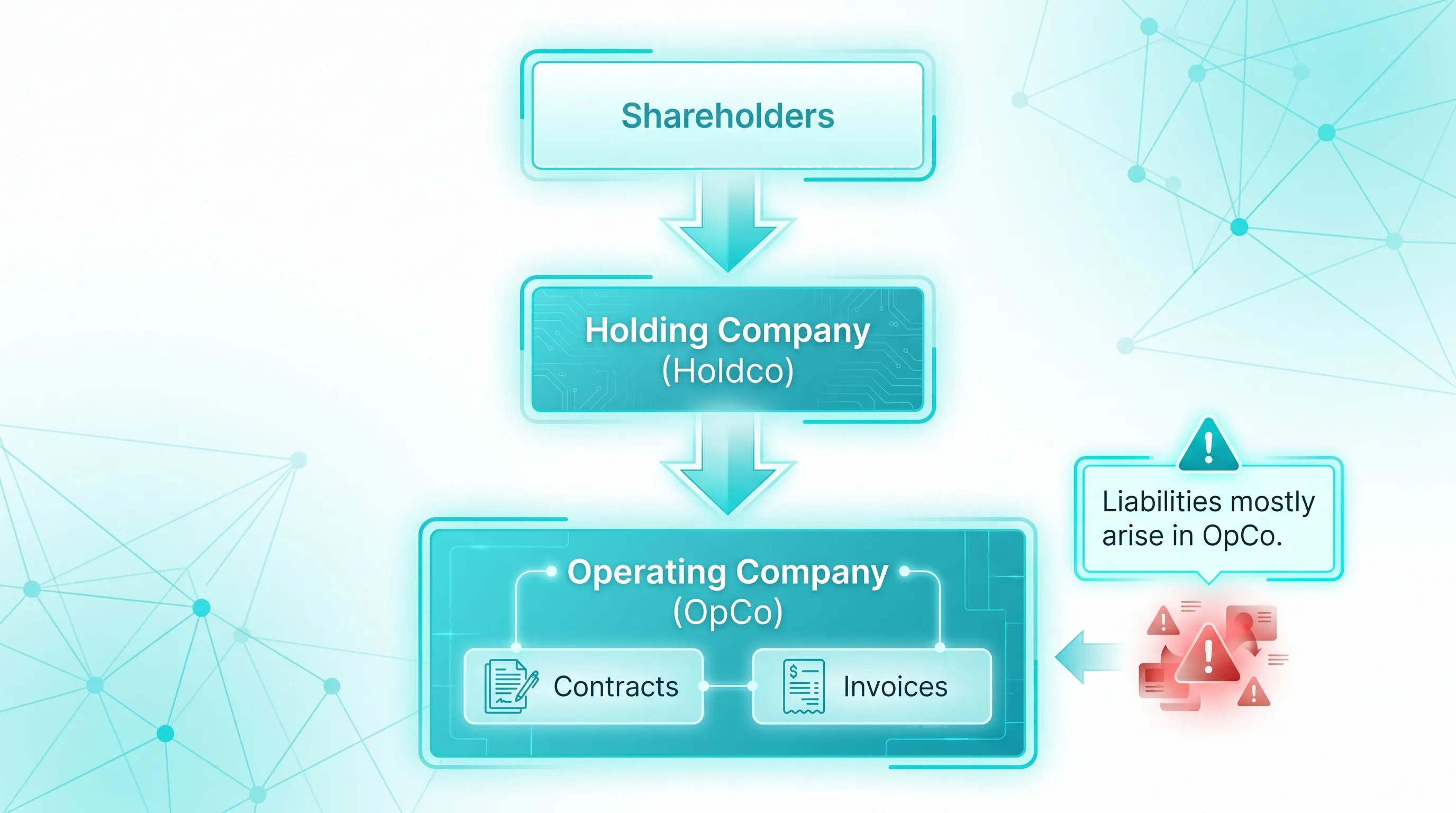
If you keep only one idea from this article, keep this one: the operating entity is where problems land first. Structuring is often about making sure problems do not spread further than necessary.
A simple map of roles, documents, and risks
Here is a practical way to visualize the core building blocks.
| Layer | Typical roles | Common documents | What can go wrong if unclear |
|---|---|---|---|
| Ownership | Shareholders, members, beneficial owners | Share register, shareholders’ agreement, UBO records | disputes over economics, hidden control issues, compliance failures |
| Control | Directors, managers, signatories | board resolutions, powers of attorney, delegation matrix | invalid contracts, bank mandate issues, “shadow director” allegations |
| Operations | Executives, employees, contractors | employment contracts, invoicing, accounting records | liability concentrated in wrong entity, weak audit trail |
Common corporate structure patterns (explained simply)
There is no single “best” structure. The best structure is the one that matches your real activity, risk, and growth plan.
Single entity (one company does everything)
This is the simplest structure: one company owns the assets, hires staff, signs contracts, invoices customers.
It can work well when:
- risk is low to moderate
- there is one founder or a small shareholder group
- operations are straightforward
The downside is concentration risk. If the operating company is sued or suffers a major compliance problem, everything is exposed in one place.
Holding company with an operating subsidiary
This is one of the most common “grown up” structures:
- Holdco owns the shares of the operating company
- OpCo signs contracts, hires, invoices, carries operational risk
This can help with:
- ring-fencing operational liabilities
- separating ownership from operations
- preparing for investors or a future sale
Group structure (multiple subsidiaries)
As businesses expand, you may separate by geography, product line, or risk category. Common examples:
- a trading subsidiary for revenue
- an IP company that owns software or trademarks (and licenses them)
- a services company for shared employees
This can be powerful, but it adds governance overhead. More entities means more bank accounts, filings, board resolutions, and compliance workflows.
Branch structure
A branch is not a separate legal person in the same way a subsidiary is (the exact treatment depends on jurisdiction and registration). As a result, the parent may remain closely tied to branch liabilities and obligations.
Branches are often used when:
- you want to extend an existing company into a new place
- you want operational continuity under a single parent identity
Why corporate structure matters (in the situations that actually hurt)
Corporate structure is not paperwork for paperwork’s sake. It determines outcomes in five high-impact areas.
Liability and asset protection
Limited liability is one of the main reasons companies exist. But limited liability is not magic. It relies on governance discipline:
- clear contracts in the right entity name
- separate books and records
- proper approvals for major decisions
When structure and behavior do not match, courts and regulators may treat the company as an “alter ego” of its owners (the language varies by jurisdiction), or banks may refuse onboarding due to governance weaknesses.
Banking and counterparty trust
Banks and serious counterparties want to understand:
- who owns the company
- who controls it
- where it operates and why
A structure that is too complex for the business activity (or too minimal for the claimed scale) can trigger enhanced due diligence questions.
Tax and reporting
Tax outcomes are heavily structure-dependent, but structure is only one part of the equation. Two companies with the same org chart can have different tax outcomes based on:
- where management decisions are made
- where revenue is earned
- whether the entity is treated as resident or non-resident
- whether exemptions or special regimes apply
For UAE readers, the Ministry of Finance provides a helpful starting point on the UAE Corporate Tax regime on its Corporate Tax page.
Raising capital, selling the business, or bringing in partners
Investors and buyers typically want clarity on:
- cap table and share classes
- IP ownership
- clean financials for the operating entities
- board and shareholder approval mechanics
If you wait until fundraising or exit discussions to “fix” structure, you often end up doing it under time pressure, which increases cost and execution risk.
Succession planning and continuity
Founders often focus on growth and ignore continuity until it is forced on them by life events. Structure determines:
- what happens to shares on death or incapacity
- who can continue to operate (sign, bank, renew licenses)
- whether there is a governance mechanism to avoid business paralysis
What “good governance” looks like in plain English
Governance sounds formal, but at its core it means: decisions are made by the right people, in the right way, with evidence.
In practice, strong governance usually includes:
- Defined decision rights: which decisions require shareholder approval vs director approval.
- Documented approvals: written resolutions for major actions (bank mandates, significant contracts, appointments).
- Clear signing authority: who can sign, for what, and up to what value.
- Accurate ownership records: up-to-date beneficial ownership information and share registers.
- Accounting discipline: separate books per entity, consistent invoicing flows, no mixing personal and corporate expenses.
If you want a global reference point for governance principles, the OECD Principles of Corporate Governance provide a widely cited framework.
How to sanity-check your corporate structure in 10 minutes
You do not need a whiteboard session to spot obvious structure issues. Start with these questions:
- What does each entity do? If you cannot explain an entity’s purpose in one sentence, that is a red flag.
- Where does revenue land? Which entity invoices customers and receives funds.
- Where is risk created? Which entity signs contracts, hires staff, and makes representations.
- Who can bind the company? Are director powers and signatory powers clear and consistent across banks and counterparties.
- What is the “story” to a bank or regulator? If your structure looks like one thing but operates like another, expect friction.
A short UAE note (without repeating jurisdiction comparisons)
In the UAE, the corporate structure conversation often becomes more technical because company formation and ongoing compliance intersect with:
- licensing and regulated activity boundaries
- beneficial ownership updates and registry filings
- corporate tax registration, VAT registration, and ongoing reporting
- banking onboarding expectations around substance and operational footprint
If you are choosing between UAE jurisdictions and legal forms (mainland vs free zone vs offshore, LLC vs branch, and so on), Alldren already covers that decision process in detail in Company Structure Basics for UAE Businesses.
This article is meant to help you understand the underlying logic so that any UAE setup decision is easier to evaluate.
When it’s time to restructure (common triggers)
Restructuring is not only for large companies. It is often triggered by a change in risk, ownership, or compliance exposure.
Typical triggers include:
- you are signing bigger contracts (higher downside if a dispute occurs)
- you are hiring employees in volume
- you are adding partners or issuing equity
- you are separating IP from operations
- banking is becoming difficult because the structure and operational footprint do not align
- you plan to sell part of the business, spin off a division, or bring in investors
If any of these apply, it is usually better to review structure early, while choices are still available.
Frequently Asked Questions
What is the corporate structure of a company? It is the framework that defines who owns the company (shareholders), who controls it (directors and signatories), and how the business is organized across one or more legal entities.
What is the difference between corporate structure and organizational structure? Corporate structure is the legal entity and ownership layout (Holdco, OpCo, subsidiaries). Organizational structure is the internal reporting and management setup (CEO, teams, departments). They should align, but they are not the same.
Is a holding company always better than a single company? Not always. A holding company can help ring-fence risk and clarify ownership, but it adds cost and governance overhead. The right choice depends on activity, liability profile, and future plans.
Who has control, shareholders or directors? Shareholders own the company and typically appoint directors. Directors control day-to-day decision-making and can legally bind the company (within their authority). Good governance clearly separates these roles.
Why do banks care about corporate structure? Banks need to understand beneficial ownership, control, and the legitimacy of operations for AML and risk purposes. Unclear governance, mismatched substance, or overly complex structures often trigger delays or rejection.
Need a structure that holds up under banking, tax, and governance scrutiny?
Alldren helps founders, businesses, and private clients design and maintain robust UAE corporate structures, with transparent pricing and direct access to senior experts.
If you want a second opinion on whether your current setup matches your real activity and risk profile, explore Alldren’s approach at alldren.com or start with the UAE-focused guide: Company Structure Basics for UAE Businesses.


