

Setting up a company can feel deceptively simple from the outside: pick a name, file paperwork, get a license, open a bank account. In the UAE, the reality is more structured. Choices you make early (jurisdiction, activities, ownership model, and compliance approach) shape everything that follows, from banking to visas to tax registration.
This guide explains what you should expect from company incorporation services, step by step, so you can evaluate providers, budget realistically, and avoid common delays.
What “company incorporation services” typically include (and what they don’t)
At a high level, incorporation services should cover two things:
- Formation: getting your legal entity and license issued correctly.
- Operational readiness: helping you become able to trade compliantly (banking, tax registrations where applicable, visas, governance, and ongoing filings).
Where clients get surprised is scope. Some providers only do “license issuance,” while others handle end-to-end setup and ongoing compliance. Before you sign, ask for a written scope that clearly states what’s included, what’s optional, and what depends on third parties (banks, immigration, authorities).
Formation vs. ongoing support
A reputable incorporation partner will explain the difference between:
- One-time setup (entity formation, initial approvals, license issuance)
- Recurring compliance (renewals, bookkeeping, corporate governance, tax registrations/filings where applicable, regulatory updates)
In practice, the UAE rewards companies that treat compliance as an operating system, not a one-off task.
Step 1: Discovery and feasibility, your provider should start by understanding your business
You should expect a proper intake process before anyone recommends a jurisdiction or submits forms. That usually includes:
- Your business model and revenue flows
- Where clients and suppliers are located
- The exact activities you plan to perform (this matters for licensing)
- Whether you need office space or can use flexi-desk options (depending on the authority)
- Whether you need UAE residency visas and for whom
- Your timeline and banking requirements
A good incorporation consultant will also flag “non-obvious” constraints early, for example, activity restrictions, naming rules, or banking realities for certain profiles.
Step 2: Structuring recommendation (jurisdiction, legal form, and licensing)
In the UAE, structuring decisions are not just administrative, they are strategic. Company incorporation services should include a clear recommendation and rationale on:
- Jurisdiction: mainland vs. free zone (and which free zone), and in some cases offshore structures (depending on objectives)
- Legal form: common options include limited liability entities, branch setups, and others depending on authority and purpose
- Licensed activities: selecting the correct activity codes and approvals required
Your provider should also discuss practical consequences, such as:
- Where you can trade (onshore vs. within a free zone vs. internationally)
- Office and substance expectations (as applicable)
- Compliance obligations and renewal cycles
- Visa eligibility and typical quotas (where relevant)
For readers who want an official starting point on business regulation, the UAE Ministry of Economy is a useful reference.
Step 3: Clear documentation checklist (and help preparing it)
Expect your incorporation partner to provide a document list tailored to your situation, not a generic template. While requirements vary by authority and applicant profile, documentation commonly includes:
- Passport copies and personal details of shareholders and managers
- Proof of address (often with specific recency and format requirements)
- Business plan or activity description (for certain activities or free zones)
- Corporate documents (if a shareholder is a company), such as certificate of incorporation, board resolutions, and beneficial ownership details
A strong provider adds value here by:
- Reviewing documents for formatting issues before submission
- Explaining attestation/legalization needs when foreign corporate documents are involved
- Coordinating signatures and resolutions so they match authority requirements
Step 4: Name reservation, initial approvals, and authority coordination
This is where a lot of “hidden work” sits. Company incorporation services should include hands-on coordination with the relevant authority for:
- Trade name reservation (and alternatives if rejected)
- Initial approvals and pre-approvals (where required)
- Activity-specific clearances (for regulated or sensitive activities)
Your provider should also set expectations on what can delay approvals, such as missing documents, unclear activity descriptions, or mismatched signatory information.
Step 5: Drafting and issuing formation documents
Depending on the jurisdiction and legal form, your incorporation partner may prepare and coordinate documents such as:
- Memorandum/Articles (or equivalent constitutional documents)
- Shareholder and manager resolutions
- Appointment documents (manager, secretary, or other roles if applicable)
You should expect:
- A chance to review documents before submission
- An explanation of key clauses that affect control, governance, and signatory authority
- Proper alignment between licensing information and constitutional documents
Step 6: License issuance and establishment card (where applicable)
Once approvals are in place, incorporation services typically proceed to:
- Issuing the trade license
- Completing immigration-related registrations needed to sponsor visas (often referred to as an establishment card or similar registration, depending on the authority)
At this stage, ask your provider to confirm what you receive (digital copies, original certificates, portal access) and what renewals will look like.
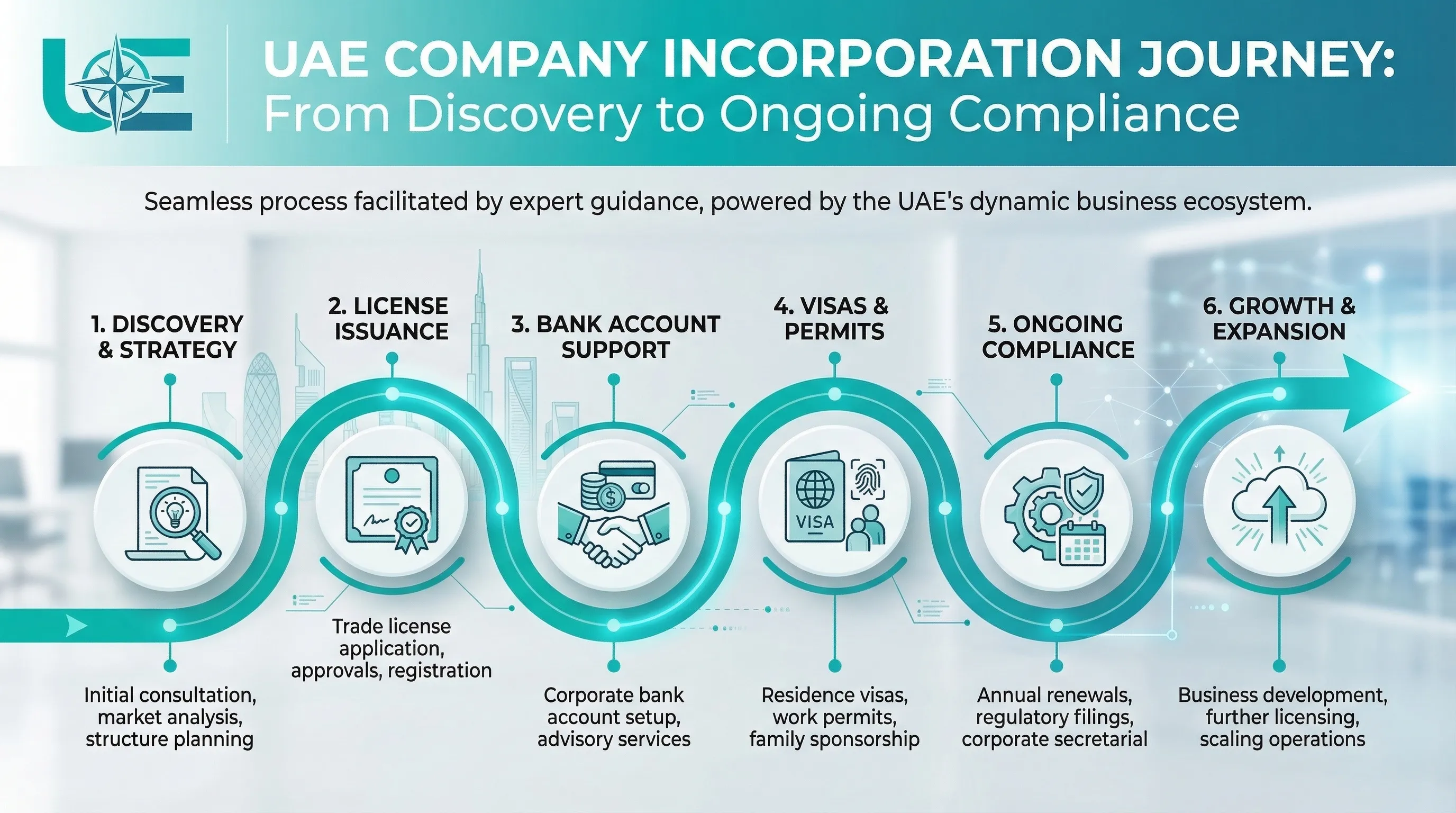
Step 7: Bank account opening support (expect support, not guarantees)
Banking is often the most underestimated step. A good incorporation firm can significantly improve your readiness and reduce friction, but it cannot promise approvals because banks make independent risk decisions.
What you should realistically expect from bank account opening support:
- Guidance on which banks may be suitable for your profile and activity
- Help preparing a compliant “banking pack” (company documents, ownership structure summary, source of funds explanation, contracts/invoices where relevant)
- Assistance scheduling meetings and responding to follow-up questions
What you should be cautious about:
- Any provider guaranteeing account approval
- Vague claims like “instant account” without explaining conditions
Step 8: UAE residency visas (if you need them)
If your plan includes relocating, hiring, or frequently traveling with resident status, visa processing often becomes part of incorporation services.
Your provider should explain:
- Which visa pathways are available under your chosen setup
- The process steps and typical sequencing (entry permit, medical, Emirates ID biometrics, stamping where applicable)
- What depends on your company’s immigration registration and office lease status
Because visa rules can change and vary by authority, the key expectation is transparency: a clear process map and a realistic timeline.
Step 9: Tax registration and bookkeeping readiness (where applicable)
Many founders only ask about tax after the license is issued. Strong incorporation services bring tax and accounting into the conversation earlier, especially if you:
- Need VAT registration (depending on taxable supplies and thresholds)
- Need corporate tax registration and compliance planning
- Need an accounting system and bookkeeping process from day one
For official guidance on VAT, see the UAE Federal Tax Authority (FTA). Your provider should not offer “one-size-fits-all” advice, but they should help you understand what registrations and processes your business may require.
Step 10: Ongoing compliance and governance support (the part that protects you long-term)
Incorporation is the start. What keeps your company resilient is ongoing compliance and governance, including:
- License renewals and related authority filings
- Maintaining corporate records and resolutions where needed
- Bookkeeping and financial statements (requirements vary)
- Regulatory obligations tied to your activity
- Responding to bank compliance reviews or information requests
As your company grows, compliance management can become a workload multiplier. Some teams augment their internal capacity with automation tools. For example, an AI-powered compliance platform for streamlining regulatory workflows can help compliance teams organize risk assessments, remediation actions, and policy management.
A practical timeline: what the stages look like
Exact timing depends on jurisdiction, activity, document readiness, and third parties (especially banks). Still, incorporation services should give you a staged plan with dependencies.
Here is a simple way to think about it:
| Stage | What “done” looks like | Common dependency that affects timing |
|---|---|---|
| Discovery and structuring | Recommended jurisdiction, activities, and setup plan | Clarity on your business model and activities |
| Document readiness | Complete, correctly formatted documents ready to submit | Attestation/legalization for foreign corporate docs |
| Authority approvals | Trade name and initial approvals obtained | Activity-specific approvals or clarifications |
| License issuance | Trade license issued, company legally formed | Final payments, signature coordination |
| Immigration setup | Establishment registration complete (if needed) | Lease/office requirements (if applicable) |
| Banking support | Bank applications submitted with a complete pack | Bank risk review and follow-up questions |
| Ongoing compliance | Renewals, filings, and governance calendar defined | Business growth, new regulations, and reporting needs |
The value of a good provider is not just speed, it is predictability and fewer rework cycles.
What excellent incorporation services feel like (quality indicators)
You are buying more than form-filling. High-quality incorporation support tends to have these characteristics:
Transparent scope and pricing
You should receive an itemized proposal (what’s included, what’s optional, what’s pass-through cost) and no surprises when the authority asks for an additional step.
Senior expertise when it matters
Complex cases need judgment calls: structuring, regulated activities, cross-border shareholders, and banking preparation. Direct access to senior professionals can be the difference between a smooth setup and months of rework.
Proactive compliance thinking
A good provider builds a compliance calendar and governance approach, rather than treating renewals and registrations as last-minute emergencies.
Written rationale for key decisions
Your provider should be able to explain why a particular jurisdiction or activity set is recommended, in plain language, and what trade-offs you accept.
Red flags to watch for
Not every incorporation offer is comparable. Be cautious if you see:
- Guarantees that sound absolute (especially for bank accounts)
- Unclear deliverables (“we handle everything”) without a written scope
- Recommendations made before understanding your business model
- Pressure to pick the cheapest option without discussing compliance implications
- No plan for post-incorporation obligations
How to choose the right provider: questions to ask before you sign
Asking better questions is the fastest way to compare incorporation partners.
| Question | Why it matters |
|---|---|
| “Which activities will be on my license, and why?” | Activities drive approvals, costs, and what you can legally do |
| “What are the recurring obligations after setup?” | Prevents compliance gaps and last-minute renewals |
| “What can realistically delay this process?” | Sets expectations and improves planning |
| “What do you need from me, and by when?” | Clarifies client responsibilities and avoids bottlenecks |
| “How do you support bank account opening?” | Distinguishes real support from empty promises |
| “Who will advise me if my case gets complex?” | Ensures access to senior expertise when needed |
Where Alldren fits (and what you should expect)
Alldren positions its offering around expert-led, transparent corporate services for establishing and managing companies in the UAE, including structuring, incorporation, compliance management, governance, banking support, visas, and bookkeeping and tax registration support.
If you engage an advisory-led firm like Alldren, you should expect the relationship to extend beyond issuance of a license, with support oriented around building a robust, compliant operating setup, not just completing forms.
Frequently Asked Questions
How long do company incorporation services take in the UAE? Timelines vary by jurisdiction, activities, and document readiness. Your provider should give you a staged plan and highlight which steps depend on authorities, immigration, or bank reviews.
Do incorporation services include bank account opening? Often they include bank account opening support, such as preparing documents and coordinating applications. No provider can ethically guarantee approval because banks make independent decisions.
What documents are usually required to incorporate a company? Commonly passports, proof of address, shareholder and manager details, and sometimes business plans or corporate shareholder documents. Requirements vary by authority and business activity.
Is ongoing compliance part of company incorporation services? It depends on the provider. Many firms offer incorporation as a one-off service, while others provide ongoing compliance management (renewals, governance, bookkeeping, and tax-related support where applicable).
How do I know which jurisdiction is right for my business? The right choice depends on where you will trade, your activities, visa needs, office requirements, and compliance preferences. A good provider will document the rationale and trade-offs.
Talk to Alldren about a setup plan that holds up under scrutiny
If you want incorporation done correctly the first time, with clear scope, transparent pricing, and access to senior expertise, start with a structuring conversation. Explore Alldren’s UAE company setup and compliance support at alldren.com.


