

Most companies don’t fail in the UAE because the tax rules are “too hard.” They fail because responsibilities are unclear: bookkeeping is done in one place, VAT is handled in another, corporate tax work starts too late, and nobody owns the calendar.
If you’re deciding how to run tax services UAE operations, the right model is usually hybrid: keep the day-to-day data and approvals in-house, outsource specialist interpretation, filings, and risk-heavy work to experienced professionals.
Below is a practical way to split the work so you stay compliant, audit-ready, and cost-efficient.
The UAE tax scope you actually need to cover
The UAE tax footprint varies by activity, emirate, and licensing setup, but most operating companies will touch at least some of these areas:
- Corporate Tax (CT): registration, ongoing compliance, and annual return filing under UAE Corporate Tax rules.
- VAT: registration (if applicable), periodic returns, and documentation controls.
- Transfer Pricing (TP): related-party transactions and supporting documentation when relevant.
- Withholding tax: generally 0% in many UAE scenarios, but cross-border payments still require analysis for classification and documentation.
- Bookkeeping and financial statements: not “tax,” but the foundation of every tax position.
Your outsourcing decision should map to two questions:
- Is this work repeatable operations (process-driven), or technical judgment (interpretation-driven)?
- If it goes wrong, is the impact mostly internal (messy reports), or external (penalties, disputes, banking issues)?
What to keep in-house (so you stay in control)
In-house ownership does not mean doing everything yourself. It means retaining control over source data, approvals, and the operating rhythm of finance.
1) Transaction processing and source documentation
Keep internal responsibility for:
- Sales invoices, purchase invoices, and expense capture
- Vendor onboarding and collecting tax invoices
- Correct coding of transactions (revenue types, expense categories, asset vs expense)
- Maintaining contracts, customs docs (if relevant), and proof for VAT treatment
Why this belongs in-house: your team is closest to the commercial reality. External providers can only work with what they receive, and late or incomplete documentation is the most common root cause of VAT and CT issues.
2) Payment approvals and internal controls
You should own:
- Approval matrix (who can approve what)
- Segregation of duties (request, approve, pay)
- Record retention policy and access rights
Why it matters: tax compliance is easier when governance is clean. Banks and counterparties also look for strong financial controls.
3) Management reporting and cash planning
Even if an external accountant prepares statements, keep internal accountability for:
- Monthly performance review (revenue, margin, burn)
- Cash flow forecasts
- Budget vs actual tracking
If you want an easy way to keep day-to-day spending organized (especially for founders managing both business and personal outflows early on), a tool like a free expense tracker and budgeting app can help centralize visibility and reduce “missing expense” surprises that later complicate bookkeeping.
4) Tax calendar ownership (even if tasks are outsourced)
Outsourcing does not transfer responsibility. Someone internally should “own the calendar” and ensure:
- Registration deadlines are met
- VAT periods are closed on time
- Corporate tax preparation starts early enough to fix data issues
A simple rule: if a deadline is missed, the business is accountable, not the advisor.
What to outsource (where expertise reduces risk)
UAE tax is detail-heavy. Outsourcing the right parts is less about saving money and more about reducing exposure.
1) Corporate Tax registration, return preparation, and review
Outsource when:
- You are newly incorporated and unsure of CT registration requirements
- You have mixed income streams, cross-border activity, or multiple licenses
- You want defensible positions (treatment of expenses, related party charges, revenue recognition)
A good external advisor will also provide a clear information request list early, so bookkeeping can be adjusted before year-end instead of “fixing it in the return.”
Reference point: for official guidance and updates, consult the UAE Federal Tax Authority (FTA) resources on taxation and compliance.
2) VAT returns, VAT health checks, and complex VAT treatment
Many businesses can prepare VAT data internally, but should outsource at least a periodic review if:
- You have imports/exports, shipping terms, or multi-jurisdiction invoicing
- You provide bundled services (for example, software plus support plus hardware)
- You issue credit notes often or have frequent adjustments
A quarterly or semi-annual VAT health check often costs less than cleaning up years of issues later.
3) Transfer pricing documentation and related-party policies
If you have related-party transactions (management fees, IP charges, shared services, intercompany loans), outsource:
- Transfer pricing methodology
- Documentation support and file structure
- Policy drafting and implementation guidance
This is judgment work. It needs benchmarking logic, consistency, and alignment with what you can actually prove.
4) Tax dispute support, clarifications, and voluntary disclosures
When you are facing:
- FTA queries
- Penalty assessments
- Uncertain treatment discovered after filing
Outsource immediately. Dispute work is procedural and time-sensitive, and the quality of your written response and evidence pack matters.
5) Tax and compliance setup for new UAE entities
For new market entry, outsourcing is usually the fastest route to a clean baseline:
- Tax registrations (as applicable)
- Bookkeeping framework (chart of accounts aligned to reporting and tax)
- Governance basics (board resolutions, signatory setup)
This is especially important if your UAE company is part of a wider group and needs alignment with group reporting.
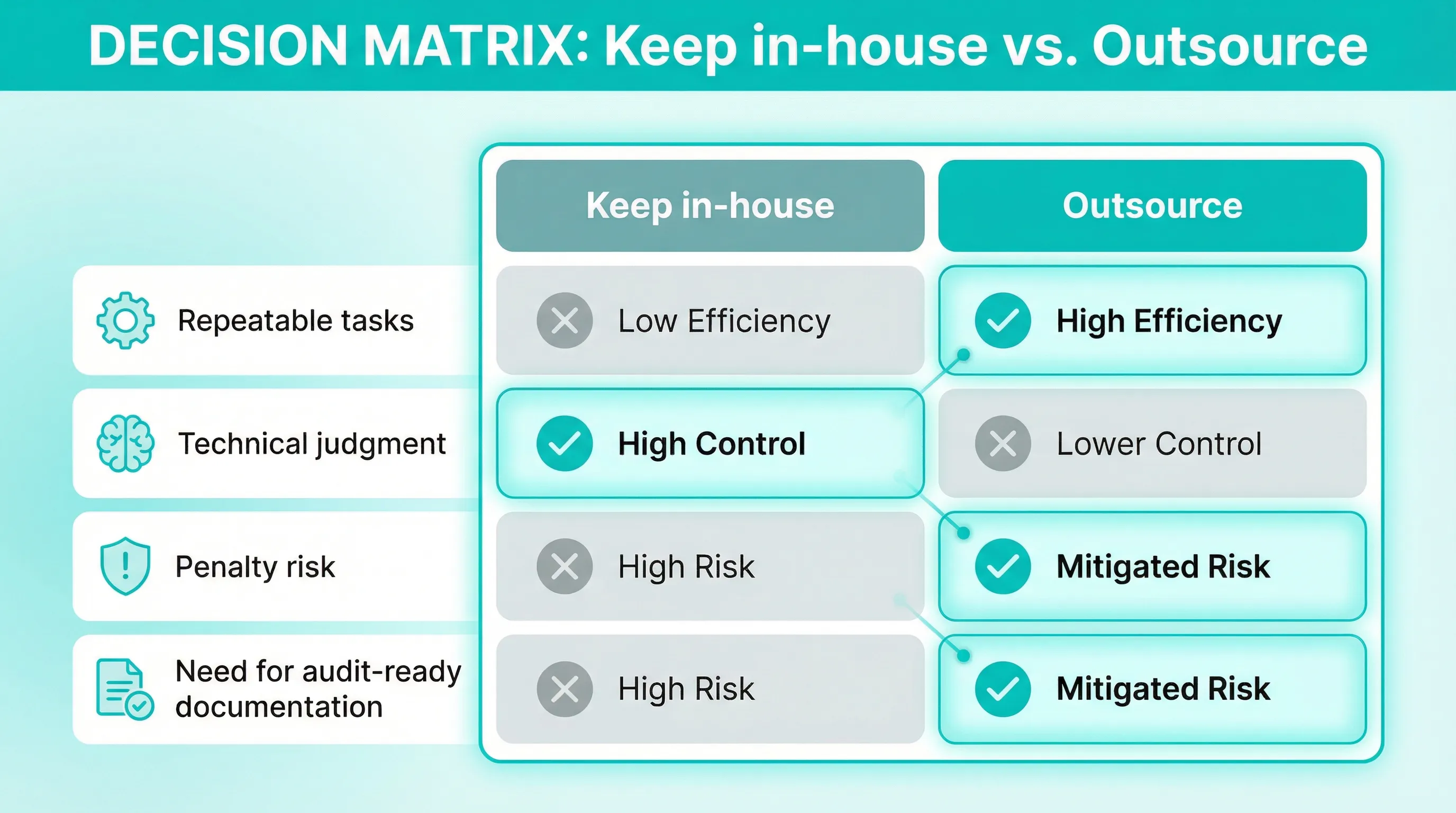
A practical decision framework: outsource vs in-house
Use this as a quick filter.
| Task area | Keep in-house when… | Outsource when… | Risk if handled poorly |
|---|---|---|---|
| Bookkeeping and invoice capture | You have steady volume and consistent processes | You have high volume, multi-entity, or messy source docs | Incorrect VAT/CT outputs from bad inputs |
| VAT compliance | Transactions are standard and well-documented | You have complex supplies, imports/exports, frequent adjustments | Penalties, wrong VAT treatment, audit exposure |
| Corporate tax compliance | You have an experienced finance lead and simple structure | You are scaling, have multiple income streams, or group complexity | Misstatements, weak tax positions, late preparation |
| Transfer pricing | Minimal related-party activity | Any material intercompany transactions | High scrutiny area, documentation gaps |
| Tax authority queries/disputes | Rare, low stakes | Any formal query, penalty, or ambiguity | Escalation, poor outcomes, time loss |
| Compliance calendar and ownership | Always | Never fully outsource ownership | Missed deadlines, operational stress |
Common UAE setups and the best operating model
Scenario A: Early-stage startup (lean team)
Best split:
- In-house: expense capture, approvals, basic reporting
- Outsource: bookkeeping close, VAT (if registered), corporate tax registration and return
Key focus: build the habit of documentation and monthly closes. Tax outcomes improve dramatically when month-end discipline is consistent.
Scenario B: Trading or e-commerce business (high transaction volume)
Best split:
- In-house: operational finance, inventory/COGS logic, returns/refunds tracking
- Outsource: VAT review, periodic controls testing, corporate tax computation support
Key focus: VAT treatment of discounts, returns, and cross-border shipping terms.
Scenario C: Group entity with related parties
Best split:
- In-house: intercompany contracts repository, transaction mapping, internal approvals
- Outsource: transfer pricing policy and documentation, corporate tax positions review
Key focus: consistency between contracts, invoices, and what actually happens operationally.
How to choose a tax services provider in the UAE
Look for operational clarity more than marketing.
What “good” looks like
- Clear scope (what is included, what is not)
- A timeline that starts before deadlines
- Named accountability (who reviews, who signs off, who you contact)
- A documented information request list (so your team can deliver what’s needed)
Questions to ask before signing
- Who is the senior reviewer, and how involved are they?
- What assumptions are you making about our bookkeeping quality?
- How do you handle complex items (cross-border supplies, related parties, adjustments)?
- What does your handover look like if we change providers?
The biggest mistake: outsourcing without internal ownership
Outsourcing works when your company still owns:
- Data quality
- Documentation completeness
- Approval and governance
- Deadline tracking
If you outsource everything and nobody internally understands the basics, you get “filings completed” but not “compliance achieved.” The difference shows up when a bank asks for reconciliations, an investor asks for clean numbers, or the authority asks for proof.
Frequently Asked Questions
Do I need in-house accountants if I outsource tax services in the UAE? You do not always need a full in-house team, but you do need internal ownership of source documents, approvals, and the finance calendar. Many companies start with an internal finance admin or controller and outsource technical work.
Is bookkeeping a tax function in the UAE? Bookkeeping is not a tax filing by itself, but it is the foundation for VAT returns and corporate tax computations. Poor bookkeeping is one of the most common causes of compliance risk.
Can I outsource VAT and corporate tax to different providers? Yes, but coordination matters. If VAT and CT providers use different assumptions or don’t reconcile to the same ledger, you can end up with inconsistencies that create audit risk.
When should I bring transfer pricing support into scope? As soon as you have meaningful related-party transactions (management fees, shared services, intercompany financing, IP charges), you should get specialist support to set a defensible approach and documentation.
Who is responsible if an outsourced provider makes a mistake? The business is typically responsible for filings and compliance. A provider may support remediation, but you should assume accountability stays with the company, and structure governance accordingly.
Need a clean split between in-house finance and outsourced UAE tax compliance?
If you’re establishing or running a UAE company and want a clear, defensible compliance operating model, Alldren can help you design the right split across structuring, tax registration, bookkeeping, and ongoing compliance management. Explore options at Alldren and align responsibilities before deadlines (and risk) stack up.


