

A strong corporate structure is only as good as the governance that maintains it. In practice, that governance is delivered through company secretarial duties: the repeatable, provable tasks that keep your entity properly authorised, accurately recorded, and compliant with local rules.
If you run a UAE mainland company or a free zone entity, the details vary by jurisdiction, but the operating principle is the same: regulators, banks, auditors, investors, and counterparties expect clean records, clear approvals, and up-to-date filings.
Below is a practical checklist you can use to audit your current setup and build an “always-ready” compliance file.
What “company secretarial duties” actually cover
Company secretarial work is often misunderstood as “meeting minutes and paperwork.” In reality, it sits at the intersection of:
- Corporate governance (who can approve what, how decisions are documented)
- Statutory recordkeeping (registers, constitutional documents, resolutions)
- Regulatory compliance (licenses, filings, beneficial ownership, economic substance where applicable)
- Operational enablement (bank signatories, authorised signers, KYC packs for counterparties)
In the UAE, this matters even more because many obligations are tied to renewals, authority approvals, and documentary standards that banks and free zone registrars can enforce strictly.
Why this matters in the UAE (beyond “avoiding fines”)
Well-run secretarial operations help you:
- Renew licenses on time without last-minute document scrambles
- Avoid bank disruption by keeping signatory lists, KYC packs, and ownership records consistent
- Close deals faster because your due diligence folder is complete
- Reduce personal risk for directors and managers by showing proper approvals and segregation of authority
It also prevents a common UAE pain point: a simple change (address, activity, shareholder, manager, or signatory) triggering a chain reaction of updates across the registrar, immigration, bank, and tax records.
A practical checklist of company secretarial duties
Use the checklist in the order below: start with your constitutional baseline, then confirm registers and approvals, then map recurring filings and renewals.
1) Maintain your constitutional and formation documents (the “source of truth”)
Your “source of truth” file should be complete, current, and consistent across stakeholders.
Typical documents to keep current (exact names vary by emirate and free zone):
- Trade name reservation and initial approvals (where applicable)
- Commercial license and any activity schedules/appendices
- Memorandum/Articles (or free zone regulations and company bylaws)
- Share certificates and shareholding evidence
- Specimen signatures, authorised signatory lists, and powers of attorney (if used)
- Office lease/tenancy documents supporting the registered address
Practical test: If your bank asked for your latest constitutional docs and signatory proof today, could you produce a clean pack within 30 minutes?
2) Keep statutory registers and ownership records up to date
A recurring failure point is when internal records drift away from what the registrar has on file.
Maintain a controlled, versioned set of:
- Register of shareholders (and transfers, if any)
- Register of directors/managers and authorised signatories
- Register of ultimate beneficial owners (UBO) and supporting IDs
- Related-party register (useful for governance, audit readiness, and tax support)
If you operate through holding companies, nominees, or multi-layer ownership, make sure you also maintain an ownership chart that matches your filings and bank KYC.
3) Document decisions properly (board resolutions, shareholder resolutions, minutes)
In a lot of SMEs, decisions happen in chats and emails, then someone tries to “paper it” later. That creates risk.
Your secretarial process should ensure that key actions are supported by proper approvals, such as:
- Appointment or removal of managers/directors
- Opening, changing, or closing bank accounts
- Adding or removing authorised signatories
- Issuing shares, transferring shares, or changing ownership percentages
- Approving material contracts, loans, guarantees, or related-party arrangements
- Changing registered address, activity, or licensing details
Tip: Build a simple “resolution library” (templates) so approvals are consistent and fast.
4) Run an annual compliance calendar (so nothing is missed)
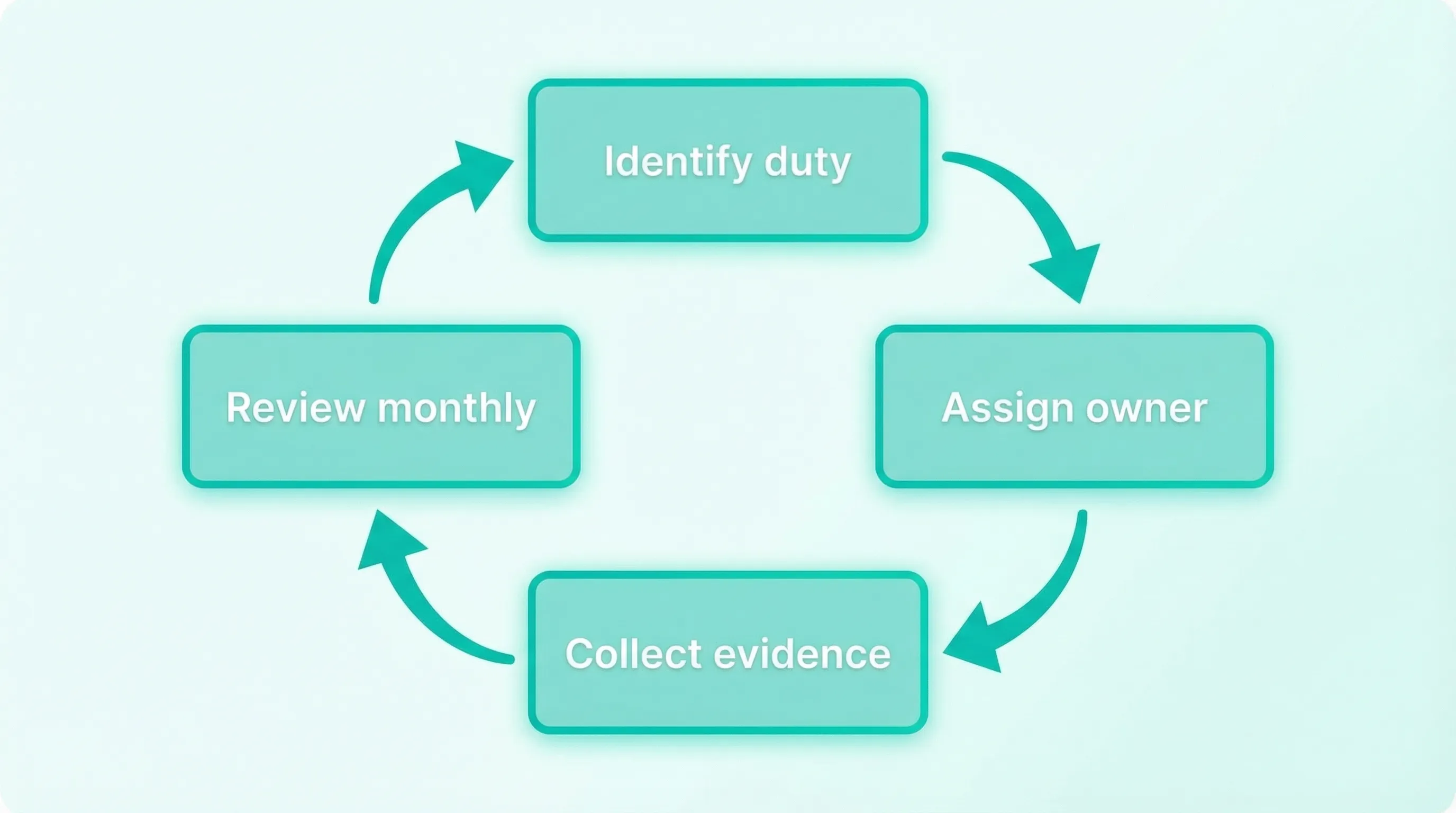
A calendar turns compliance from reactive to routine. It also helps you assign clear ownership for each duty.
Here is a practical calendar structure you can adapt:
| Area | What to track | Typical cadence | Evidence to file |
|---|---|---|---|
| Licensing | Commercial license renewal, permits, activity updates | Annual (often) | Renewal confirmation, updated license |
| Immigration | Establishment card, visas, renewals/cancellations | Ongoing | Visa copies, cancellation docs |
| Tax | VAT (if registered), Corporate Tax registration/filings as applicable | Periodic/annual | FTA confirmations, returns, payment receipts |
| Governance | Annual resolutions, signatory review, authority matrix review | Annual | Signed resolutions, updated matrix |
| Banking/KYC | KYC refresh, ownership confirmation, signatory updates | Periodic | Bank acknowledgements, updated KYC pack |
| Accounting | Bookkeeping close, audit prep (if required) | Monthly/annual | Management accounts, audit report |
Cadence differs by free zone, activity, and whether you are audited. The point is to have one calendar that is reviewed monthly.
5) Track UAE regulatory filings relevant to your entity
Not every UAE company has the same obligations. Mainland, free zone, regulated activities, and multi-entity groups can have different requirements.
At a high level, many UAE businesses should be prepared to address the following compliance areas:
| Compliance area | What it generally involves | Primary counterparties |
|---|---|---|
| Beneficial ownership | UBO data accuracy and supporting documents | Registrar or relevant authority |
| Economic substance (where applicable) | Assessing whether rules apply and maintaining support | Relevant authority depending on jurisdiction |
| AML (if applicable) | Controls, policies, risk assessments for relevant businesses | Supervisory authorities |
| Tax | VAT and Corporate Tax obligations, registrations, filings, payments | UAE Federal Tax Authority |
For official guidance on tax obligations, refer to the UAE Federal Tax Authority and the UAE Ministry of Finance Corporate Tax resources.
6) Maintain a “bank-ready” KYC and due diligence pack
Even if you are not fundraising, a well-maintained KYC pack saves time whenever your bank requests updates or you onboard vendors.
A strong pack usually includes:
- Current license and constitutional documents
- Ownership chart and UBO documents (IDs, proof of address where required)
- Director/manager and signatory IDs and proof of authority
- Office lease and proof of business presence (as applicable)
- High-level business profile (what you do, who you serve, expected flows)
Best practice: Put one person in charge of ensuring the KYC pack is always aligned with your latest filings and approvals.
7) Control signing authority (and prove it)
Secretarial duties are not only “records,” they also prevent unauthorised commitments.
Put in place:
- An authority matrix (who can sign what, up to what value)
- A contract signature process (especially for leases, loans, and long-term commitments)
- A controlled process for issuing powers of attorney (if you use them)
This is particularly important in owner-managed companies where the founder is travelling and needs decisions executed quickly without losing control.
8) Keep accounting and tax records aligned with governance
Compliance becomes fragile when governance documents say one thing and finance records say another.
A few common alignment checks:
- Shareholding and capital structure in records match constitutional documents
- Related-party transactions are approved and documented consistently
- Director/manager changes are reflected in finance approvals and banking permissions
- Invoices, contracts, and revenue narratives support tax positions
If your entity requires audited financials (common in some free zones or for certain banking relationships), secretarial readiness reduces audit friction significantly.
9) Manage changes properly (the “event-driven” checklist)
Most compliance problems arise when something changes and the updates are only done partially.
When any of the following events occur, treat it as a mini-project with a checklist:
- New shareholder, share transfer, or exit
- New director/manager, resignation, or change in signing powers
- Address change or office move
- Activity changes, adding regulated activity, or changing license type
- Visa applications, renewals, cancellations, status changes
- Bank account opening or signatory updates
For each event, capture three things: approval (resolution), registrar update (where required), and stakeholder updates (bank, tax, key vendors).
10) Recordkeeping standards: retention, version control, and access
“Having documents” is not the same as having controlled records.
Aim for:
- A single repository with folder conventions (Formation, Governance, Registers, Tax, Banking, Immigration)
- Version control (final signed PDFs, clear naming, date format)
- Access control (who can view, who can edit)
- A retention policy aligned with legal and practical needs

A “one-page” internal control: the secretarial responsibility matrix
To make your company secretarial duties operational, assign each task an owner and a backup.
| Task | Primary owner | Backup | Where evidence lives |
|---|---|---|---|
| License renewal tracking | Operations/Admin | Finance | Compliance calendar + Renewal folder |
| UBO register accuracy | Corporate/Legal | Director’s office | Registers folder |
| Resolutions and minutes | Corporate/Legal | Company manager | Governance folder |
| Bank KYC pack updates | Finance | Operations/Admin | Banking folder |
| Tax registrations/filings | Finance/Tax agent | CFO/Director | Tax folder |
| Visa and immigration updates | PRO/Immigration | Operations/Admin | Immigration folder |
This simple matrix helps when staff change, founders travel, or you scale into multiple entities.
Common gaps (and how to fix them quickly)
A few patterns show up repeatedly in UAE compliance cleanups:
“We have documents, but they do not match each other”
Fix by reconciling the registrar file, bank file, and internal file. Align ownership, signatories, and constitutional documents, then lock a new “golden set.”
“We cannot prove approvals for past actions”
Fix by rebuilding a decision trail: collect key emails, contracts, and bank forms, then formalise where appropriate with properly dated resolutions (get professional guidance to avoid creating inconsistencies).
“Renewals are last-minute every year”
Fix by creating a 12-month calendar and setting internal deadlines 30 to 60 days before official expiry, especially if external attestations or audits are required.
When to get expert help
If you are managing multiple shareholders, cross-border ownership, nominee arrangements, regulated activities, or you are preparing for banking, fundraising, or a sale, secretarial work should be treated as a controlled function, not admin.
Alldren provides expert-led corporate services for establishing and managing UAE companies, including structuring, governance, and ongoing compliance support. If you want a senior review of your current compliance file and a practical operating cadence, you can start at Alldren.


