

If you run a UAE company, “business secretarial support” can sound like basic admin. In reality, it is the operational backbone of corporate compliance: keeping your legal records accurate, your filings on time, your approvals properly documented, and your governance defensible when a bank, regulator, auditor, investor, or buyer asks for proof.
This guide breaks down what business secretarial support really includes, what you can skip, what you cannot, and how to choose the right support model for your UAE entity.
What “business secretarial support” actually means (and what it does not)
In many jurisdictions, people use “secretarial” to mean reception, diary management, and paperwork. Corporate secretarial support is different. It is about maintaining the company’s “corporate memory” and ensuring that key decisions and changes are legally valid and properly recorded.
Business secretarial support typically covers:
- Maintaining core corporate records (registers, resolutions, constitutional documents)
- Organising shareholder and director decisions (minutes, written resolutions)
- Managing recurring compliance items (renewals, filings, governance housekeeping)
- Supporting controlled changes (share transfers, manager/director changes, amendments)
- Preparing an “audit-ready” corporate pack for banks and counterparties
It usually does not replace specialist advice in areas like tax structuring, legal disputes, or regulated financial services licensing (though good providers coordinate those workstreams).
Why it matters in the UAE: compliance is operational, not theoretical
In the UAE, corporate compliance touches multiple systems at once: licensing authorities (mainland and free zones), immigration, banking onboarding and periodic reviews, and increasingly formal tax and reporting processes.
Two real-world moments when secretarial gaps become expensive:
1) Bank account opening and ongoing KYC reviews
Banks commonly request up-to-date corporate documents and evidence of control and substance. If your shareholding history is unclear, signatures are inconsistent, or resolutions are missing, onboarding can stall or periodic reviews can trigger account restrictions.
For reference, the UAE Central Bank sets expectations around anti-money laundering and sanctions compliance for financial institutions, which drives the documentation banks request from corporate customers. See the UAE Central Bank AML/CFT information.
2) “Change events” that must be documented properly
Even simple changes (new shareholder, new manager, change of address, new activity) can require a precise chain of approvals and filings. If documentation is incomplete, you can run into delays, rejections, or downstream disputes about authority.
The core deliverables you really need (the practical checklist)
The right scope depends on your jurisdiction (mainland vs free zone), your activity, and your risk profile. But most UAE companies benefit from a baseline package that keeps them “clean” year-round.
Corporate records that should always be current
At minimum, you should be able to produce, quickly and confidently:
- Trade license and any annexures
- Memorandum/Articles (or equivalent constitutional documents)
- Shareholder register and (where applicable) share certificates
- Director/manager register and authorised signatory list
- Ultimate Beneficial Owner (UBO) information and supporting documents
- Minutes and resolutions for major decisions
- Powers of attorney (if used) and a record of scope and validity
A good rule: if a bank asked you tomorrow to prove who owns the company and who can sign, could you do it within 24 hours?
A governance rhythm (so you are not scrambling once a year)
Secretarial support is most valuable when it runs on a calendar, not on panic.
That means:
- A compliance calendar with renewal and filing dates
- A standard approval workflow for routine actions
- Document templates aligned with your authority matrix (who can approve what)
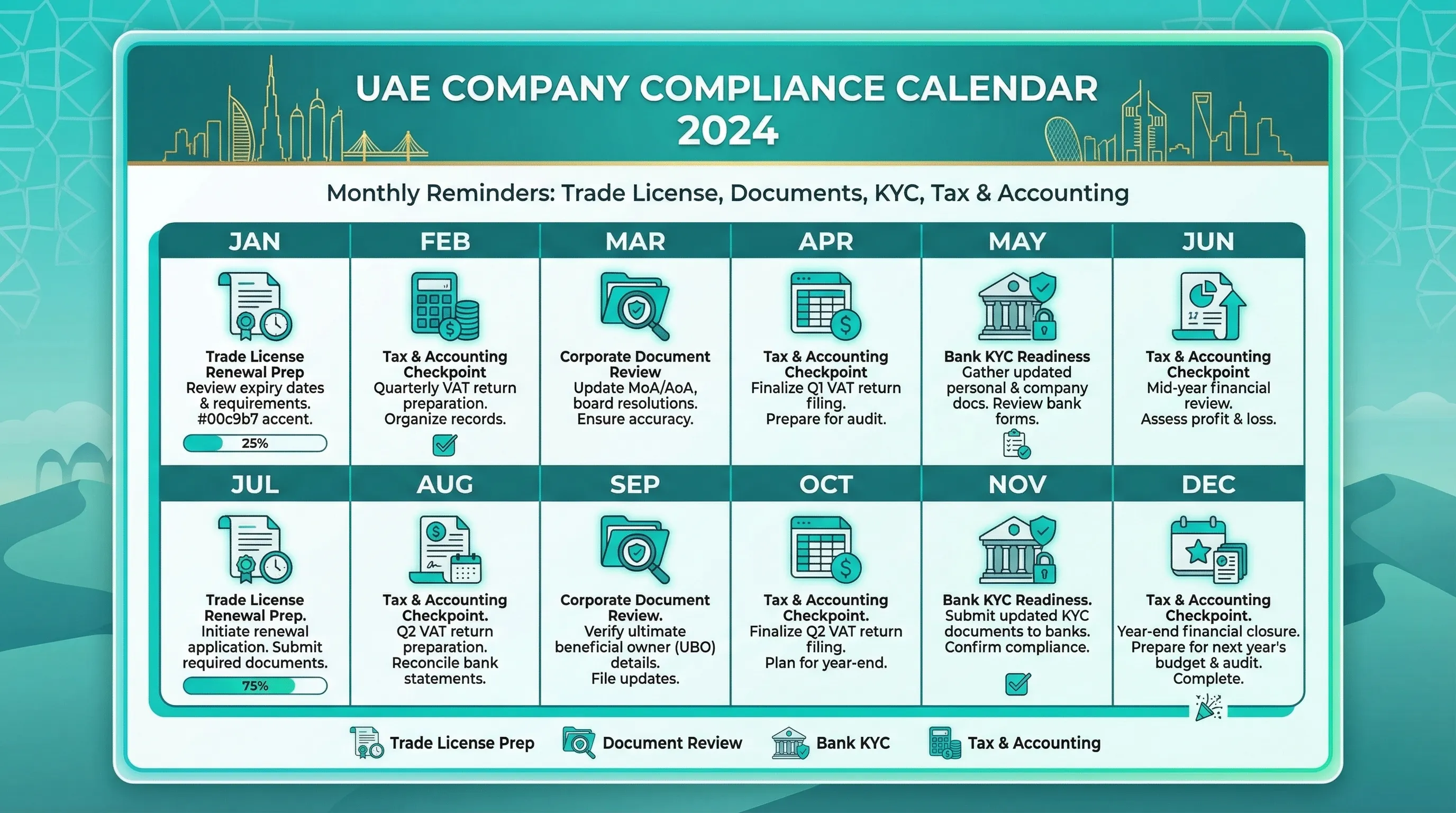
Proper documentation for decisions (minutes and resolutions)
Well-written minutes are not “bureaucracy.” They are evidence.
You typically want written records for:
- Appointment or resignation of directors/managers
- Changes to authorised signatories
- Opening, maintaining, or changing bank accounts
- Related-party arrangements (especially for groups)
- Significant contracts or commitments
- Share transfers or changes in ownership
If you ever face a shareholder dispute, a compliance inspection, or due diligence for a sale, these records become central.
UAE-specific areas where secretarial support intersects with other compliance
Secretarial support is not the same as tax or legal advisory, but in practice it connects to them. The best setups avoid gaps between “paper compliance” and real operations.
Corporate tax and VAT: record-keeping and readiness
The UAE has a federal Corporate Tax regime and an established VAT regime. While the tax analysis itself may sit with tax advisors, secretarial support helps ensure the entity’s records, signatory authority, and governance match what is being filed.
- UAE Corporate Tax guidance and updates are published by the Federal Tax Authority.
In practice, businesses often need to align:
- Who is authorised to sign and submit filings
- Whether internal approvals exist for material tax elections or positions
- Whether accounting and corporate records tell the same story (ownership, activities, control)
UBO and transparency expectations
UBO information is frequently requested in banking and compliance processes. The secretarial function typically maintains the supporting documents and the “chain of control” evidence so updates are consistent and defensible.
Immigration and visas (where corporate documents are required)
Visa processing itself is often handled as a separate workflow, but secretarial support becomes relevant because immigration steps can depend on:
- Correct entity details (name, license, establishment card information)
- Clear authorised signatory powers
- Updated manager/director information
In-house vs outsourced business secretarial support
Many companies start with “we will handle it internally,” then outsource once the first renewal rush or bank review hits. Neither approach is inherently better. The right choice depends on complexity and risk.
Here is a practical comparison:
| Model | Best for | Strengths | Typical risk if unmanaged |
|---|---|---|---|
| In-house (office admin or operations) | Very small, stable companies with low change frequency | Fast access, context on day-to-day operations | Compliance knowledge gaps, inconsistent records, missed deadlines |
| Outsourced to a corporate services firm | Companies that value predictability and audit-ready records | Structured processes, templates, reminders, experience across authorities | Over-reliance if scope and responsibilities are not clearly defined |
| Hybrid (in-house owner + outsourced governance) | Growing companies and groups | Clear internal ownership plus expert oversight | Confusion if handoffs and document control are not disciplined |
What to ask before you hire a secretarial support provider
You are not just buying document production. You are buying risk reduction.
1) Who is accountable for accuracy and consistency?
Ask how the provider controls document versions, maintains registers, and prevents mismatches between:
- License details
- Constitutional documents
- Bank signatories
- Tax registrations
2) What is their change-management process?
A strong provider will explain, clearly:
- What information they need from you
- What approvals are required n- What gets filed where
- What evidence you receive at the end (not just “it’s done”)
3) How do they handle recurring compliance (not just one-off tasks)?
Look for a proactive cadence: renewal planning, periodic record reviews, and a compliance calendar.
4) Can you speak to a senior expert when the situation is complex?
In real life, the hard moments are not template-based (ownership restructures, shareholder changes, bank escalations). If you can only reach a ticketing inbox, timelines and outcomes can suffer.
Red flags: when “secretarial support” is too thin to protect you
Not all providers deliver the same depth. Watch for these signals:
- They cannot describe what registers they maintain (or they “only do renewals”)
- They do not ask about ownership, signatory powers, or governance requirements
- They give you documents but do not manage a controlled master set
- They cannot explain how you will be ready for bank KYC and due diligence
- They rely on informal approvals (WhatsApp-only instructions) without proper written resolutions
A simple “minimum viable” secretarial stack for most UAE SMEs
If you want to start lean but correct, aim for:
- A master corporate folder (controlled versions) with constitutional documents, license, registers, and IDs
- A decision log (board/shareholder resolutions and key contracts)
- A compliance calendar (renewals plus quarterly housekeeping)
- A standard bank pack (ownership chart, UBO support, signatory evidence)

Frequently Asked Questions
What is included in business secretarial support in the UAE? It typically includes maintaining corporate records and registers, preparing minutes and resolutions, managing compliance calendars and renewals, and supporting changes like signatories, management, or ownership updates.
Do UAE companies legally need a company secretary? Requirements vary by jurisdiction and entity type. Even when not strictly mandated, keeping secretary-level records (minutes, registers, approvals) is a practical necessity for banking, compliance, and due diligence.
Is business secretarial support the same as PRO services? Not exactly. PRO services usually focus on government liaison and immigration-related processing. Secretarial support focuses on corporate governance, records, resolutions, and ongoing compliance readiness (though providers may offer both).
What documents do banks usually ask for during KYC reviews? Common requests include license and constitutional documents, ownership and UBO information, registers, authorised signatory evidence, and resolutions approving account opening or signatory changes. Exact requirements vary by bank and risk profile.
How often should corporate records be reviewed? At least quarterly for growing companies, and immediately after any change event (new shareholder, new manager/director, new signatory, address change, business activity updates).
Need business secretarial support that is actually compliance-grade?
Alldren provides expert-led, transparent corporate services for establishing and managing UAE companies, including ongoing compliance management and corporate governance support. If you want your records, approvals, and renewals handled with the same rigor a bank or counterparty expects, you can start by discussing your entity type, jurisdiction, and operational needs.
Explore Alldren’s approach at alldren.com.


