UAE companies are operating in one of the world’s most dynamic regulatory environments. That is a strength, but it also means compliance is not something you “do once” after incorporation. Licenses need renewing, corporate records must stay current, tax registrations and filings can apply, and ownership transparency rules are increasingly scrutinized by banks and counterparties.
Company secretarial services sit at the center of this. Done well, they help you prove good governance, keep statutory records clean, and reduce the risk of avoidable delays (for example, when opening a bank account, onboarding with partners, or responding to a regulator request).
What “company secretarial services” actually mean in the UAE
In many markets, “company secretary” can sound like administrative support. In the UAE context, it is closer to governance and compliance operations for your entity.
Company secretarial services typically cover:
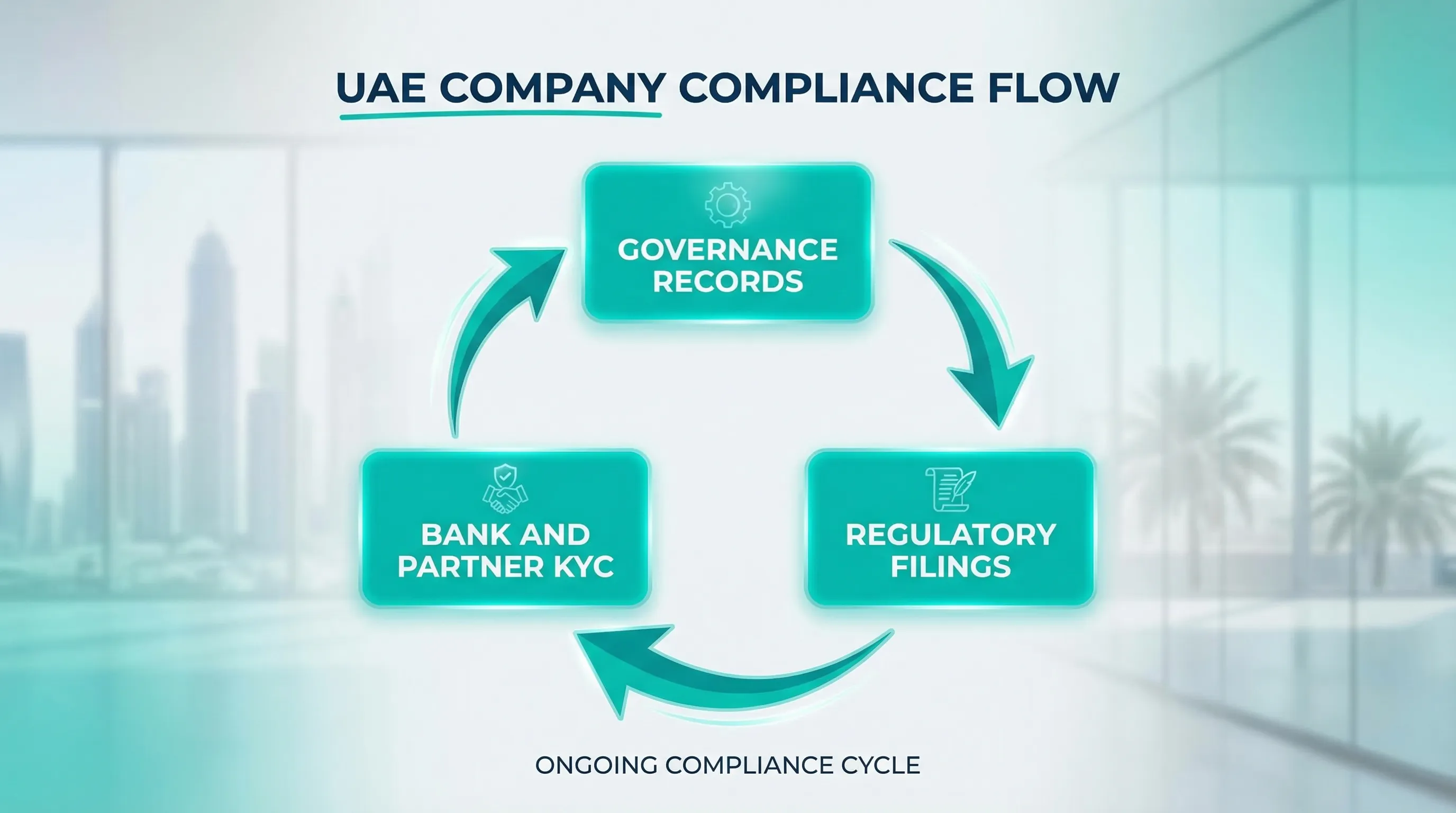
- Maintaining statutory and governance records (registers, resolutions, minutes)
- Managing corporate changes (directors, shareholders, signatories, addresses)
- Coordinating recurring compliance requirements (renewals, filings, confirmations)
- Creating an audit-ready paper trail for banks, investors, and regulators
Because the UAE has multiple licensing authorities (mainland departments and many free zones), the exact requirements vary. A strong secretarial function translates broad obligations into a jurisdiction-specific checklist, then keeps it running throughout the year.
Why UAE compliance is different (and why it catches businesses off guard)
UAE compliance is not “one regulator, one annual return.” Depending on how you are set up, you may need to coordinate obligations across:
- Your licensing authority (mainland or free zone)
- Federal transparency and disclosure frameworks
- The UAE tax ecosystem (when applicable)
- Banks’ compliance teams, which often require more documentation than the legal minimum
Even when two companies have the same activity, their compliance workload can differ based on:
- Legal form (for example, LLC vs branch)
- Free zone vs mainland
- Number of shareholders, classes of shares, or corporate shareholders
- Whether the business is part of an international group
The practical takeaway is simple: your compliance system should match your structure, not a generic template.
The core components of company secretarial services for UAE compliance
Below are the areas where company secretarial services most directly support UAE compliance. Not every item applies to every company, but these are the recurring themes that determine whether an entity stays “clean” over time.
1) Governance records that stand up to scrutiny
Well-kept governance records are your first line of defense when a bank, counterparty, auditor, or authority asks basic questions such as “who can sign,” “who owns this entity,” or “was this decision properly authorized?”
A secretarial service typically helps maintain:
- Shareholder and director registers (as applicable)
- Resolutions for key decisions (appointments, signatory changes, major contracts)
- Meeting minutes where required or advisable
- Corporate document packs for banks and third parties
This is not only about formality. In practice, good records reduce friction during bank account opening, KYC refresh cycles, financing, or future restructuring.
2) Ownership transparency and UBO readiness
The UAE has established frameworks around beneficial ownership disclosure and maintaining accurate ownership information for relevant entities. Requirements and submission processes can vary by authority and situation.
A secretarial function helps by:
- Keeping ownership and control records consistent across corporate documents
- Preparing UBO-related supporting documentation for filings and bank KYC
- Managing updates when ownership, control, or key persons change
For official context, see the UAE Ministry of Economy (which publishes federal corporate compliance guidance and updates).
3) License and establishment maintenance (mainland or free zone)
Many businesses treat license renewal as a calendar reminder. In reality, renewals often depend on prerequisites such as lease or facility documentation, immigration-related establishment details, or updated signatory information.
Company secretarial services can support:
- Renewal coordination and document preparation
- Tracking authority communications and required updates
- Ensuring corporate changes are reflected before renewal deadlines
This matters because missed or messy renewals can affect immigration processing, banking, and the company’s ability to contract.
4) Economic substance and related regulatory touchpoints (when applicable)
Some UAE entities may have obligations under Economic Substance Regulations (ESR) or related reporting frameworks depending on activities and facts. This area is highly fact-specific.
A secretarial and compliance partner can add value by:
- Assessing whether ESR-style obligations may be relevant based on activities
- Organizing supporting documents and internal sign-offs
- Coordinating submissions with the relevant portals or authorities
For official information, refer to the UAE Ministry of Finance and its regulatory resources.
5) Tax registrations and compliance coordination (where within scope)
While “secretarial” is not the same as accounting, in the UAE the operational reality is that governance, licensing, and tax quickly overlap. For example, shareholding changes can impact tax registrations, and banking KYC often expects consistency across corporate and tax profiles.
Many corporate service providers coordinate or support:
- VAT registration and ongoing administration (if applicable)
- Corporate tax registration and ongoing requirements (if applicable)
- Keeping corporate documents aligned with tax profiles
For official tax guidance, use the UAE Federal Tax Authority.
6) Managing corporate changes without creating compliance gaps
Event-driven changes are a common source of accidental non-compliance, especially when the “change” is agreed commercially but not updated legally.
Typical changes include:
- Appointing or removing directors and managers
- Updating authorized signatories (especially for banking)
- Share transfers and share issuance (where permitted)
- Amending business activities or company names
- Updating addresses, leases, or facility agreements
A strong secretarial process focuses on sequencing. For example, banks may require updated resolutions before updating signatory mandates, and some authorities require specific forms and supporting documents in a particular order.
A practical UAE compliance calendar (generic, but useful)
The exact calendar depends on your licensing authority, tax status, and activity. Still, most entities benefit from organizing compliance into repeatable cycles.
| Compliance item | Typical cadence | What company secretarial services do | Why it matters |
|---|---|---|---|
| Corporate governance records (registers, resolutions, minutes) | Ongoing, event-driven | Draft and store resolutions, maintain registers, keep a consistent document pack | Reduces disputes, supports KYC, proves authority to act |
| License renewal readiness | Annually (or per license cycle) | Track renewal requirements, coordinate updates before renewal | Avoids interruption to operations and immigration processes |
| Ownership and UBO documentation updates | Event-driven, plus periodic KYC refresh | Keep ownership records consistent, prepare supporting documents | Prevents banking issues and regulatory inconsistencies |
| Tax registrations and filings (if applicable) | Per tax cycle (for example, quarterly VAT, per financial year corporate tax) | Coordinate documentation and corporate profile consistency | Avoids filing errors caused by outdated corporate data |
| Compliance “health check” | Quarterly or biannually | Review changes, ensure filings and records align, flag upcoming risks | Catches gaps early, before banks or authorities do |
Use this table as a starting point, then tailor it to your authority (free zone or mainland) and your internal operating rhythm.
When to outsource company secretarial services vs keep them in-house
Outsourcing is most valuable when compliance work is real, recurring, and business-critical, but you do not want to carry the fixed overhead of senior governance expertise.
Outsourcing tends to be a good fit if:
- You have multiple shareholders, directors, or group entities
- You expect changes (new partners, restructuring, added activities)
- You rely on banking relationships and want smoother KYC cycles
- You want a documented compliance system, not scattered email threads
Keeping it in-house can work when:
- Your structure is simple and stable
- You have experienced operational staff who can manage governance documentation correctly
- You can still access senior advice quickly when a complex change arises
A hybrid approach is common: a business runs basic admin internally, while a specialist handles governance drafting, compliance scheduling, and authority-facing processes.
How to choose a company secretarial provider in the UAE
Because “secretarial” touches legal, regulatory, and operational layers, quality differences show up fast. Evaluate providers on signals that correlate with lower risk.
Senior expertise and accountability
Ask who actually reviews and signs off on governance and compliance work. In complex situations, junior-only delivery can lead to inconsistent documents, wrong sequencing, or avoidable back-and-forth with authorities.
Clear scope and transparent pricing
The best engagements define what is included (and what is not) such as governance documentation, renewals coordination, change management, and compliance calendar management.
Documentation discipline
Look for a provider that builds a clean, retrievable document pack (resolutions, registers, licenses, IDs, KYC support files) so you are not recreating your corporate history during every bank request.
Proactive compliance management
Good secretarial services do not wait for deadlines. They run a calendar, monitor changes, and flag items that could create inconsistencies (for example, a new signatory added commercially but not updated in the corporate approvals).
How Alldren supports UAE compliance through company secretarial services
Alldren provides expert-led corporate services for establishing and managing UAE companies, with a focus on building robust, compliant corporate structures and maintaining them over time. For company secretarial services, that typically means helping clients stay organized across governance records, recurring compliance management, and event-driven corporate changes.
If you are aligning incorporation, ongoing compliance, and governance under one roof, Alldren can also support related needs such as company setup and structuring, corporate governance services, bank account opening support, bookkeeping and tax registration, and UAE residency visa processing (as applicable to your situation).
To discuss the right compliance setup for your entity and authority, you can start at Alldren.