

Opening a UAE business bank account can feel harder than incorporating the company itself. That is not because banks want to slow you down, it is because UAE banks run strict KYC (Know Your Customer) and AML (anti money laundering) checks and they need enough evidence to understand who owns the business, what it does, and how money will move.
This guide breaks down what banks typically ask for during company account opening in the UAE, why they ask for it, and how to prepare a clean, approval ready file.
Why banks ask for so much in the UAE
UAE banks must comply with local AML/CFT requirements and international expectations around transparency, beneficial ownership, and sanctions screening. In practice, that means they do not just verify your documents, they verify your story.
A few key realities shape the process:
- Risk based onboarding: banks assess the risk level of the customer and activity, then decide what evidence they need.
- Beneficial ownership transparency: banks must identify and verify the ultimate beneficial owners (UBOs) and understand control.
- Source of funds and source of wealth: banks want to know where the initial deposit comes from and how the owners made their money.
If you want to go deeper into the broader framework, see the UAE Central Bank (CBUAE) resources and the FATF standards that influence global banking compliance.
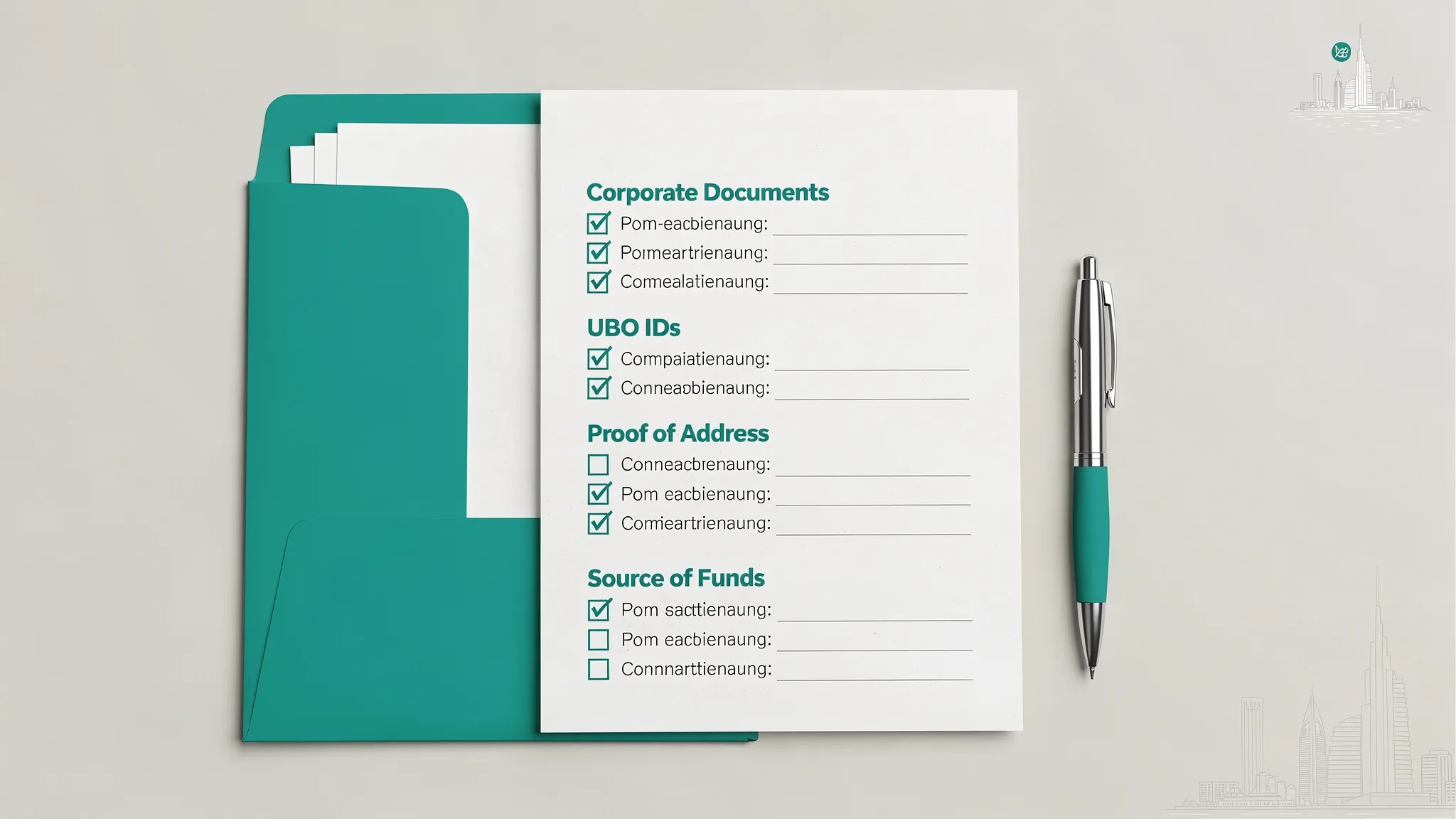
The core UAE company bank account checklist (what banks typically request)
Exact requirements vary by bank and profile, but most UAE banks ask for the same categories of information.
1) Company incorporation and licensing documents
Banks need to confirm the entity is properly formed and authorized to do business.
Common asks include:
- Trade license (and any relevant activity pages)
- Certificate of incorporation or registration
- Memorandum and Articles of Association (MOA/AOA)
- Share certificate(s) or share register
- Board resolution authorizing the account opening and approved signatories
- Specimen signature form(s)
2) Ownership and management (UBO and controllers)
Expect the bank to map your ownership and control chain. If a shareholder is a corporate entity, banks typically request documents for each layer until they reach the individuals who ultimately own or control the company.
Common asks include:
- UBO declaration form (bank template)
- Shareholding structure chart (especially for multi layer structures)
- Passport and Emirates ID (if applicable) for shareholders, directors, and signatories
- Visa page and entry stamp copies (often requested for non residents)
3) Proof of address and contact information
Banks must verify where the business and the owners are reachable.
Common asks include:
- Proof of address for individual owners (utility bill, bank statement, tenancy contract, depending on bank policy)
- Company office address details (lease, Ejari where relevant, flexi desk contract if applicable)
- Corporate website and domain email (sometimes requested as credibility signals)
4) Business model evidence (what you do, who you serve, where money comes from)
This is often the deciding factor. Banks want to understand the nature of your activity and the expected transaction behavior.
Common asks include:
- Company profile and brief business plan
- Description of products/services, target markets, and customer types (B2B vs B2C)
- Expected monthly volumes (number of transfers, average ticket size, currencies)
- Expected counterparties and countries
- Copies of signed contracts, proposals, invoices, purchase orders, or supplier agreements
5) Source of funds (SOF) and source of wealth (SOW)
These are related but not identical:
- Source of funds: where the initial and ongoing business funds come from (for example, retained earnings, shareholder loans, client payments).
- Source of wealth: how the owners accumulated their wealth (for example, sale of a company, employment income, investments).
Common asks include:
- Bank statements (personal and/or corporate, usually recent months)
- Salary slips or employment letters (for individual owners)
- Audited financials or management accounts (for existing businesses)
- Proof of business sale, dividend income, investment statements (when relevant)
6) Compliance questionnaires and interviews
Most banks require forms and, increasingly, a short compliance call. The goal is consistency between your documents and your narrative.
Typical topics:
- Detailed business activity and reason for choosing the UAE
- Expected flows (inbound/outbound), cash usage, and key partners
- Any connections to sanctioned jurisdictions or high risk sectors
What gets extra scrutiny (and what to prepare)
Some profiles are completely legitimate but tend to trigger more questions. Being ready for them can save weeks.
Non resident owners
Non residents can open accounts in many cases, but banks often request stronger proof of business substance and clearer transaction rationale.
Helpful supporting items:
- Signed client contracts (not just forecasts)
- Evidence of a UAE nexus (UAE customers, UAE suppliers, local presence, or regional operations)
Complex shareholding or holding companies
If your structure has multiple layers, prepare a clear ownership chart and certified copies of parent company documents.
“High risk” or regulated activities
Banks may apply enhanced due diligence for certain sectors (for example, crypto related activities, money services, high volume cash businesses, some trading models). If your license activity is close to these categories, be ready to explain controls, counterparties, and compliance measures.
Free zone vs mainland
Both can be banked. The difference is rarely the location itself, it is whether the activity, substance, and documentation are consistent. If your office is a flexi desk, banks may request additional evidence that operations are real.
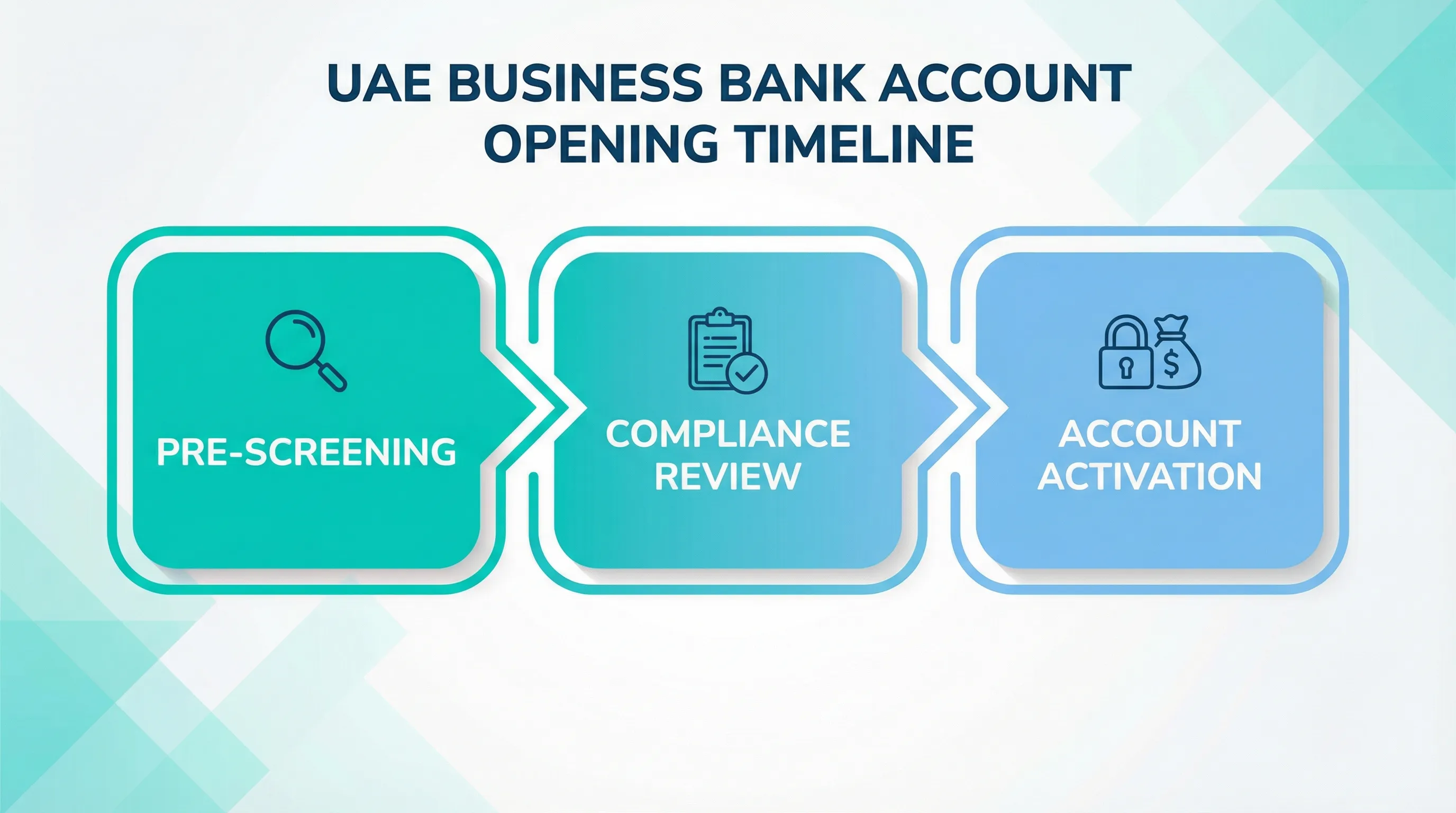
How the UAE company bank account opening process usually works
While each bank has its own workflow, most onboarding follows the same pattern.
Pre screening (initial review)
You submit basic documents and answer initial questions. The bank decides whether the profile fits its risk appetite.
Full application and compliance review
You provide the full pack, complete bank forms, and attend a compliance interview (in person or remote, depending on the bank and case).
Approval, account setup, and activation
After approval, you receive account details and set up online banking tokens and signatory permissions.
Timelines vary widely. A well prepared file can move faster, while higher risk profiles may take longer due to enhanced checks and follow ups.
A practical table: what banks ask for and why
Use this as a quick sanity check before submitting your file.
| What the bank asks for | Examples | Why it matters to the bank |
|---|---|---|
| Legal existence and authority | Trade license, incorporation certificate, MOA/AOA | Confirms the entity is valid and permitted to conduct the stated activities |
| Ownership and control | UBO form, share register, ownership chart | Identifies who ultimately owns/controls the business and screens them |
| Identity verification | Passports, Emirates ID, visas, specimen signatures | Confirms the identities of directors, shareholders, and signatories |
| Address verification | Utility bills, tenancy contract/Ejari, office lease | Verifies where the company and owners are based and reachable |
| Business model and flows | Business plan, contracts, invoices, expected volumes | Establishes expected transaction behavior and detects inconsistencies |
| Source of funds/wealth | Bank statements, financials, salary slips, investment proofs | Confirms funds are legitimate and aligns with AML obligations |
How to increase approval odds (without overcomplicating your file)
Most delays come from gaps, inconsistencies, or unclear activity narratives. These steps usually help.
Make the business model “bank readable”
Banks do not want marketing language. They want operational clarity:
- What exactly do you sell?
- Who pays you, from which country, and via which method?
- Who do you pay, for what, and how often?
- What is the expected monthly range of inbound and outbound transfers?
Align license activities with real operations
If the trade license activity sounds broad but your actual business is narrow, write a short explanation that connects the two, and support it with contracts or invoices.
Prepare proof, not promises
Forecasts help, but signed agreements help more. If you are pre revenue, be ready with:
- Pipeline evidence (signed proposals, LOIs where acceptable)
- Owner funding evidence (shareholder loan documents and supporting statements)
Keep the ownership chain simple and transparent
If you can legally and strategically simplify the structure, it often reduces questions. If you cannot, provide a clean ownership chart and certified documents for each layer.
Expect follow up questions and answer consistently
Most banks will ask follow ups. Respond quickly, and make sure answers match what is in your documents, forms, and website.
Where expert support helps (structuring + banking readiness)
Company account opening in the UAE is easier when your incorporation choices, compliance posture, and documentation pack are designed with banking in mind.
Alldren supports UAE company formation and ongoing compliance, and can also assist with bank account opening support as part of a broader, robust corporate setup. Because each bank and case is different, it is best to approach account opening as a process: the right structure, the right evidence, and clear communication with the bank.
Frequently Asked Questions
Can I open a UAE company bank account as a non resident? Many banks consider non resident owners, but requirements can be stricter. Expect deeper checks on business substance, contracts, and source of funds.
How long does company account opening take in the UAE? Timelines vary by bank and risk profile. Some straightforward cases move quickly, while others take longer due to compliance reviews and follow ups.
Do I need a physical office to open a business bank account? Not always, but the bank typically wants credible evidence of business operations and a verifiable company address. If you use a flexi desk, provide strong supporting documentation.
What is the difference between source of funds and source of wealth? Source of funds explains where the money used in the business comes from (today). Source of wealth explains how the owner built their wealth over time.
Why do banks ask for contracts and invoices? These documents help the bank validate your business model and assess whether expected transactions match what you claim you do.
Need help preparing a bank-ready file for the UAE?
If you want your company setup, structuring, and compliance documentation to support smoother company account opening in the UAE, Alldren can help you prepare a clear, consistent onboarding pack and guide you through the process.
Explore Alldren’s services at alldren.com and request a consultation to discuss your structure, activity, and the most practical path to opening your business account.


