

Opening a corporate bank account in the UAE is rarely “just paperwork.” Banks must follow strict onboarding rules, and they will only approve applications that clearly demonstrate a legitimate business purpose, transparent ownership, and a financial profile that matches the company’s licensed activity.
If you want to improve approval odds and reduce back-and-forth, use the checklist below before you approach any bank. It is written for founders, CFOs, holding-company owners, and international entrepreneurs setting up a UAE entity (mainland or free zone).
Why UAE banks can be strict about corporate onboarding
Most delays and declines come from the same root cause: risk management. UAE banks are required to apply customer due diligence and ongoing monitoring under UAE anti-money laundering and counter-terrorist financing expectations. You can see the Central Bank’s high-level AML/CFT focus areas on the CBUAE AML/CFT page.
In practice, this means the bank must be comfortable with:
- Who owns and controls the company (including the ultimate beneficial owner, or UBO)
- What the company will do (licensed activity and real-world business model)
- Where money will come from and go (source of funds, source of wealth, counterparties, countries)
- Whether the expected account activity makes sense (volumes, currencies, transaction types)
The better you document these points, the more “approvable” your file becomes.
Company bank account opening in UAE: Approval checklist
Think of a strong bank account application as a short, coherent story with evidence. The sections below are the story banks want to understand.
1) Corporate documents (clean, consistent, and up to date)
Prepare a complete corporate pack, and ensure names, addresses, and shareholding details match across documents.
Typically requested items include:
- Certificate of Incorporation
- Trade license (and any activity annexes)
- Memorandum and Articles of Association (or equivalent constitutional documents)
- Share certificate(s) and a current shareholding structure
- Board resolution authorizing account opening and appointing signatories
- Incumbency certificate (common for some free zone entities) or equivalent proof of current officers
If your structure involves a parent company, holding company, or offshore entity as shareholder, expect to provide a similar set of documents for those entities, plus a clear ownership chart to the UBO level.
2) UBO, KYC, and personal compliance file (for each relevant person)
Banks will verify the identity and profile of:
- UBOs
- Directors
- Authorized signatories
- In some cases, key managers or POA holders
Common requirements:
- Passport copy and UAE visa / entry stamp (if applicable)
- Emirates ID (if already issued)
- Proof of residential address (usually recent utility bill or bank statement)
- CV or professional profile (especially for service companies, consulting, advisory, or regulated-adjacent activities)
- Personal bank statements (often requested to support source of funds or wealth)
Tip: If you have name variations (middle names, initials, different spellings across documents), address them early with supporting documents. Small mismatches can create big delays.
3) A business model that matches the license
Banks compare your narrative to your trade license activity.
Be ready to provide:
- A plain-English description of what you sell and to whom
- Website and business email domain (a simple but consistent online presence helps)
- Key suppliers and customers (even if only prospective at the start)
- Countries you will operate in, and why
- Expected transaction types (card payments, bank transfers, marketplaces, cash deposits, crypto exposure, etc.)
If you are newly incorporated and pre-revenue, that is not automatically a problem, but you must show credible planned activity and funding.
4) Source of funds and source of wealth (evidence, not explanations)
Two phrases cause most of the follow-up requests in UAE corporate banking:
- Source of funds: Where the money being deposited into the company account comes from (for example, shareholder injection, revenue, sale proceeds).
- Source of wealth: How the UBO accumulated overall wealth (for example, salary history, dividends, business exit).
Banks typically prefer documentary proof such as:
- Salary slips and employment contracts
- Audited financial statements (for the shareholder or parent company)
- Dividend vouchers, share sale agreements, or business sale agreements
- Tax returns (depending on the person’s residency and jurisdiction)
- Evidence of savings and investment holdings
If initial funding is a shareholder loan or capital injection, align the amounts with realistic startup needs and have a short written explanation supported by statements.
5) Proof of real business activity (contracts, invoices, pipeline)
For many applications, the strongest approval driver is evidence that the company is built to operate.
Useful documents include:
- Signed client contracts or master service agreements
- Purchase orders, invoices, or pro forma invoices
- Tenancy contract or flexi-desk agreement (if applicable)
- Supplier agreements
- Platform contracts (marketplace agreements, payment processor onboarding, logistics contracts)
If you are pre-contract, provide a credible pipeline: proposals, LOIs, emails confirming terms, or documented negotiations.
6) Expected account activity (make it internally consistent)
Banks will ask about:
- Expected monthly turnover range
- Average incoming and outgoing transfer size
- Currencies and countries involved
- Number of counterparties
- Whether you will need cheque book, debit cards, or payroll
A common mistake is overestimating turnover to “look bigger.” Unrealistic projections often increase perceived risk. Keep it consistent with your business model, staffing, and launch stage.
7) Compliance risk flags (address them proactively)
Some factors do not automatically block approval, but they typically trigger deeper review:
- Complex multi-layer ownership without a clear reason
- Counterparties or UBO links to higher-risk jurisdictions
- Activities that are commonly restricted by bank policy (varies by bank)
- Heavy cash model without a clear operational explanation
- Business model that does not align with the licensed activity description
If any apply, prepare a short, factual rationale and additional supporting documents. The goal is to remove ambiguity.
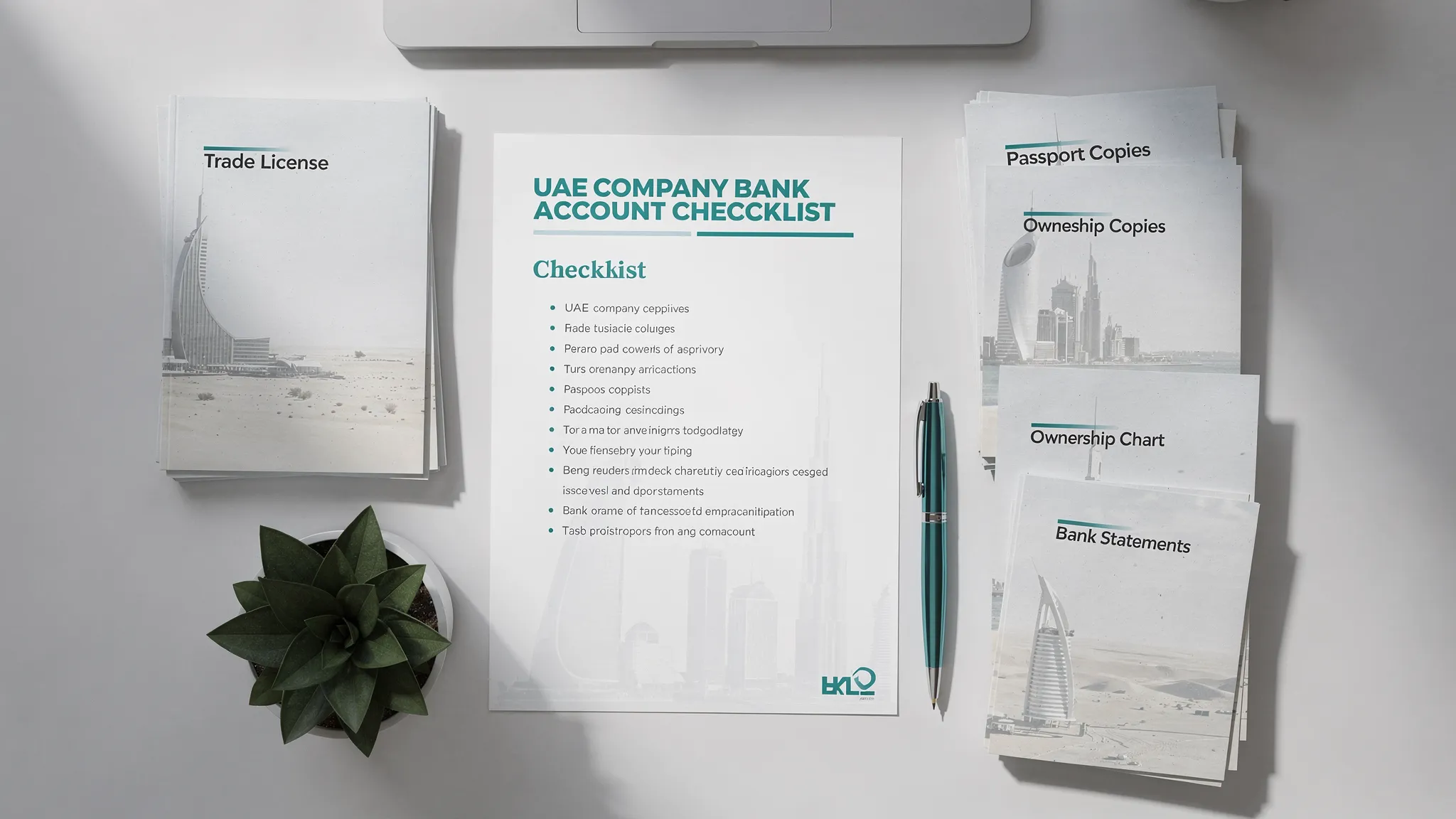
Document checklist table (what banks usually ask for)
Exact requirements differ by bank and by your risk profile, but this table covers the most common categories.
| Category | What to prepare | Why it matters |
|---|---|---|
| Company incorporation | Trade license, Certificate of Incorporation, MOA/AOA, share certificates | Proves the entity exists and is authorized for the stated activity |
| Authority to operate | Board resolution, signatory list, (sometimes) incumbency certificate | Confirms who can open and operate the account |
| Ownership clarity | Ownership chart to UBO level, parent-company documents if applicable | Helps the bank assess transparency and control |
| Individual KYC | Passports, visas/EID (if any), proof of address, CVs | Enables mandatory identity and suitability checks |
| Financial credibility | Bank statements, audited accounts (if any), management accounts (if any) | Supports the story that funds and activity are legitimate |
| Source of funds/wealth | Salary proof, sale agreements, dividends, investment statements, tax documents (if applicable) | Reduces AML risk and prevents repeated follow-ups |
| Business activity proof | Contracts, invoices, supplier/customer lists, website | Demonstrates operational substance and purpose |
| Expected activity | Turnover estimates, countries, currencies, transaction types | Lets the bank assess if expected usage fits its risk appetite |
Common reasons UAE corporate bank accounts get rejected (and how to prevent them)
Inconsistent or incomplete information
Small mismatches (addresses, spelling, shareholder percentages) can snowball into rework.
Prevention: Ensure one “master profile” for the company and each UBO that matches every document and form.
Business activity not supported by evidence
A trade license alone is rarely enough if the model is not clear.
Prevention: Provide at least one of the following: signed contract, invoice, supplier agreement, pipeline evidence, or a detailed business plan summary.
Unclear funding story
“Personal savings” without documentation is often not sufficient.
Prevention: Provide bank statements and a short explanation linking the funding amount to its origin.
Ownership structure looks opaque
Layered holding structures can be legitimate, but ambiguity triggers caution.
Prevention: Provide a clean ownership chart and supporting documents for each entity up to the UBO, plus a brief rationale for the structure.
Projected turnover does not fit the company profile
A new consultancy projecting very high international turnover in month one can look inconsistent.
Prevention: Use realistic ranges and align them with contracts, pipeline, and staffing.
Practical tips before you submit an application
Choose a bank approach that matches your profile
Different banks have different risk appetites, sector preferences, and minimum balance expectations. Rather than applying everywhere, focus on the bank most aligned with your activity and ownership profile.
Prepare a one-page “bank onboarding brief”
A concise summary can reduce meeting time and follow-up.
Include:
- What the company does (2 to 3 sentences)
- Ownership and roles (UBO, director, signatory)
- Expected monthly activity (range, currencies, key countries)
- Funding plan and source of funds
- Supporting documents list
Expect enhanced due diligence if your case is complex
If you have multiple nationalities, international counterparties, a holding structure, or higher-risk geographies, anticipate more questions. This is normal, and strong documentation is the fastest path through it.
Where Alldren can help
If you want to increase approval odds and avoid repeated document rounds, support matters most before you apply. Alldren provides bank account opening support alongside UAE company setup, structuring, and ongoing compliance, with transparent, upfront pricing and direct access to senior experts.
Learn more at Alldren or explore their corporate services for building a robust, compliant UAE operating setup.
Frequently Asked Questions
How long does company bank account opening in UAE take? Timelines vary widely by bank and by risk profile. A complete, consistent file with clear source-of-funds evidence typically moves faster than an application that triggers multiple follow-ups.
Can a newly formed UAE company open a bank account with no revenue yet? Yes, often, but banks usually want a credible business plan, expected activity, and clear documentation for initial funding (for example, shareholder injection supported by statements).
Do UAE banks require a physical office to open a corporate account? Not always. Some banks accept flexi-desk or shared workspace arrangements depending on the license type and business model, but you should be ready to provide a tenancy or facility agreement if asked.
What is the biggest reason corporate bank applications get delayed? Incomplete source of funds and source of wealth documentation is a frequent cause of delays, especially when the funding explanation is not backed by bank statements or other evidence.
Will every shareholder need to provide KYC documents? Banks typically require KYC for UBOs and key controlling persons. Depending on the structure, they may also request documents for other shareholders, directors, or parent entities.
Next step: Get your file “approval-ready” before you apply
If you want a smoother banking process, treat the application like a compliance project, not a formality. With the checklist above, you can build a complete onboarding pack, reduce follow-ups, and present a coherent profile that matches your UAE license and real business activity.
If you would like hands-on support with company structuring and UAE corporate bank account opening, Alldren can guide you through the requirements and help you submit a clean, bank-ready application. Visit alldren.com to get started.


