

Many founders come to the UAE with the same goal: build a real business and secure a stable residence status at the same time. The good news is that the UAE has clear, well-used pathways to UAE residency through business, but the best option depends on how you plan to operate (local clients vs global, hiring needs, office requirements, and budget).
This guide breaks down the main business-linked residency routes and the practical steps, from company formation to Emirates ID, plus the compliance habits that keep your status secure.
What “UAE residency through business” actually means
In most cases, you do not “buy” residency. You qualify for a residence visa because you have a valid reason recognized by immigration, commonly:
- You are an owner/partner of a UAE company.
- You are an employee of a UAE company (including your own company if structured that way).
- In specific cases, you qualify under longer-term programs (for example, certain Golden Visa categories), which are not strictly “through business formation” but can be related to investment or entrepreneurship.
A UAE residence visa is typically issued for a fixed validity period (often 1 to 3 years depending on visa type and issuing authority). Long-term options (such as 10-year visas) exist for qualifying categories.
Official immigration rules and processes are handled by federal and emirate-level authorities. For reference, see the UAE’s Federal Authority for Identity, Citizenship, Customs & Port Security (ICP): ICP Smart Services.
Your main options for UAE residency through business
There are three common business-linked routes. They differ in setup complexity, operating freedom, and what immigration expects from you.
Option 1: Investor or partner visa via your own company
You form a company (free zone or mainland) and then apply for a residence visa as an investor/partner (terminology varies by jurisdiction). This is the classic “residency through business ownership” model.
Best for:
- Founders who want control and long-term flexibility
- People who may not need a local employer
- Small teams where the owner will also be the manager
Option 2: Employment visa via your own company
Your company sponsors you as an employee (for example, as a general manager). This is common in many jurisdictions and can be practical when you want a clear employer-employee structure.
Best for:
- Owners who want a payroll and HR structure aligned with hiring plans
- Businesses that need work permits and staff visas under a consistent framework
Employment-related labor processes are typically linked to MOHRE for mainland employment. Reference: MOHRE.
Option 3: Residency linked to entrepreneurship or investment programs (where eligible)
Depending on your profile and investment level, you may be eligible for longer-term residence pathways (often discussed under “Golden Visa” categories). These are not guaranteed, are criteria-driven, and should be assessed case by case.
Best for:
- Founders and investors who meet specific thresholds
- People seeking longer visa validity and reduced renewal friction
If you are exploring this route, treat it as a separate eligibility assessment rather than assuming business formation alone qualifies you.
Quick comparison: which route fits you?
| Route | Typical sponsor | Best for | Main trade-offs |
|---|---|---|---|
| Investor/Partner visa | Your own company | Solo founders, owner-operators | Jurisdiction rules vary, approvals depend on proper licensing and filings |
| Employment visa | Your own company (as employer) | Founders hiring or building a formal org structure | More ongoing HR and compliance administration |
| Long-term eligibility programs (where applicable) | Usually federal frameworks | Qualified investors/entrepreneurs | Strict criteria, more documentation, not “automatic” with a new company |

Free zone vs mainland: how it affects residency
Your visa pathway is shaped by where your company is registered.
Free zone companies
Free zones are popular for international businesses, digital services, and holding structures. They often offer streamlined incorporation and visa processing tied to the free zone authority.
Typical considerations:
- Visa quotas can be linked to facility type (for example, flexi desk vs office)
- Business scope is limited to what your license allows
- Serving UAE mainland customers may require additional structuring or agreements depending on activity
Mainland companies
Mainland structures can be better when you need to contract directly with UAE mainland clients, open physical locations, or operate in certain regulated activities.
Typical considerations:
- More interaction with UAE federal employment processes for staff
- Additional approvals may apply depending on activity
- Office or tenancy requirements can be stricter in some cases
The “best” choice is usually operational, not just immigration-based. If your business model is unclear, start with the business plan and reverse-engineer the licensing and visa approach.
Step-by-step: how to get UAE residency through business
Exact steps vary by emirate and authority, but most business-linked residence visas follow a predictable sequence.
1) Choose your activity and licensing authority
Start with two questions:
- What will the company do (activities and revenue model)?
- Where will it operate (mainland clients, global clients, regulated sectors)?
This determines your license type, authority, and what is realistically approvable.
2) Incorporate the company and secure the setup essentials
Formation typically includes:
- Company name approval
- Legal form selection
- Shareholder and manager documentation
- Office solution or lease (depending on rules)
- License issuance
If you are planning residency, ensure the structure supports the visa type you want (owner vs employee) and that your authority allows the intended sponsorship.
3) Create the immigration file for the company (establishment registration)
Before a company can sponsor visas, it generally needs an immigration establishment file under the relevant authority (free zone immigration channel or emirate immigration).
This step is where many timelines slip if corporate documents, signatories, or facility details are not aligned.
4) Apply for an entry permit (and change status if you are in-country)
You usually begin with an entry permit. If you are already in the UAE on another status, a status change process may apply (rules depend on your current visa and the issuing authority).
5) Complete medical fitness and biometrics, then Emirates ID
The residence process typically includes:
- Medical fitness test
- Biometrics appointment
- Emirates ID application
Emirates ID is the core identity document you will use for banking, telecom, and many government services.
6) Residence approval, visa issuance, and post-visa steps
Once approved, you receive your residence visa (now often issued electronically rather than as a passport sticker, depending on the process and emirate). You then typically finalize:
- Emirates ID collection
- Health insurance arrangements (requirements differ by emirate and employment status)
- Corporate and personal admin tasks (banking, leasing, utilities) aligned with your new status
A realistic workflow snapshot
| Phase | What happens | What to watch |
|---|---|---|
| Planning | Activity selection, authority choice | Misaligned activity can block licensing or banking later |
| Incorporation | License and company documents issued | Signatory consistency, office requirements |
| Immigration setup | Company becomes eligible to sponsor visas | Missing corporate filings can delay establishment registration |
| Entry permit | Initial immigration approval | In-country status change rules vary |
| ID and medical | Medical test, biometrics, Emirates ID | Appointment availability affects timelines |
| Final issuance | Residence confirmed and post-setup begins | Keep records, track renewal dates, maintain compliance |
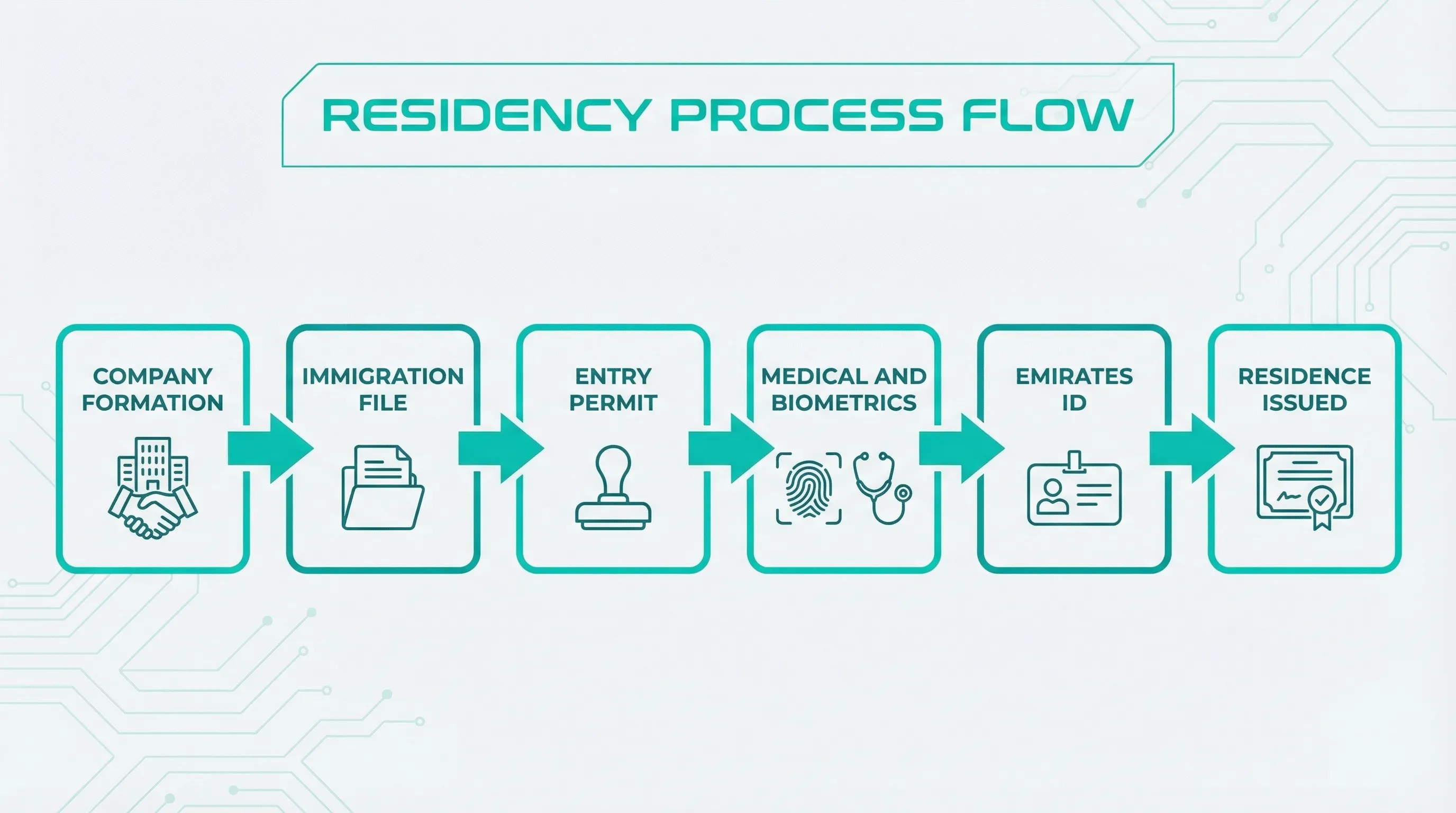
Documents you should expect to prepare
Document lists vary by authority and your nationality, but these are commonly requested:
- Passport copy (and sometimes full passport scan)
- Passport photo meeting UAE specifications
- Proof of current status if you are already in the UAE
- Company documents (license, registry extracts, shareholder/manager documents)
- Entry permit forms and signed declarations
If you plan to sponsor family later, you will also need to prepare for relationship documents (and, in some cases, attestation/legalization workflows).
What drives the cost (without guessing numbers)
Costs for UAE residency through business are not one flat fee. They usually depend on:
- Jurisdiction (free zone vs mainland, and which emirate)
- Number of visas (you only, or you plus employees)
- Facility type (flexi desk vs dedicated office)
- Whether you need additional approvals (regulated activities)
- Medical, Emirates ID, and insurance requirements
- Professional support scope (formation only vs full compliance and governance)
A transparent provider should be able to itemize what is government cost vs service cost, and what is optional vs required.
Compliance after you get residency: what keeps you safe
The UAE is business-friendly, but it is compliance-forward. The biggest mistakes happen after visa issuance, when founders stop monitoring obligations.
Here are the recurring areas that affect your ability to renew visas, keep accounts open, and operate smoothly:
Company license and establishment renewals
Your ability to sponsor residency is tied to an active, compliant company. If you miss license renewals or related filings, you can face penalties and blocks.
Bookkeeping, tax registration, and reporting
Depending on your activities and thresholds, you may need tax registrations and ongoing bookkeeping. Even when not legally mandatory for every small entity, clean books are often essential for banking, audits, and investor due diligence.
For UAE tax orientation and updates, the Federal Tax Authority is the source of record: UAE Federal Tax Authority.
Corporate governance and signatory discipline
As your company grows, governance matters (who can sign, how decisions are recorded, and how you document ownership and control). Weak governance becomes a real risk when:
- Banks request updated corporate documents
- You add partners
- You want to sell the business or bring in investment
Immigration and personal status management
Residency is not “set and forget.” Track:
- Renewal windows and required steps
- Dependents’ visas if you sponsor family
- Time spent outside the UAE, which can affect visa validity depending on your status and circumstances
(Always verify the applicable rules for your visa category through official channels such as ICP and the relevant emirate authority.)
Common pitfalls (and how to avoid them)
Choosing a license for speed instead of fit
A fast license that does not match your real activity can create downstream issues with invoicing, payment providers, and banking.
Better approach: define revenue flows, client location, and hiring plan first, then select the authority.
Underestimating office and visa quota constraints
Some jurisdictions tie visa eligibility to your facility type. If you need multiple visas in the next 6 to 12 months, plan facility options early.
Treating banking as an afterthought
Bank account opening is often the longest pole in the tent. Banks may ask for:
- A clear business model
- Contracts or pipeline evidence
- Proof of address and residency
- Source-of-funds documentation
Your corporate structure and documentation quality directly affect outcomes.
Ignoring compliance until renewal time
Renewals are smoother when compliance is continuous. Keep a calendar for:
- License renewal
- Establishment and immigration file renewals (where applicable)
- Visa and Emirates ID renewals
- Accounting and tax milestones
Where Alldren fits if you want an expert-led setup
If you want UAE residency through business, you typically need more than just a license. You need a structure that holds up under immigration, banking, and ongoing compliance.
Alldren provides expert-led, transparent corporate services for establishing and managing UAE companies, including tailored structuring, compliance support, corporate governance, bank account opening support, residency visa processing, and bookkeeping and tax registration assistance. If you are comparing options (free zone vs mainland, owner visa vs employment visa), working with senior specialists can help you avoid expensive rework later.
You can explore Alldren’s approach at alldren.com.
The takeaway
The most reliable path to UAE residency through business is the one where your company structure, license scope, and compliance plan match how you will actually operate. Start with the business model, choose the right jurisdiction, set up the company correctly, then run the immigration process with complete documentation and a clear renewal plan.
If you want, share your business activity, whether you need mainland clients, and how many visas you expect (now and in 12 months), and I can outline which route is typically the cleanest operational fit.


