

If you are researching RAK Offshore, you are likely weighing a specific question: should you form an offshore company in Ras Al Khaimah (commonly a RAK ICC company) instead of a UAE mainland or free zone entity?
This guide breaks down the practical benefits, typical cost components, and the compliance obligations you should expect in 2026, so you can decide confidently and avoid costly setup mistakes.
What “RAK Offshore” usually means in the UAE
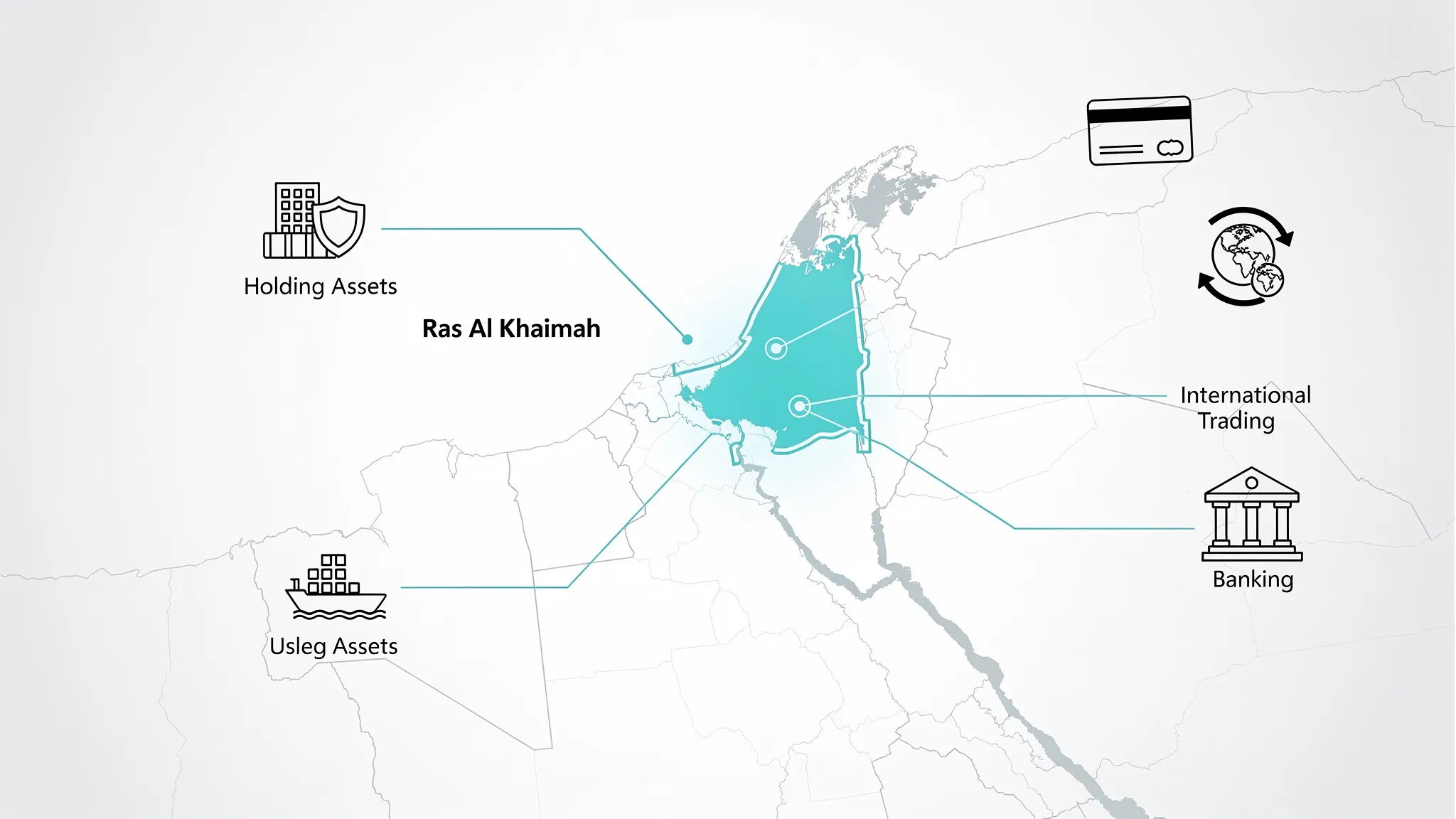
In day-to-day business language, “RAK Offshore” typically refers to an offshore company incorporated in Ras Al Khaimah under RAK ICC (Ras Al Khaimah International Corporate Centre).
A RAK offshore company is generally designed for international business and holding structures, not for operating a local onshore business in the UAE market.
To avoid confusion, keep this distinction in mind:
- Offshore (RAK ICC): commonly used for holdings, international trading (outside the UAE), IP holding, group structuring.
- Free zone: a UAE operating company with a free zone license, often used for regional operations, offices, staff, visas.
- Mainland: onshore UAE company licensed to trade directly in the UAE market (and contract with many local counterparties without structural workarounds).
For the most current registry information and official requirements, start with RAK ICC’s official site.
Key benefits of a RAK Offshore company
RAK Offshore can be a strong fit when you need a light operational footprint in the UAE but still want a recognized corporate vehicle in a stable jurisdiction.
1) Efficient holding structure for assets and subsidiaries
A common use case is to hold:
- Shares in operating companies (in or outside the UAE)
- Real estate (where permitted and structured correctly)
- Investment portfolios and other assets
This is less about day-to-day trading and more about ownership, segregation of risk, and governance.
2) No requirement for a physical office in the UAE (in most cases)
Offshore structures are generally built for non-resident operations and do not typically require leased office space like many operating licenses do. This can reduce ongoing overhead and simplify administration.
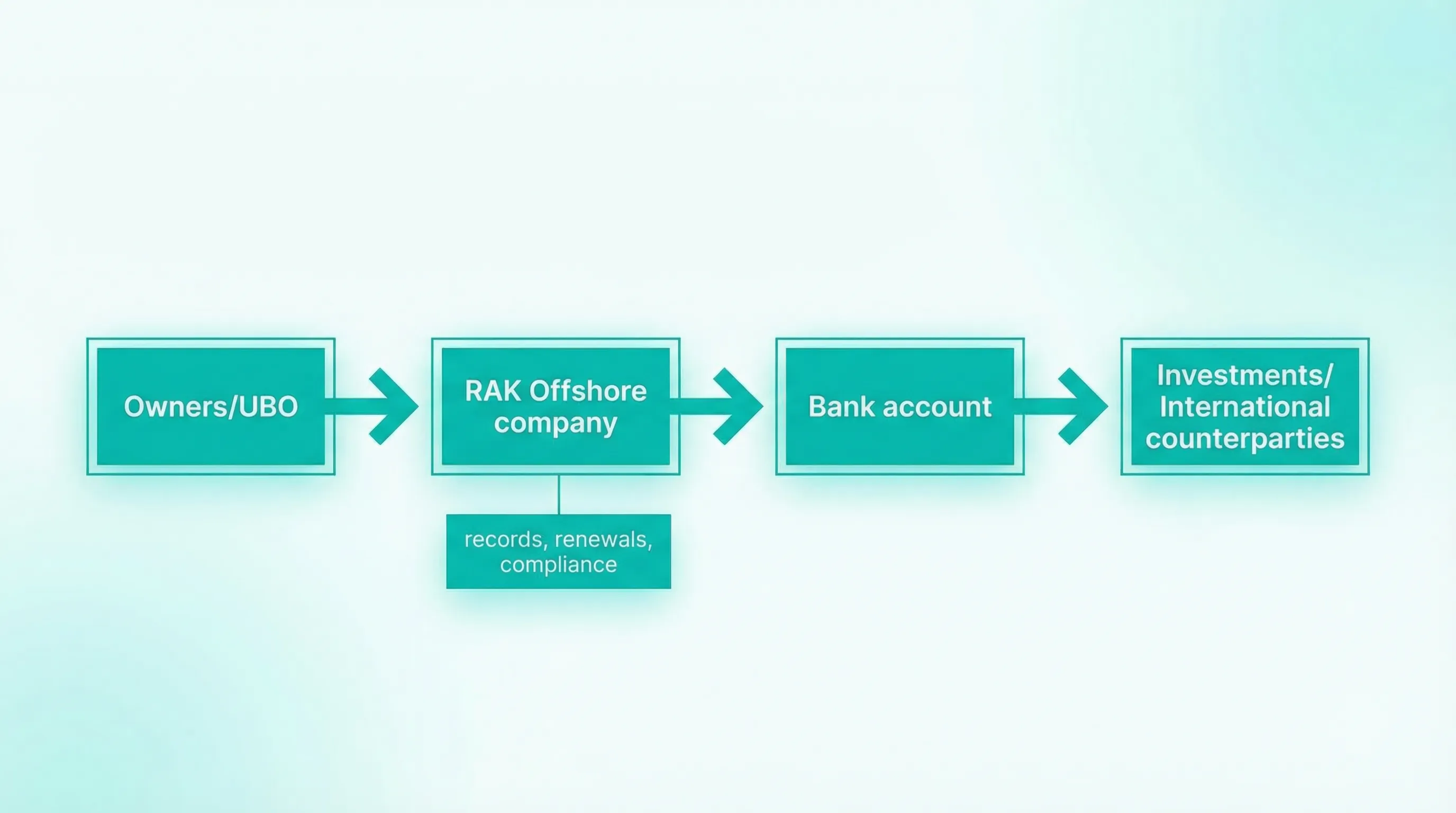
Note: you still must maintain proper corporate records and meet registry requirements through the approved channel (commonly via a registered agent).
3) Simple corporate governance for international use
For group structures, an offshore entity can make it easier to:
- Formalize shareholder agreements
- Centralize ownership and control
- Add and remove shareholders cleanly
- Document decision-making through resolutions
This matters when you need to demonstrate substance of governance to banks, investors, auditors, or counterparties.
4) Legitimacy and continuity
Ras Al Khaimah is part of the UAE, a jurisdiction widely used for cross-border trade and holding structures. Many founders choose UAE entities because they want predictability in incorporation processes and ongoing administration.
5) Privacy within modern transparency rules
Offshore used to be synonymous with “anonymous.” That is not the reality in 2026.
Today, you should expect KYC/AML checks and beneficial ownership transparency requirements. The practical benefit is better described as:
- Public-facing documentation may show the company and its officers
- Regulators, registered agents, and banks will require disclosure of the ultimate beneficial owner (UBO)
In other words, you can still achieve a clean, professional structure, but not a structure designed to hide ownership.
When RAK Offshore is a good fit (and when it is not)
Good fit scenarios
RAK Offshore is often considered when you:
- Need a holding company for international assets or subsidiaries
- Want a UAE-based ownership vehicle but do not need staff, visas, or premises
- Run international trade where contracts, invoicing, and counterparties are outside the UAE
- Need a special purpose vehicle (SPV-like use) for a transaction, with proper advice
Not a good fit scenarios
RAK Offshore is usually the wrong tool if you:
- Need to trade directly in the UAE local market (common limitation for offshore)
- Need UAE residence visas tied to the company (often better suited to free zone or mainland)
- Need a full operating setup with local premises, employees, and frequent local contracting
Because restrictions and practical bank requirements can matter more than the incorporation itself, it is worth validating your exact business model before you incorporate.
RAK Offshore vs Free Zone vs Mainland (quick comparison)
| Topic | RAK Offshore (commonly RAK ICC) | UAE Free Zone | UAE Mainland |
|---|---|---|---|
| Primary use | Holding, international business, structuring | Operating business, regional hub, staff/visas | Onshore business in UAE market |
| Local UAE trading | Typically not the right structure | Possible within rules, sometimes via distributors | Yes |
| Office requirement | Often not required | Often required (flexi/office options vary) | Often required |
| Visas | Commonly not the intended route | Commonly available | Commonly available |
| Bank account | Possible but can be more scrutiny | Common, depends on activity | Common, depends on activity |
| Compliance load | Moderate (KYC, registers, renewals) | Moderate to high (license compliance, visas, etc.) | Moderate to high |
This is not legal advice, and details vary by activity, counterparties, and regulator expectations. Treat it as a decision framing tool.
RAK Offshore costs: what you pay for (and why quotes vary)
“Cost” is one of the most misunderstood parts of offshore formation, because people compare only the incorporation fee and forget the ongoing, compliance-driven costs.
Rather than quoting figures that can change and depend on the provider and your risk profile, here is a reliable breakdown of the typical cost components that drive your total.
One-time setup cost components
| Cost component | What it covers | What makes it higher or lower |
|---|---|---|
| Incorporation and registration | Creating the legal entity and issuing corporate documents | Entity type, share structure, add-ons (certified documents) |
| Registered agent / corporate services provider | Handling filing, liaison, and required administration | Service level, complexity, turnaround time |
| Due diligence (KYC/AML) | Identity checks on owners/controllers | Number of shareholders, PEP/sanctions screening complexity, jurisdictions |
| Document attestations (optional) | Certified copies and legalization for foreign use | Country where documents will be used, embassy/MOFA processes |
Ongoing annual cost components
| Ongoing cost | What it covers | Common pitfalls |
|---|---|---|
| Annual renewal | Keeping the company in good standing | Missing deadlines leads to penalties and operational disruption |
| Compliance maintenance | Updating registers and records, ownership changes, filings (as applicable) | Not reporting changes promptly, inconsistent records across bank and registry |
| Accounting support (if needed) | Maintaining records and substantiating transactions | Assuming “offshore” means “no records” |
| Tax registrations/filings (as applicable) | Corporate tax and other filings depending on activity and status | Ignoring filing obligations because revenue is “outside the UAE” |
The biggest “hidden” cost driver: bankability
For many founders, the real project is not incorporation. It is opening and maintaining banking.
Banks may request:
- Clear business model and counterparties
- Contracts and invoices
- Source of funds and source of wealth documentation
- Corporate structure chart and rationale
If your structure is unclear or your documentation is inconsistent, time costs and delays can exceed the incorporation fee.
If bank account opening is essential, treat it as a workstream from day one, not as an afterthought.
Compliance obligations for RAK Offshore (what to expect in 2026)
Offshore companies are not “set and forget.” Compliance is generally lighter than an operating company with staff and premises, but it is still real.
1) KYC/AML and ongoing monitoring
You should expect identity verification and screening at incorporation and potentially on an ongoing basis (especially when ownership or control changes).
This aligns with the UAE’s broader AML framework. A helpful starting point for the national regulator context is the UAE Ministry of Economy AML pages (policy and ecosystem references are often cross-linked across federal sites).
2) Beneficial ownership (UBO) information
UAE entities are generally expected to maintain and provide ultimate beneficial owner details through required channels.
Practically, this means:
- Your registered agent and bank will request UBO details
- Changes in ownership or control should be documented and updated promptly
3) Corporate records and governance hygiene
Even if you have no physical office, you should keep orderly records, typically including:
- Register of shareholders and directors
- Share certificates (if applicable)
- Resolutions approving key actions (bank account opening, investments, dividends)
- Basic accounting records that support transactions
This is not only “compliance,” it is what makes the company usable with banks, auditors, and counterparties.
4) Economic Substance and related notifications (case-by-case)
Economic Substance Regulations (ESR) concepts have evolved over recent years, and the practical question today is usually:
- Are you conducting a “relevant activity” (as defined by the rules applicable to your entity)?
- If yes, do you have notification and/or reporting obligations?
Because this depends heavily on what the company actually does (and earns), it is best handled as a structured assessment rather than a guess.
5) UAE Corporate Tax considerations
The UAE Corporate Tax regime is now established. Whether your RAK offshore company has registration and filing obligations can depend on its status and activities, even if it is not generating large profits.
For authoritative reference on the regime and definitions, use the Federal Tax Authority (FTA) resources.
Important: do not assume “offshore” automatically means “tax-free” or “no filing.” The correct position depends on facts, elections, and how the company is used.
6) VAT is usually activity-driven
VAT registration is generally triggered by taxable supplies and thresholds, not by the label “offshore.” Many offshore holding companies do not make taxable supplies in the UAE, but if your structure does, you need proper advice.
Common compliance mistakes (and how to avoid them)
Mistake 1: Choosing offshore when you actually need an operating license
If you need visas, premises, staff, or local UAE contracting, offshore is often the wrong foundation. Fixing it later typically means restructuring and duplicating costs.
Mistake 2: Treating documentation as a formality
Banks and counterparties increasingly require consistency across:
- Corporate documents
- Ownership disclosures
- Contracts and invoices
- Financial flows
A clean paper trail is a strategic asset.
Mistake 3: Overcomplicating the structure too early
Multiple layers, nominee arrangements, or unclear control logic can slow banking and increase compliance reviews.
If you need nominee services for legitimate governance or confidentiality reasons, make sure it is implemented transparently and compliantly, and that it will still be bankable.
Mistake 4: Ignoring ongoing obligations until renewal time
Ownership changes, new directors, and new activities should be reflected promptly. “We will update it later” is one of the most common causes of bank friction.
A practical decision checklist for founders
Use this as a quick sanity check before you proceed.
| Question | If “yes” | If “no” |
|---|---|---|
| Do you need UAE visas linked to the company? | Consider free zone or mainland | Offshore may still fit |
| Will you trade directly with UAE customers inside the UAE? | Mainland (or a compliant operating structure) | Offshore may fit |
| Is your main need a holding/ownership vehicle? | Offshore is often suitable | Consider operating entities |
| Do you need a bank account from day one? | Plan for a bankability-first setup | Offshore may be simpler |
| Do you have clear UBO/source-of-funds documentation? | Faster compliance and banking | Expect delays and extra requests |
Frequently Asked Questions
Is RAK Offshore the same as a free zone company? No. “RAK Offshore” typically refers to an offshore entity (commonly via RAK ICC) used for holding or international business, while free zone companies are licensed operating entities designed for running a business with facilities and often visas.
Can a RAK offshore company do business in the UAE? Generally, offshore structures are not intended for direct trading in the UAE local market. If your revenue comes from UAE customers or you need onshore contracting, you should evaluate a mainland or appropriate free zone structure.
Can I open a bank account with a RAK offshore company? It can be possible, but banks may apply enhanced scrutiny depending on your activity, ownership, and transaction profile. Plan to provide clear documentation (UBO, source of funds, contracts) and expect timelines to vary.
Do RAK offshore companies have Corporate Tax obligations in the UAE? Potentially, yes. Obligations can depend on activities, taxable income, and the entity’s circumstances. Verify requirements using the FTA’s guidance and obtain professional advice for your specific fact pattern.
Do I need to rent an office for RAK Offshore? Offshore entities are typically structured to avoid physical office requirements, but you still need proper registered-agent support and must maintain corporate records and compliance obligations.
Set up RAK Offshore correctly (and keep it compliant)
RAK Offshore can be a powerful tool when it matches your real business needs: a clean holding structure, international operations, and a compliance-forward setup that remains bankable.
If you want help choosing the right UAE structure (offshore vs free zone vs mainland), preparing a bank-ready file, and staying compliant after incorporation, Alldren provides expert-led, transparent corporate services for establishing and managing companies in the UAE, with direct access to senior experts.
Explore your options at Alldren and request a structured assessment based on your activity, ownership, and compliance requirements.


