

Foreign founders choose Ras Al Khaimah because it can be one of the most operationally practical ways to establish a UAE base without overbuilding on day one. But in 2026, “incorporation” is not the hard part. The hard part is getting the structure right so your company is bankable, tax-ready, and defensible under modern AML, corporate tax, and substance expectations.
This guide explains how RAK free zone company formation works for non‑UAE founders, what you need to decide before you apply, and where setups typically fail.
What “RAK Free Zone” means (and what it doesn’t)
When founders say “RAK free zone,” they typically mean forming an operating company in RAKEZ (Ras Al Khaimah Economic Zone) under a Free Zone licence.
A RAK free zone entity is generally used to run an actual business (services, trading, e‑commerce, light industrial), hire staff, and obtain UAE residence visas (subject to the chosen package and immigration approvals).
It is not the same thing as a RAK ICC (offshore) company, which is usually positioned for holding and structuring rather than day-to-day UAE operations.
If you are still deciding between free zone, mainland, and offshore, Alldren’s overview on UAE structure options is a useful starting point.
Who RAK free zone company formation is a good fit for
RAK free zone formation is often a strong match when you want UAE presence with manageable overhead and a clear compliance perimeter.
Common fit scenarios include:
- International service providers who contract globally and want a UAE operating entity.
- E‑commerce and trading businesses that can operate through compliant channels for imports, warehousing, and distribution.
- SMEs that need visas for founders and key staff.
- Groups that want a UAE entity as part of a wider structure (for example, a UAE operating company under a holding company, where appropriate).
The key is aligning the licence, operating model, and governance with what banks and tax authorities expect your business to look like in practice.
The 6 decisions foreign founders must make before filing
Most delays (and expensive rework) come from treating formation as a form-filling exercise. Before you submit anything, decide the points below.
| Decision you must make | Why it matters in 2026 | Typical foreign-founder mistake |
|---|---|---|
| Licensed activity | Drives what you can invoice for, what contracts you can sign, and how banks assess your risk profile | Picking a “near enough” activity that later conflicts with your actual invoices |
| Where your customers are | Impacts whether you may need additional permissions to sell into the UAE mainland and how VAT may apply | Assuming a free zone licence automatically means “sell anywhere in the UAE” |
| Visa plan | Determines how many residence visas you may be eligible for and what facilities you need | Incorporating first, then discovering the package does not fit hiring or relocation plans |
| Office and address strategy | Directly affects bank onboarding and substance credibility | Using a generic flexi-desk address that banks treat as high-risk |
| Banking readiness pack | Banks require coherent KYC, source-of-funds, and a clear operating narrative | Waiting until after licence issuance to build documentation and contracts |
| Tax and accounting posture | Corporate Tax registration, VAT thresholds, and accounting evidence are now operational requirements | Treating bookkeeping and tax registration as “later” tasks |
For a broader planning flow, see Alldren’s step-by-step guide on company formation in a UAE free zone.
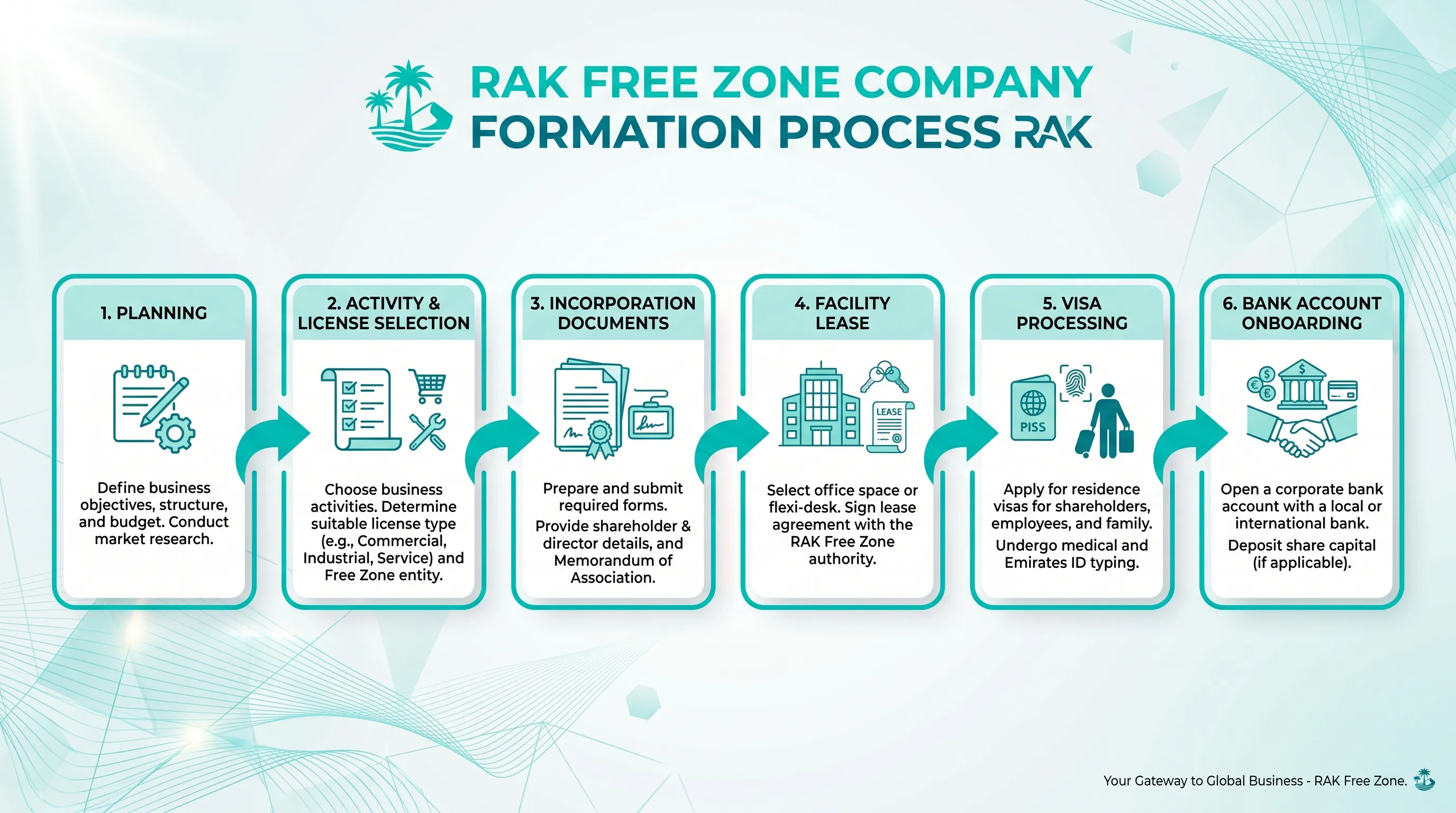
RAK free zone company formation: a practical, bank-aware process
Below is a formation sequence that reflects what foreign founders actually experience, including the downstream banking and compliance steps that should run in parallel.
1) Define the operating model first (not just the licence)
A “business model narrative” is now a core compliance asset. You should be able to explain:
- What you sell, to whom, and in which countries.
- How you get paid (payment processors, invoicing terms, currency flows).
- Where delivery happens (remote, UAE-based, warehousing, third-party logistics).
- Who will manage operations day-to-day and where that person will be located.
This narrative should match your website, contracts, invoices, and the activity on your licence.
2) Choose the right licence scope and legal form
Licence scope should be selected for the work you will actually invoice for over the next 12 to 24 months, not just for day one.
If you expect the business to expand into multiple lines (for example, services plus distribution), it is often better to structure for that upfront rather than forcing mid-year amendments.
3) Prepare incorporation and KYC documentation to an AML standard
Expect robust due diligence on:
- Shareholders and Ultimate Beneficial Owners (UBOs).
- Source of funds and (in many cases) source of wealth.
- Prior business history, especially if the activity is regulated, high-volume, or cross-border.
This is not just about the free zone. The same pack will be reused for banking, payment processors, counterparties, and sometimes marketplace onboarding.
4) Align your facility choice with your banking plan
Many founders optimize for the cheapest address, then discover that banking becomes the most expensive hidden cost.
In 2026, UAE banks are increasingly sensitive to “cluster-risk” addresses and low-substance footprints. Alldren has covered this trend in detail in UAE corporate banking address requirements in 2026.
A facility decision should be made with these practical questions in mind:
- Will the lease be in the company’s legal name and clearly link to your licence?
- Can you evidence actual use (access logs, signage, meeting records, staff presence), if asked?
- Does the setup support your visa plan?
5) Run visa processing as a coordinated workstream
For many foreign founders, the company is formed primarily to enable residence and operational banking. Visa steps should be planned alongside:
- Signatory powers and who will attend bank meetings.
- Emirates ID timing (often relevant for bank onboarding).
- Hiring timeline if you need staff quickly.
If you want an overview of the moving parts, see UAE residency through business.
6) Treat bank account opening as a project (not an application)
Corporate banking is a compliance assessment. The strongest applications are consistent across documents, behavior, and operating reality.
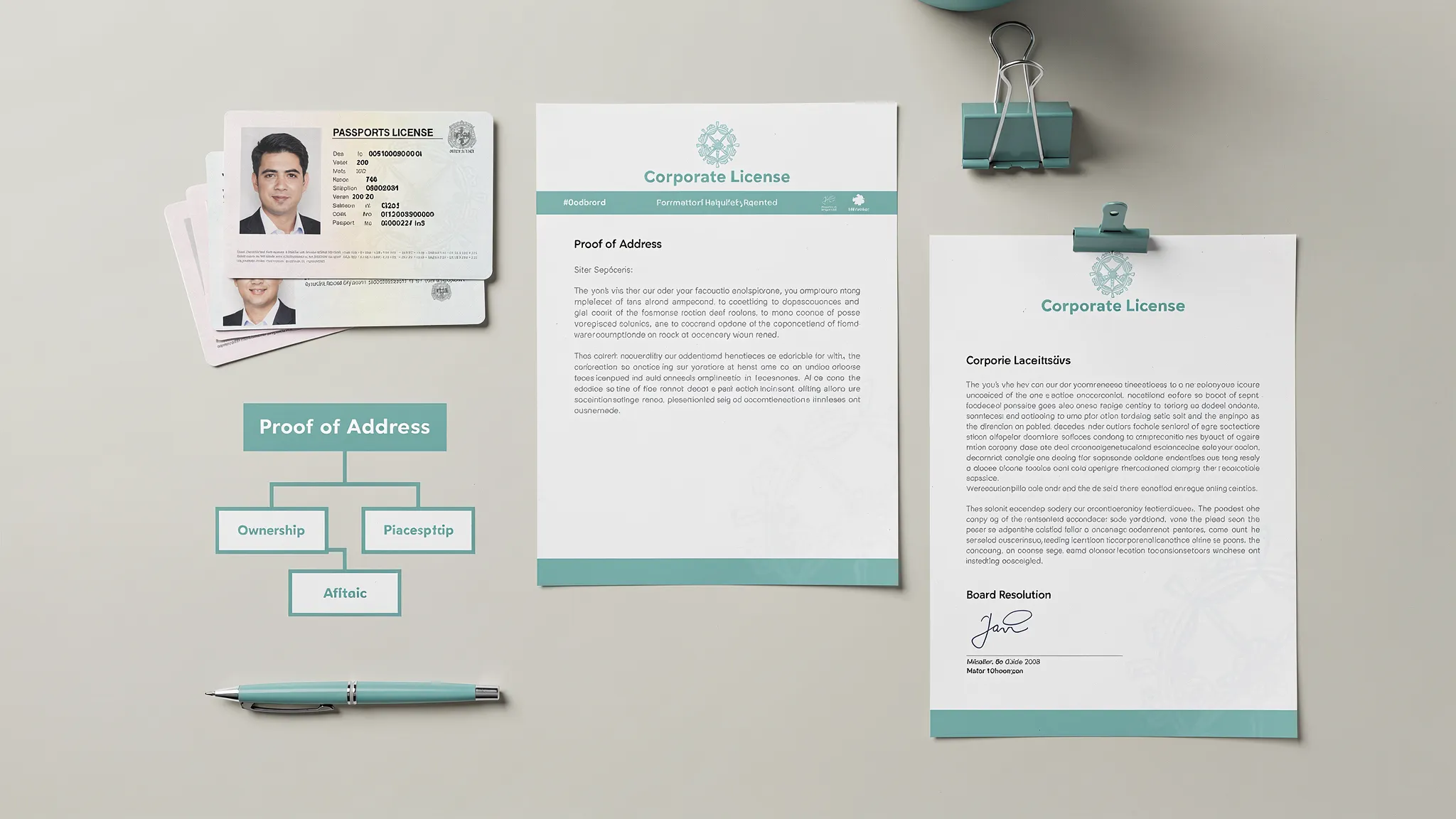
A good bank-ready pack commonly includes:
- Corporate documents (licence, incorporation certificates, registers).
- Ownership chart with UBO clarity.
- A one-page business profile and explanation of transaction flows.
- Contracts, invoices, pipeline evidence, or platform proofs.
- Source-of-funds evidence aligned to the expected account activity.
Alldren’s corporate bank account opening checklist is a practical reference for what banks typically request.
The “foreign founder” banking issue: substance is now part of KYC
Foreign founders are often surprised that two companies with the same licence can receive very different banking outcomes.
In 2026, banks increasingly test for a credible local footprint, including the reality of management and premises. This is consistent with broader regulatory expectations around adequate substance and operational coherence.
Two practical implications:
- If decision-making and execution are obviously happening outside the UAE, banks may challenge the setup as a shell or “form over substance.”
- If your address looks like a mass virtual-office cluster, you may be treated as higher risk even if your business is legitimate.
This is one reason governance and documentation discipline matter from day one, not only after you “start trading.”
Tax and compliance fundamentals you should plan for on day one
RAK free zone companies are not “set and forget” entities. Corporate tax and reporting expectations have turned compliance into a core operating function.
Corporate Tax: plan for classification, evidence, and auditability
At a minimum, most companies must consider:
- Corporate Tax registration and filing obligations.
- Whether the company can, or should, pursue Qualifying Free Zone Person (QFZP) treatment (this is fact-specific and depends on meeting conditions).
- Whether Small Business Relief is relevant, and the trade-offs involved.
Alldren’s article on UAE Small Business Relief in 2026 explains an important planning point: Small Business Relief is not compatible with QFZP status, so founders should avoid accidentally building a structure that conflicts with their intended tax position.
For a broader overview, see UAE tax in 2026: what businesses must know.
VAT: cross-border founders often misread the threshold
If you provide services internationally, it is easy to assume VAT is irrelevant. In practice, VAT registration can still be triggered depending on your taxable supplies and the VAT rules applicable to your fact pattern.
If you need a technical baseline, start with the UAE Federal Tax Authority’s official site: FTA.
UBO updates and change management are time-sensitive
Foreign founder setups often evolve quickly: new investors, new directors, new addresses, new activities.
The UAE has strict expectations around keeping beneficial ownership and corporate records current. Treat corporate secretarial work as a control function, not admin. Alldren’s practical overview of company secretarial services for UAE compliance outlines what that looks like in day-to-day operations.
Common pitfalls in RAK free zone company formation (and how to avoid them)
Mistake 1: Choosing a licence that cannot support your real contracts
If your invoices describe work outside the scope of the licensed activity, it can create problems with:
- Bank compliance and transaction monitoring.
- VAT and corporate tax position support.
- Counterparty onboarding and procurement checks.
Fix: map the activity to your actual statement of work and the language you will put on invoices.
Mistake 2: Underestimating “place of management” and shadow director optics
Foreign founders frequently manage everything remotely. That may be commercially normal, but it can create tax and governance risk if the company looks like it is controlled entirely outside the UAE.
If this concern applies to your situation, Alldren’s analysis on Place of Effective Management risks is a strong primer.
Fix: establish a governance rhythm that matches reality and is documentable (board decisions, signing authority, management presence, and clear roles).
Mistake 3: Treating bookkeeping as optional until “we hit revenue”
Banks and tax authorities increasingly expect clean, timely records. Also, operational partners (payment processors, marketplaces, enterprise clients) may request financials and tax registrations earlier than you expect.
Fix: set up accounting ownership, invoice standards, and a compliance calendar immediately after licensing.
Mistake 4: Planning visas and banking sequentially
A common failure mode is: licence issued, then visa, then bank. In reality, timelines and dependencies can overlap, and delays compound.
Fix: run licensing, immigration, banking, and tax-readiness as coordinated workstreams.
How Alldren supports foreign founders in Ras Al Khaimah
Alldren provides expert-led, transparent corporate services for establishing and managing UAE companies, including Ras Al Khaimah free zone formations. Support typically includes:
- Structuring and jurisdiction fit (so the licence matches your operating model)
- Incorporation execution and documentation quality control
- Bank account opening support and bank-ready packaging
- UAE residency visa processing
- Bookkeeping and tax registration coordination
- Ongoing compliance management and corporate governance support
If you want a formation plan that is designed around bankability and 2026 compliance realities (not just fast licence issuance), you can start at alldren.com.
Frequently Asked Questions
Can a foreigner own 100% of a RAK free zone company? In most free zone setups, foreign founders can generally hold 100% ownership, subject to the specific free zone rules and the activity. Your exact structure should be confirmed against your licence scope and any sector-specific requirements.
Do I need a physical office for RAK free zone company formation? Free zones offer different facility options, but banking and substance expectations in 2026 often make ultra-light “virtual” footprints harder to support. Plan your address and lease with bank onboarding in mind.
How long does RAK free zone company formation take? Timelines vary based on activity, due diligence complexity, document readiness, and visa and banking workstreams. In practice, founders should plan for variability and avoid making commitments that assume a guaranteed bank account date.
Will a RAK free zone company automatically get 0% corporate tax? Not automatically. Corporate Tax outcomes depend on your classification, elections, and compliance with relevant conditions (including, in some cases, free zone qualifying requirements). You should obtain tailored tax advice for your fact pattern.
What documents do banks usually ask for after I form the company? Typically: company documents, UBO and management KYC, a clear business profile, source-of-funds evidence, and commercial proof (contracts, invoices, pipeline, or platform records). Requirements vary by bank and risk profile.
Ready to form a RAK free zone company with fewer surprises?
If you are a foreign founder and want your RAK free zone company formation handled with senior oversight, transparent pricing, and a bank-aware compliance approach, Alldren can help.
Contact Alldren to scope the right licence, structure, and onboarding plan at alldren.com.


