

Choosing the right free zone is less about picking the cheapest headline price and more about matching your license, facility, and compliance obligations to how you actually plan to operate. Ras Al Khaimah (RAK) is a common choice for founders who want a pragmatic setup path, flexible facility options, and a cost structure that can stay efficient as the company grows.
This guide breaks down what most people mean when they search for RAK free zone companies: what you can do under the license (activities), what you should budget for (cost drivers), and what “renewal” really involves each year.
What counts as a RAK free zone company?
In practice, “RAK Free Zone” usually refers to companies registered in Ras Al Khaimah’s free zone ecosystem, most commonly under RAKEZ (Ras Al Khaimah Economic Zone).
A RAK free zone company is a UAE legal entity (or branch) licensed by a free zone authority, with rules that differ from mainland UAE in areas like where you can lease space, how you sponsor visas, and how you can trade within the UAE.
Common legal forms you will see
- FZE (Free Zone Establishment): typically a single-shareholder company.
- FZCO / FZC (Free Zone Company): typically multiple shareholders.
- Branch: a branch of an existing UAE or foreign company.
The best fit depends on ownership, future fundraising plans, substance needs, and whether you are setting up a new vehicle or extending an existing group.
The key operating constraint to plan for
Most free zone companies are structured primarily for:
- International trade and cross-border services
- B2B contracting
- Holding and IP ownership
- UAE operations that do not require direct onshore retailing (or that use compliant routes to access the mainland)
If you intend to sell directly into the UAE mainland market (for example, contracting directly with UAE mainland consumers or performing certain regulated activities), you generally need the correct approach, such as a mainland entity, an approved distribution model, or other compliant structure depending on the activity.
RAK free zone company activities (what you can do)
Your license “activity” is not a marketing description, it is a regulatory category. It impacts what you can invoice for, what your bank expects to see, what compliance filings you may need, and whether you can hire and sponsor staff.
RAK free zone authorities maintain activity catalogues. Always verify your exact activity list with the authority before incorporating.
Typical activity families
Most founders considering RAK free zone companies fall into one of these buckets:
Service and consultancy activities
Common for professional services, management consulting, marketing, IT services, design, and other B2B services.
Best for: founders billing for time, expertise, retainers, or project delivery.
Trading and commercial activities
Used for import, export, distribution outside the mainland, and some forms of wholesale.
Best for: businesses with physical goods, shipping, and supplier relationships.
E-commerce and digital trading
Often used for online businesses selling goods or services. The exact permissions (and whether you can store inventory locally) depend on the license and facility.
Best for: online-first operators who need a UAE base, payment processing, and visas.
Industrial and manufacturing activities
RAK is known for industrial capability. Industrial licensing can involve additional requirements depending on the activity, facility, and approvals.
Best for: manufacturing, assembly, packaging, and related operations.
Holding and investment structures
Holding activities are typically used for owning shares, intellectual property, or group assets.
Best for: group structuring, asset holding, and clean separation of risks.
Regulated activities and “grey areas”
Some activities require additional approvals from UAE regulators or specific qualifications (for example, financial services, certain health-related activities, education, and other regulated professions). If your business touches a regulated area, you should treat the license selection as a compliance project, not a formality.
For authoritative references and updates, start with the relevant free zone authority and UAE federal guidance:
RAK free zone company costs (what you should budget for)
People often ask for “the cost” of a RAK free zone company, but the total cost is the sum of several moving parts. Your actual spend depends on:
- License type and number of activities
- Facility (flexi desk, office, warehouse, land)
- Number of visas required
- Whether you need a complex structure (holding, multi-entity, nominees, etc.)
- Compliance posture (accounting, tax registrations, economic substance expectations)
The main cost components
Use this table as a budgeting checklist. Exact fees change over time and vary by package, facility, and promotions, so treat it as a framework to estimate, then confirm.
| Cost component | What it typically covers | What drives the price up | Notes for planning |
|---|---|---|---|
| Registration and incorporation | Company registration, initial approvals, issue of incorporation documents | More complex structures, additional approvals | Often paid upfront during setup |
| License fee (annual) | Right to conduct the licensed activities | Additional activities, higher-risk categories | Renewed yearly |
| Facility / lease | Flexi desk, office, warehouse, or land lease | Larger space, premium locations, industrial requirements | Facility choice can determine visa quota |
| Immigration establishment file | File to sponsor visas (where applicable) | Additional channels and processing | Usually required if you need visas |
| Visas and Emirates ID | Entry permit, medical, biometrics, Emirates ID | More employees, faster processing | Renewal cycles vary by visa type |
| Corporate banking support | Assistance compiling and presenting bank onboarding documents | Complex ownership, multi-country profile | Banking approval is not guaranteed |
| Accounting and compliance | Bookkeeping, financial statements, tax and regulatory support | Volume of transactions, VAT scope, audit needs | Often underestimated in year 1 |
| Professional advisory | Structuring, governance, ongoing corporate secretarial | Group structuring, nominee arrangements | Use reputable advisors and document decisions |
A practical way to estimate total cost (without guessing numbers)
If you are comparing RAK free zone companies to other free zones, estimate using a “scenario budget” instead of searching for a single sticker price:
- Lean setup: service license + flexi desk + 0 to 1 visa
- Operating setup: service or trading license + small office + 2 to 6 visas
- Substance setup: larger office/warehouse + multiple visas + heavier compliance and reporting
This approach prevents a common issue: choosing the lowest upfront package, then realizing your visa quota, facility, or activity scope does not match your operating needs.
Costs founders forget to include
The setup invoice is rarely the whole story. Plan early for:
- Document attestation and legalization (if needed for certain uses)
- VAT registration and ongoing filings (if your business meets UAE VAT requirements)
- Corporate tax compliance and position (even if you expect preferential treatment, you still need to document eligibility and file as required)
- Annual bookkeeping and financial reporting
- Updates to UBO and corporate records when ownership or management changes
Renewals for RAK free zone companies (what happens every year)
Renewal is not just “pay the license fee again.” A clean renewal requires your company to remain administratively and legally in good standing.
What typically must be renewed
Most RAK free zone companies should expect some combination of:
- Trade/license renewal: the core annual renewal
- Facility/lease renewal: flexi desk or office/warehouse lease
- Immigration-related renewals: establishment card or related files (where applicable)
- Visas and Emirates ID renewals: based on visa validity
If your company has employees, investors, or banking relationships, renewals also become a governance moment: it is when outdated records and missing filings tend to surface.
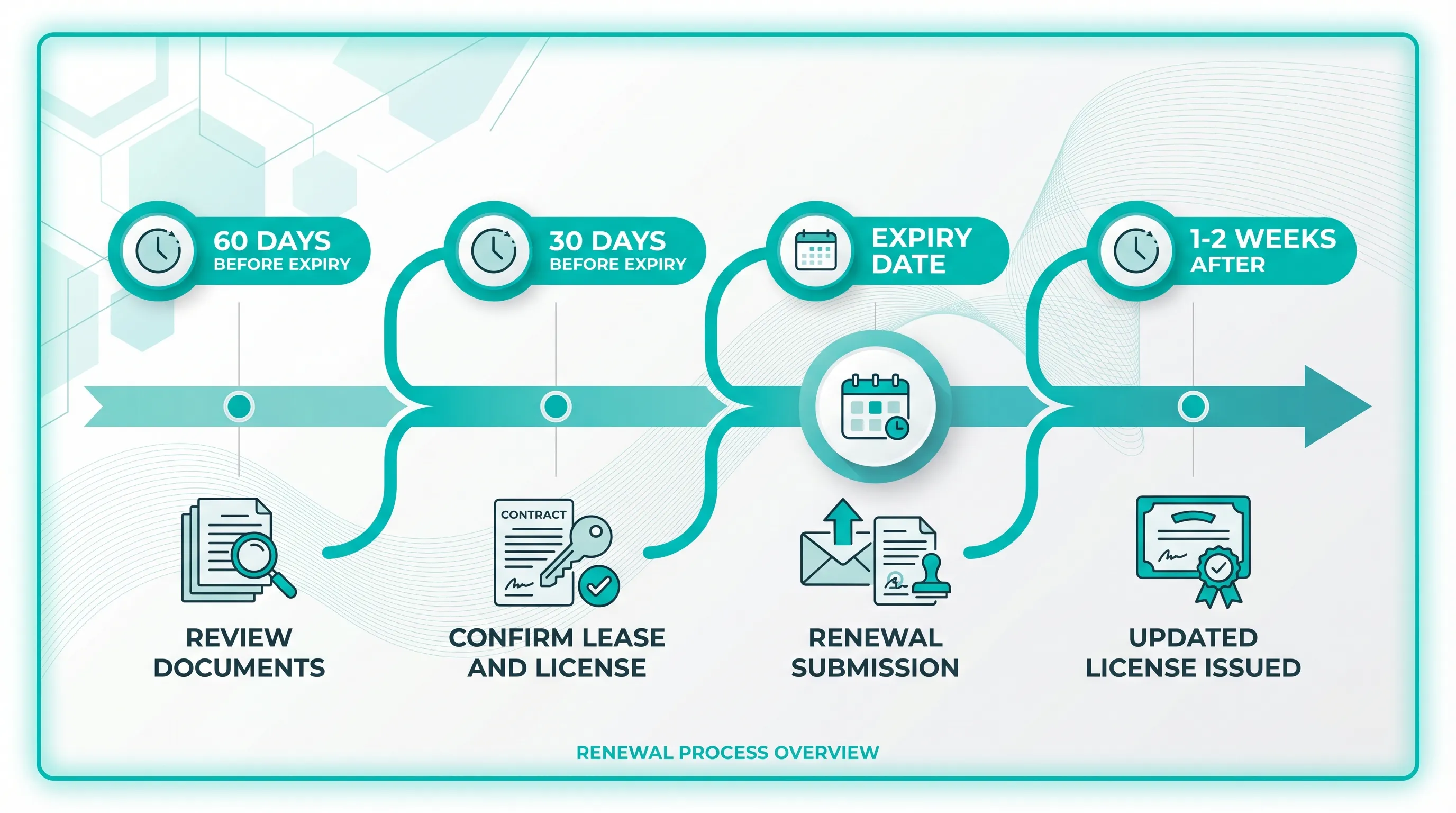
Renewal checklist (operational and compliance)
Before you renew, ensure you can confidently answer:
- Are the company’s activities still accurate for what you invoice?
- Is the lease/facility valid and aligned with your visa needs?
- Are shareholder and manager details up to date?
- Do you have a bookkeeping trail that supports your invoices and bank transactions?
- If applicable, are your tax registrations and filings current?
Depending on the authority’s requirements and your company profile, you may also need to prepare financial statements or additional declarations.
Timing and penalties
Exact timelines and grace periods vary. The main best practice is simple: start the renewal process early enough to avoid an expired license.
An expired license can create cascading problems, such as:
- Issues renewing visas or work permits
- Banking friction (some banks request updated licenses periodically)
- Contracting delays with customers who require valid corporate documents
Tax and compliance considerations (often missed in early planning)
Even if your immediate question is “costs and renewals,” the smarter question is whether the structure you are choosing will remain compliant as you grow.
Corporate tax in the UAE
The UAE has a federal corporate tax regime. Free zone companies may qualify for preferential treatment in certain cases, but eligibility depends on meeting conditions and maintaining documentation.
Because rules and guidance can evolve, anchor your planning to official sources and avoid relying on social media summaries. Start here:
VAT and customs
VAT may apply based on your taxable supplies and thresholds, regardless of whether you are in a free zone. Trading companies should also understand customs and import rules that depend on how goods move and where they are sold.
Banking reality check
A RAK free zone license can support corporate bank account opening, but it does not guarantee it. Banks assess:
- UBO transparency and source of funds
- Business model clarity and contracts
- Expected transaction volume and counterparties
- Jurisdictions involved
Preparing a clear compliance narrative and documentation pack often matters as much as the license itself.
How to choose between RAK and other UAE free zones
RAK is often shortlisted for its practical offerings and industrial footprint, but the “best” free zone depends on your operating plan.
Consider RAK when:
- You want a cost structure that can stay efficient with flexible facility options
- You need trading or industrial pathways and may grow into warehousing or light manufacturing
- You value straightforward administration and renewal processes
Consider alternatives when:
- Your activity is tightly regulated and best supported by a specialized free zone
- Your customers require a specific jurisdiction or authority for vendor onboarding
- You need a particular office location as part of your sales strategy
If you are unsure, it is usually better to design the structure around your revenue model, contracting flow, and compliance requirements first, then pick the jurisdiction.
Frequently Asked Questions
How much do RAK free zone companies cost in total? The total cost is the combination of incorporation, annual license, facility/lease, and (if needed) visa and compliance costs. The exact amount depends on your activities, facility type, and visa needs, so budget by scenario (lean, operating, substance) and confirm fees with the authority.
What activities are allowed for RAK free zone companies? Activities depend on the free zone’s official activity list and your chosen license category (service, trading, industrial, holding, and more). Always align the activity with what you will actually invoice for and verify regulated activity requirements.
How often do I need to renew a RAK free zone license? Licenses are typically renewed annually. You may also need to renew your facility lease and manage separate renewal cycles for visas and Emirates ID.
Can a RAK free zone company do business in mainland UAE? Free zone companies can work with mainland counterparties, but direct mainland trading and certain onshore activities can require specific compliant arrangements. The correct approach depends on your activity and contracting model.
Do RAK free zone companies need accounting and tax compliance? Yes. Even small companies should maintain proper bookkeeping and be prepared for corporate tax and VAT obligations where applicable, based on UAE federal rules and your business profile.
Set up and renew your RAK free zone company with the right structure
If you are comparing RAK free zone companies and want a setup that stays clean at renewal time, focus on getting three things right from day one: the activity scope, the facility and visa plan, and the compliance workflow that matches your real operations.
Alldren supports UAE company setup and structuring, ongoing compliance management, corporate governance, bank account opening support, and residency visa processing, with transparent, upfront pricing and direct access to senior experts. Explore your options at Alldren and align your RAK setup with how you plan to operate in 2026 and beyond.


