
Searching for a company registration number in UAE sounds simple, but the number you need depends on the document, authority, and purpose. A bank may ask for a CR number, a foreign client may ask for a company registration number, a marketplace may request a trade license number, and the Federal Tax Authority may require a tax identifier.
The safest approach is not to guess. Start with the latest corporate documents, identify the issuing authority, then match the number to the request. Sending the wrong identifier can delay bank onboarding, vendor approval, tax registration, invoicing, or visa processing.
This guide explains where to find the right number, how to verify it, and how to organize your UAE company identifiers so they are ready for banks, clients, and regulators.
Quick answer: start with the current trade license
For most active UAE companies, the first document to check is the current trade license. It usually shows the legal name, licensing authority, license number, issue date, expiry date, permitted activities, and sometimes a commercial registration or register number.
If the company is a free zone or offshore entity, you may also need the certificate of incorporation or certificate of registration. If the request comes from a tax authority or an invoice system, the number they need may be your Tax Registration Number, not your company registration number.
| If you are asked for | Start with this document | Number likely required |
|---|---|---|
| Company registration number | Trade license or certificate of incorporation | Registration number, company number, or commercial register number |
| CR number | Mainland commercial register extract or trade license | Commercial registration number, if issued separately |
| Trade license number | Current trade license | License number |
| VAT or tax number | FTA certificate or EmaraTax account | Tax Registration Number, often called TRN |
| Immigration or visa file number | Establishment card or immigration file | Establishment card number, not the company registration number |
| Offshore company number | Certificate of incorporation, incumbency certificate, or registered agent file | Incorporation or registration number |
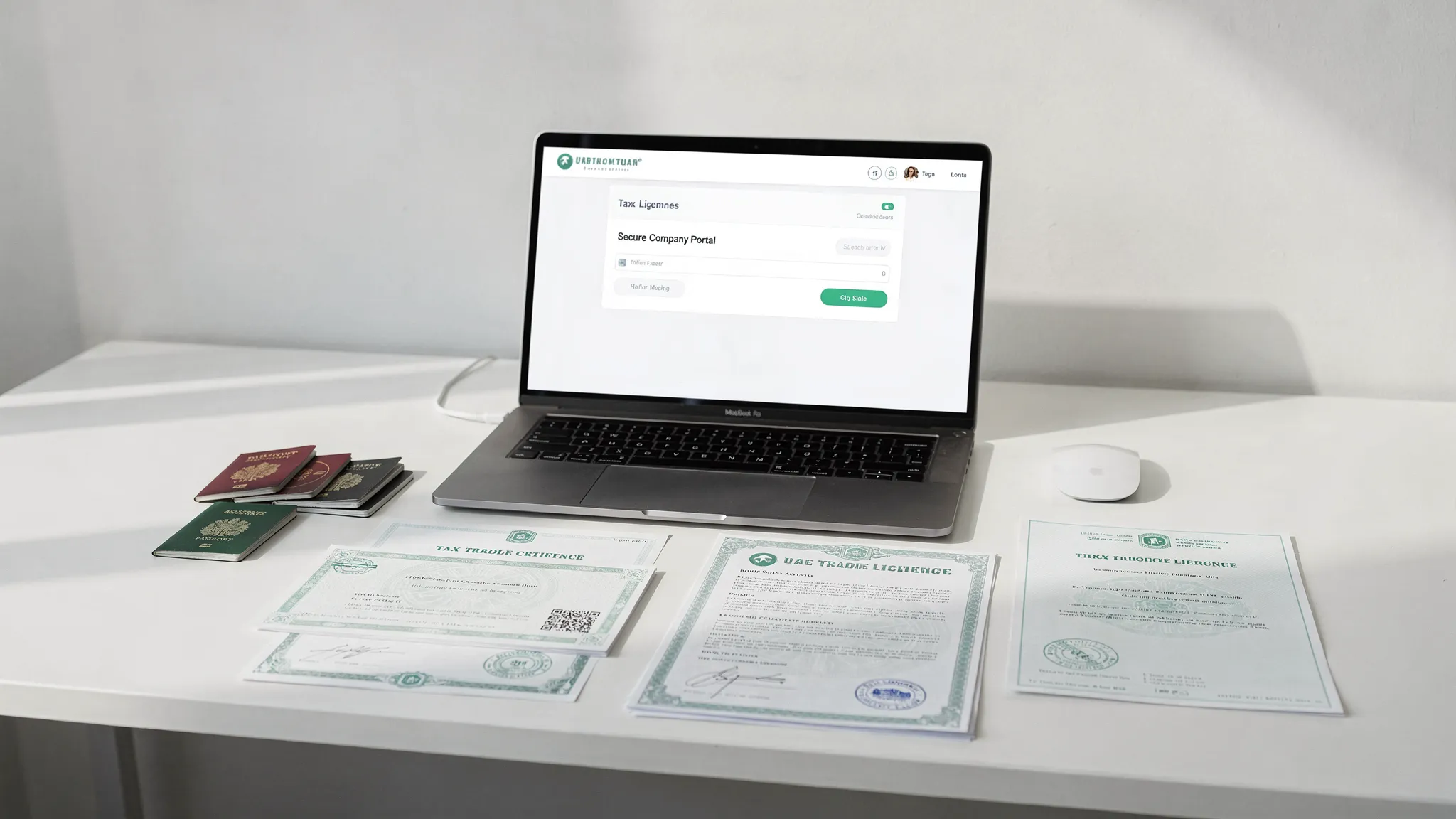
What counts as a company registration number in the UAE?
The UAE does not use one universal company number across every mainland, free zone, offshore, immigration, and tax system. Instead, each authority issues identifiers for its own purpose.
In everyday use, company registration number in UAE can mean one of the following:
- The number on the certificate of incorporation or registration
- The trade license number on the current commercial license
- The commercial register number issued by a mainland authority
- The company number shown in a free zone portal or registry extract
- The offshore incorporation number for entities such as RAK ICC, JAFZA Offshore, or Ajman Offshore
This is why context matters. If a bank asks for a registration number during corporate account opening, it normally wants the number shown on your trade license and incorporation documents. If a client is onboarding you as a supplier, the trade license number may be enough. If a tax form asks for a tax number, you should provide the FTA-issued tax identifier, not the license number.
For a deeper comparison, see Alldren’s guide to company registration number vs license no in the UAE.
Step 1: identify your UAE company type
Before searching for the number, confirm what type of UAE entity you have. The document layout and terminology differ by jurisdiction.
A mainland company is licensed by the Department of Economic Development or equivalent economic authority in the relevant emirate. Its documents often include a trade license and, in some cases, a commercial register reference.
A free zone company is registered with a free zone authority such as RAKEZ, DMCC, IFZA, JAFZA, Meydan, ADGM, DIFC, or another zone. The number may appear as License No., Registration No., Company No., or a similar label.
An offshore company is registered with an offshore registry and generally does not have a UAE operating trade license. Its key number is usually on the certificate of incorporation, certificate of registration, or a certificate of incumbency. Offshore companies are often used for holding, SPV, asset ownership, or international structuring purposes, but they are not the same as mainland or free zone operating companies.
A branch may have its own UAE license or registration details separate from the foreign parent company. Do not use the parent company’s foreign registration number unless the requester specifically asks for parent company details.
Step 2: check the latest trade license
For an operating UAE company, the current trade license is the most practical starting point. Look for labels such as:
License No.Commercial License No.Register No.Commercial Registration No.Registration No.Company No.
Use the latest renewed license, not an old setup copy. A bank, payment processor, landlord, or corporate client will usually check the expiry date and licensed activities as well as the number itself.
Also check whether the company name, legal form, and address on the license match the information you are submitting elsewhere. Small inconsistencies, such as using a trade name in one place and the legal name in another, can cause KYC delays.
If your business is still being set up and you are not sure which documents you should receive, Alldren’s company registration in the UAE guide explains the broader setup workflow.
Step 3: check the certificate of incorporation or registration
If the requester is asking for proof that the legal entity exists, the certificate of incorporation or certificate of registration is often more relevant than the trade license.
This document typically confirms:
- The legal name of the company
- The registration or incorporation number
- The date of incorporation
- The issuing authority or registry
- The legal form of the entity
Free zone companies often have both a trade license and a certificate of incorporation. The license confirms permitted business activities. The certificate confirms the legal entity’s creation.
For offshore companies, the certificate of incorporation is usually the primary document. If the company is older or being reviewed by a bank, a certificate of incumbency or good standing may also be requested to confirm current status, directors, shareholders, or continued existence, depending on the jurisdiction and authority.
Step 4: log in to the authority portal or contact the issuing authority
If you cannot find the number on your documents, the issuing authority’s portal is usually the next place to check. Many mainland and free zone authorities allow company administrators, shareholders, managers, or appointed service providers to download current licenses and certificates.
Where public search is available, tools such as the National Economic Register may help verify commercial license information. Coverage and displayed fields can vary, so you should still rely on the official license or registry document for formal submissions.
For tax identifiers, use the Federal Tax Authority or EmaraTax records. A TRN is not the same as a trade license number, but it is often requested for VAT invoicing, tax returns, customs, and certain B2B onboarding processes. Alldren explains this distinction in more detail in its guide to the Tax Registration Number UAE.
Step 5: match the number to the requester’s purpose
A common mistake is assuming that the same number should be used for every form. In the UAE, the correct number depends on why the requester is asking.
| Requester | Best number to provide | Practical note |
|---|---|---|
| UAE bank | License number plus incorporation or registration number | Provide the full document pack, not only the number |
| Corporate client | Trade license number or registration number | Match the legal name exactly to the license |
| Marketplace or payment processor | Trade license number | They may also ask for activities and expiry date |
| VAT-registered customer or supplier | TRN | Only VAT-registered businesses should use a VAT TRN on tax invoices |
| Immigration or PRO process | Establishment card number | This is separate from the company registration number |
| Foreign law firm or adviser | Certificate of incorporation number | They may also ask for good standing or incumbency evidence |
| Customs or import process | License and tax identifiers | Requirements depend on activity, emirate, and registration status |
If a form uses a generic international label, such as company registration number, and your UAE document only shows License No., submit the license number and attach the current trade license. If the form has a separate field for license number and registration number, use the incorporation certificate or registry extract for the registration field.
Where to find the number by jurisdiction type
The table below gives a practical starting point. Always follow the exact terminology used on your official documents.
| UAE setup type | Where to look first | What to watch for |
|---|---|---|
| Mainland company | Trade license, commercial register extract, local authority portal | License number and CR number may be separate |
| Free zone company | Free zone trade license, certificate of incorporation, portal account | Some zones use company number or registration number instead of CR |
| DIFC or ADGM entity | Registry extract, commercial license, incorporation certificate | Financial free zones may have registry-specific terminology |
| Offshore company | Certificate of incorporation, certificate of incumbency, registered agent file | Offshore entities may not appear in ordinary trade license searches |
| Branch | Branch license and branch registration documents | Parent company number and branch number are not the same |
| Sole establishment or freelancer permit | Permit, license, or registration document | Personal and business identifiers can be confused, especially in banking |
What if different documents show different numbers?
Different numbers are not automatically a problem. They may identify different parts of the same corporate profile. Problems arise when the wrong number is placed in the wrong context or when company details are inconsistent across documents.
For example, a company may have a trade license number, a free zone registration number, an establishment card number, a VAT TRN, and a corporate tax registration reference. Each has a different function.
Create a simple corporate identifier sheet for your company file. It should include the legal name, trade name if any, licensing authority, license number, registration number, issue date, expiry date, registered address, activities, TRN if applicable, establishment card number if applicable, manager or director names, and authorized signatories.
This sheet is not a substitute for official documents, but it helps founders, finance teams, banks, and advisers avoid mistakes. It is especially useful when opening a bank account, renewing a license, updating UBO information, registering for tax, or onboarding with a large corporate client.
If your documents are inconsistent because of a renewal, name change, share transfer, branch setup, or corporate restructuring, resolve the inconsistency before submitting a bank or tax application. Banks and authorities generally prefer a clean, current, and consistent file.
How to verify the number before sharing it
Before sending your company registration details to a bank, client, adviser, or government portal, run a quick verification check.
Confirm that the license or certificate is the latest version. Check that the legal name matches exactly, including suffixes such as LLC, FZ-LLC, FZE, FZCO, Limited, or Branch. Make sure the license has not expired. Confirm that the activity on the license supports the business you are describing. Check that the shareholder, UBO, manager, and signatory information is aligned with the documents being submitted.
For tax-related numbers, check the FTA documentation and avoid using a TRN in place of a company registration number. For public commercial license checks, use the relevant authority portal or the National Economic Register where available.
These checks may seem administrative, but they can prevent real delays. Banks, payment processors, and large clients often compare your license, incorporation documents, website, invoices, contracts, bank statements, and ownership documents. A mismatch in one place can trigger follow-up questions.
For bank onboarding specifically, you may find Alldren’s business bank account opening checklist useful.
Common mistakes to avoid
The most common mistake is using a TRN when the requester asked for a company registration number. TRNs are tax identifiers. They are not proof of incorporation or licensing.
Another frequent mistake is using an expired trade license. Even if the license number is unchanged, an expired document may be rejected by banks, counterparties, and service providers.
Founders also sometimes submit a branch number where the parent company number is required, or the parent number where the branch license is required. This is especially common for foreign companies operating through UAE branches.
Offshore entities create another source of confusion. A RAK ICC or JAFZA Offshore company may have an incorporation number but no UAE operating trade license. If a bank or client asks for a trade license, you may need to explain the entity type and provide the offshore certificate and current status documents.
Finally, avoid copying numbers manually from old PDFs into onboarding forms without checking the latest source document. A one-digit error can delay approval or trigger a compliance query.
Why this matters for UAE compliance in 2026
UAE company administration is increasingly document-driven. Banks, authorities, free zones, tax systems, and international counterparties expect consistency across corporate records. Your registration number is not just a formality. It connects your license, legal entity, beneficial ownership records, tax profile, bank file, and commercial contracts.
A clean identifier file supports:
- Faster bank account onboarding and periodic KYC reviews
- Smoother VAT and corporate tax registration
- Better supplier and client onboarding
- Accurate invoices and contracts
- Easier license renewals and amendments
- Stronger governance records for shareholders and directors
This is part of a wider compliance discipline. If you want to build a structured system around renewals, UBO records, banking, tax, and governance, see Alldren’s guide to company compliance services.
Frequently Asked Questions
Is the company registration number the same as the trade license number in the UAE? Not always. In many day-to-day situations, people use the trade license number as the practical company identifier. However, some authorities also issue a separate registration number, company number, or commercial register number. Check the wording on your documents and match the number to the request.
Where can I find my company registration number for a UAE free zone company? Check the free zone trade license, certificate of incorporation, registry extract, and free zone portal. The number may be labeled as Registration No., Company No., License No., or a similar term depending on the free zone.
Can I verify a UAE company registration number online? Often, yes, but it depends on the authority. Mainland and some free zone license details may be searchable through authority portals or the National Economic Register. Offshore company details may require confirmation through the registered agent or registry documents.
What number should I put on UAE invoices? For ordinary commercial identification, businesses often include the legal name and trade license details. If you are VAT-registered, compliant tax invoices must include the TRN and other VAT invoice details. Do not use a TRN if the business is not registered for VAT.
What if a foreign client asks for a company registration number but my UAE document says license number? Provide the license number exactly as shown and attach the current trade license. If you also have a certificate of incorporation with a separate registration or company number, provide that as well and label each document clearly.
What if I cannot find the number at all? Contact the issuing authority, free zone portal administrator, or registered agent. If your company was set up through a corporate services provider, request the latest corporate document pack, including the trade license, incorporation certificate, shareholder documents, and any current status certificates.
Need a clean UAE corporate document pack?
Finding the right number is often the first sign of a bigger issue: the company’s records are scattered, outdated, or inconsistent across licensing, tax, banking, and immigration files.
Alldren helps founders, investors, family offices, and international businesses establish and manage UAE companies with expert-led structuring, compliance management, corporate governance support, bank account opening support, visa processing, bookkeeping, and tax registration coordination.
If you need to retrieve your company identifiers, prepare a bank-ready corporate pack, correct inconsistent documents, or structure a new UAE company properly from day one, speak with Alldren. Our role is to engineer a corporate structure that is practical, compliant, and ready for real-world use.