
Renewing a Ras Al Khaimah free zone company should not feel like an annual scramble. Yet for many founders, the renewal date arrives with unanswered questions: Which documents are needed? Will the bank ask for updated records? Do visas renew automatically? Are there tax or bookkeeping items that should be fixed before paying the invoice?
A well-run Free Zone RAK renewal is more than an administrative payment. It is a yearly control point for your license, facility, visas, banking file, ownership records, and compliance position. Done early, it keeps the company operational and protects relationships with banks, clients, suppliers, and authorities.
This guide simplifies the renewal process for founders, finance teams, and private clients who want a practical way to keep a RAK free zone company in good standing.
What a Free Zone RAK renewal actually covers
When people refer to a Free Zone RAK renewal, they are most often talking about renewing a company registered with a Ras Al Khaimah free zone, commonly RAKEZ. The exact requirements depend on the authority, license package, facility, business activity, and whether the company sponsors UAE residency visas.
In practical terms, renewal usually touches several connected items:
- The trade or commercial license
- The facility arrangement, such as flexi desk, office, warehouse, or industrial premises
- Immigration file status, where applicable
- Visa eligibility and existing UAE residency visas
- Updated shareholder, manager, director, and UBO information
- Outstanding authority invoices, penalties, or amendment requirements
- Tax, accounting, and banking records that need to remain consistent with the renewed license
The license may be the visible document, but it is rarely the only issue. A company can renew its license and still face problems later if its facility is no longer suitable, its activity description is outdated, or the bank file has not been updated.
For broader context on how RAK company types, activities, and annual obligations fit together, Alldren’s guide to RAK free zone company costs, activities, and renewal requirements is a useful companion to this renewal-focused checklist.
Why you should start renewal planning early
The safest time to start reviewing a RAK free zone renewal is 45 to 60 days before expiry. That does not mean every company needs two months of processing time. It means the business has enough room to catch issues before they become urgent.
A late or rushed renewal can create avoidable friction. Banks may request a valid renewed license during periodic KYC reviews. Visa processing may pause if the company license or immigration file is not active. Suppliers, payment processors, marketplaces, and enterprise clients may ask for updated corporate documents before releasing payments or renewing contracts.
Free zone authorities may also apply late renewal penalties or restrict portal services when a license expires. The exact consequences vary by authority and case, so founders should confirm the current rules for their specific company rather than relying on informal estimates.
A simple renewal calendar helps prevent most issues.
| Timing before expiry | What to review | Why it matters |
|---|---|---|
| 60 days | Confirm license activity, facility, visas, ownership records, and bank requirements | Gives time to identify structural or compliance gaps |
| 45 days | Check authority invoices, outstanding penalties, and amendment needs | Avoids surprises when the renewal invoice is issued |
| 30 days | Prepare documents and confirm whether any tax, accounting, or UBO updates are needed | Keeps the renewal file clean and consistent |
| 15 days | Submit final renewal documents and arrange payment | Reduces the risk of expiry or service disruption |
| After renewal | Save the renewed documents and update banks, clients, and internal records | Keeps the company file current for KYC and compliance |
Documents commonly needed for renewal
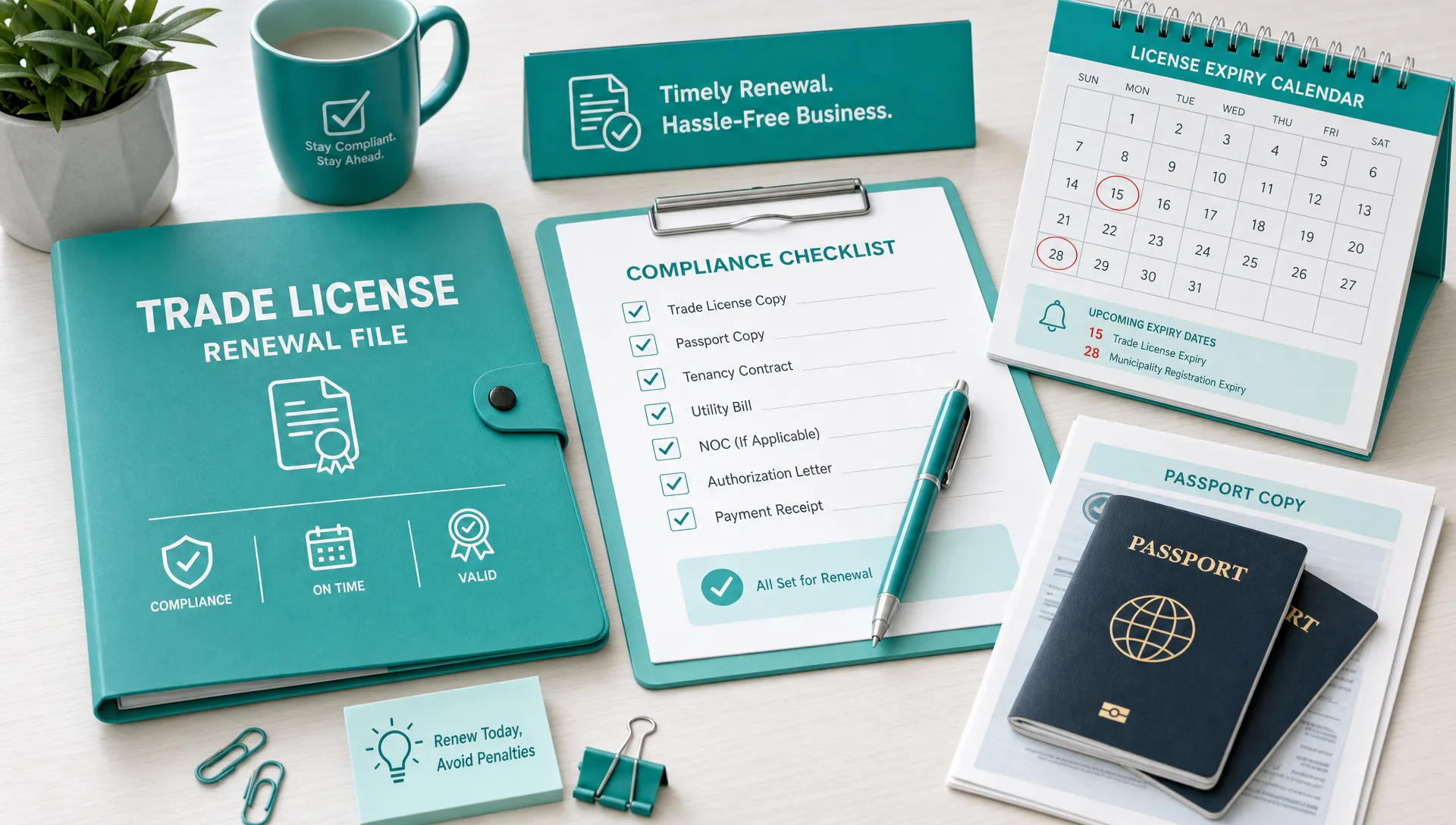
The renewal checklist depends on the free zone and the company’s situation, but most RAK free zone companies should keep a core file ready before the renewal window opens.
Typical items include the current license, lease or facility document, shareholder passport copies, Emirates ID and visa copies where applicable, manager or director details, UBO information, and any existing constitutional documents such as articles of association or share certificates.
If there have been changes during the year, the checklist becomes more important. For example, a new shareholder, a new manager, a passport renewal, a revised business activity, or a change of office can trigger additional filings. Regulated or sensitive activities may also require external approvals or updated supporting documents.
Do not treat renewal as a separate event from the company’s corporate record. The names, passport details, addresses, activities, ownership percentages, and management appointments in your authority file should match your bank file, accounting file, contracts, and tax registrations.
The cost drivers behind a renewal invoice
Founders often focus on the license renewal fee, but the annual cost of keeping a RAK free zone company active can include several components. Some are authority costs. Others relate to facility needs, visas, immigration, tax, bookkeeping, or professional support.
The exact amount depends on your structure and should be confirmed with the relevant authority or advisor. As a planning exercise, the key is to understand what can change the invoice from one year to the next.
| Cost area | What can affect it | Renewal question to ask |
|---|---|---|
| License package | Number and type of activities, legal form, package changes | Are all listed activities still needed and accurate? |
| Facility | Flexi desk, office, warehouse, land, or industrial space | Does the facility still support banking, visas, and operations? |
| Immigration | Establishment card, visa quota, visa renewals, dependent visas | Are visa dates aligned with the company renewal cycle? |
| Amendments | Changes to shareholders, managers, activities, address, or documents | Should amendments be completed before or during renewal? |
| Penalties | Late renewal, unpaid invoices, expired documents | Are there any outstanding items to clear before submission? |
| Compliance support | Bookkeeping, tax registration, governance, bank KYC assistance | Is the company file ready for banks and authorities? |
For a more detailed explanation of operational expenses that can sit outside the headline license fee, review Alldren’s breakdown of Free Zone RAK costs beyond the license fee.
Use renewal to check whether your license still fits the business
A renewal is the right moment to ask a basic but important question: Does the company still do what the license says it does?
Many companies evolve after formation. A consulting business may add software services. An e-commerce company may begin wholesale trading. A holding vehicle may start receiving management fees. A small import business may need warehousing or a different customs setup.
If the license activity no longer reflects the actual business, the mismatch can create problems with banks, tax filings, payment processors, clients, and immigration. It may also limit the company’s ability to sign contracts or issue invoices for the work it actually performs.
Before renewing, compare the license against current and expected revenue streams. If the activity is too narrow, too broad, or simply outdated, assess whether an amendment is needed. In some cases, it is better to adjust the activity before renewal. In other cases, the authority may allow the change as part of the renewal process.
The same review should apply to facilities. A flexi desk may suit a lean services business, while trading, logistics, manufacturing, or regulated activities may require a more robust presence. Banks may also look at whether the company’s substance and office arrangement make sense for the declared activity and transaction profile.
Do not ignore tax and accounting during renewal
Renewal and tax compliance are separate obligations, but they are closely connected in practice. A company can renew its license while still having unresolved accounting or tax issues. Those issues may later surface during bank reviews, tax registration checks, financial statement preparation, or due diligence.
UAE Corporate Tax applies to financial years starting on or after 1 June 2023, with a standard 9% rate generally applying to taxable income above AED 375,000. The UAE also has specific rules for qualifying free zone persons, including conditions that must be met to benefit from the 0% rate on qualifying income. The Federal Tax Authority’s Corporate Tax guidance should be treated as an official reference point, alongside professional advice for your facts.
Before renewing, review whether the company has addressed the following:
- Corporate Tax registration, where required
- VAT registration status, especially if taxable supplies or imports have grown
- Bookkeeping records for the financial year
- Invoices, contracts, and bank statements supporting revenue and expenses
- Related party transactions and transfer pricing considerations, where relevant
- Financial statements or audit requirements that may apply because of tax status, authority rules, group policy, or banking expectations
A renewal should not be used to “hide” an inactive or poorly maintained accounting file. Even dormant companies should usually keep clear records showing that they had little or no activity. For active companies, consistent books are essential for tax, banking, and long-term credibility.
Renewal is also a banking event
Corporate banking is one of the most common areas where renewal delays create real business disruption. UAE banks periodically refresh KYC records and may ask for updated documents at any time. A renewed license is often part of that file.
If the bank holds an expired license, or if the renewed license shows activities that do not match account activity, the company can face additional questions. In more serious cases, banks may restrict account activity until the file is updated.
After renewal, provide your bank with the updated license, facility document if requested, ownership details, and any amended corporate documents. If the company’s business model, client base, countries of trade, or transaction volumes have changed materially, prepare a clear explanation before the bank asks.
Founders setting up or maintaining accounts can also use Alldren’s RAK free zone banking tips to understand how banks assess structure, substance, and documentation.
A simple step-by-step renewal process
The cleanest renewal process is structured, not reactive. While each company will have its own details, the workflow below works well for most RAK free zone companies.
- Review the current structure: Confirm the legal form, shareholders, manager, UBOs, license activities, facility, visas, and bank account status.
- Identify changes before requesting renewal: Decide whether any amendments are needed for activities, ownership, management, contact details, or facility.
- Check compliance readiness: Review bookkeeping, tax registration, VAT position, contracts, and bank KYC documents.
- Clear outstanding authority items: Resolve unpaid invoices, expired documents, penalties, or pending portal requests.
- Submit the renewal file: Provide the required documents to the free zone or corporate services provider and arrange payment once the invoice is confirmed.
- Update the company records after renewal: Store the renewed license and related documents, then send updated records to banks, clients, internal finance teams, and advisors where needed.
This process is straightforward when the company file has been maintained throughout the year. It becomes difficult when changes were made informally, accounting was not kept, or the business model drifted away from the licensed activity.
Free zone renewal is not the same as RAK ICC offshore renewal
A common source of confusion is the difference between a RAK free zone operating company and a RAK ICC offshore company.
A RAK free zone company is generally used for licensed business activity within the framework of the relevant free zone. It may have a facility, immigration file, visa eligibility, and operational substance depending on the setup.
A RAK ICC company is a different type of structure, typically used for international corporate holding, asset holding, or other offshore structuring purposes. It does not renew in the same way as a free zone operating license and does not provide the same facility or visa framework.
If a group uses both structures, each entity needs its own renewal calendar, registered office or agent arrangements, corporate records, and compliance review. Mixing them together can lead to missed deadlines or incorrect assumptions about what the company is allowed to do.
Common renewal mistakes to avoid
Most renewal problems are preventable. The following mistakes are especially common among founders who formed a company quickly and did not revisit the structure after launch.
The first mistake is waiting until the license is about to expire. Even if payment can be made quickly, unresolved document issues, expired passports, facility changes, or bank questions may take longer than expected.
The second mistake is renewing the same license automatically without checking whether the activity still matches the company’s revenue. A license that was suitable in year one may be too limited in year two.
The third mistake is ignoring visas and immigration dates. License renewal does not automatically renew every visa or immigration-related document. Visa expiries, Emirates ID renewals, medical testing, and establishment card validity should be reviewed separately.
The fourth mistake is overlooking tax and bookkeeping. A paid renewal invoice does not mean the company is ready for Corporate Tax, VAT, banking due diligence, or a future sale.
The fifth mistake is failing to update the bank. Banks do not always know automatically that a license has been renewed. Sending the updated documents proactively can reduce unnecessary account questions.
When professional support is worth it
Some renewals are simple. If the company has one shareholder, one activity, no visas, clean bookkeeping, and no changes, the process may be mostly administrative.
Professional support becomes more valuable when the company has multiple shareholders, visas, international trade flows, bank KYC issues, tax uncertainty, activity changes, facility questions, or a group structure involving free zone and offshore entities.
It is also useful when the renewal is part of a wider cleanup. For example, a company may need to align its licensed activities with contracts, refresh its UBO records, update a bank file, register for Corporate Tax, organize bookkeeping, and renew the license in one coordinated process.
That is where a corporate services partner can add value beyond filing forms. The goal is not only to renew the company, but to keep the structure robust, bankable, and compliant for the year ahead.
Frequently Asked Questions
How early should I start a Free Zone RAK renewal? Starting 45 to 60 days before expiry is a sensible planning window. It gives you time to check documents, resolve authority items, review tax and accounting, and avoid late renewal pressure.
Can a RAK free zone company renew after the license expires? In many cases, late renewal may be possible, but it can involve penalties, portal restrictions, banking issues, or delays with visas and other services. The safest approach is to renew before expiry.
Does renewing the company license automatically renew UAE residency visas? No. The company license, immigration file, establishment card, and individual visas are connected but separate. Visa expiry dates should be tracked independently from the license renewal date.
Can I change business activities during renewal? Often, yes, but it depends on the activity, authority approval, and whether additional documents or fees are required. It is best to review activity changes before the renewal invoice is finalized.
Do I need audited financial statements for renewal? It depends on the authority, company type, tax position, banking requirements, and whether the company is seeking qualifying free zone treatment under UAE Corporate Tax rules. Even where an audit is not requested for license renewal, reliable bookkeeping remains important.
Is a RAK free zone renewal the same as a RAK ICC offshore renewal? No. A RAK free zone company and a RAK ICC offshore company are different structures with different renewal requirements, operating permissions, and compliance considerations.
Make your next RAK renewal predictable
A Free Zone RAK renewal becomes simple when it is treated as an annual governance exercise, not a last-minute payment. Review the structure early, confirm the activity, align the facility, check visa dates, organize tax and bookkeeping records, and update the bank once the renewed documents are issued.
If you want a clearer renewal process, Alldren provides expert-led corporate services for UAE company setup, renewals, compliance management, governance, banking support, tax registration, bookkeeping coordination, and residency visa processing. The right support helps ensure your RAK company remains compliant, operational, and ready for the next year of business.