

Choosing the right company structure in the UAE is one of the highest impact decisions you will make in your setup journey. It affects what you can legally do (and where), how you contract with customers, what your ongoing compliance looks like, how banking will view your business, and how easily you can scale later.
This guide breaks down company structure basics for UAE businesses in practical terms, with the goal of helping you ask the right questions before you commit to a jurisdiction, legal form, and governance model.
What “company structure” means in the UAE
In many countries, “company structure” mostly means legal form (LLC, corporation, partnership). In the UAE, it typically includes three layers:
- Jurisdiction: mainland (onshore), a specific free zone, or an offshore registry.
- Legal form: LLC, sole establishment, branch, free zone company (naming varies), holding company, and others.
- Governance and control: who owns shares, who manages day to day, who can sign, and what internal approvals are required.
These layers are tightly connected to licensing. Your license is not just a formality, it defines permitted activities, regulator expectations, and in many cases operational requirements.
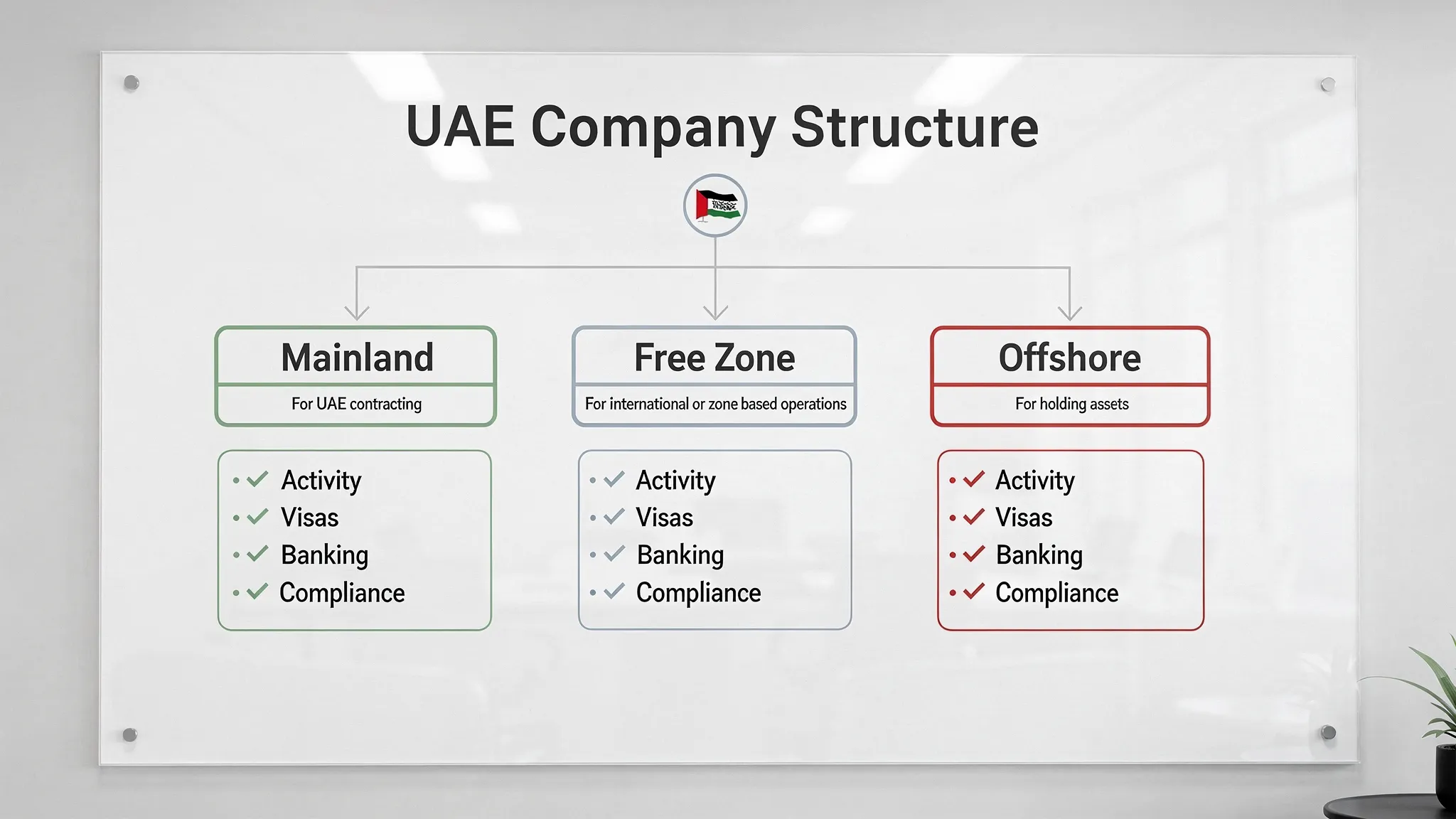
The three most common jurisdiction choices (mainland, free zone, offshore)
Most UAE setups start with a jurisdiction decision. Here is a simple comparison to ground the conversation.
| Jurisdiction | What it’s typically used for | Can you trade directly in the UAE market? | Common starting point | Main watchouts |
|---|---|---|---|---|
| Mainland (onshore) | Operating locally, contracting with UAE customers, broader activity coverage | Often yes, subject to licensing and activity | Emirate level economic departments and relevant regulators | Activity approvals, office requirements, and ongoing compliance depend on emirate and activity |
| Free zone | International trade, regional HQs, services, e-commerce, specific industry clusters | Sometimes, but often requires a local distributor/agent or a mainland branch/structure depending on the activity model | A specific free zone authority | Rules vary by free zone, substance expectations, and banking perceptions can differ |
| Offshore | Holding assets, international ownership structures, non-operating entities | Generally no local operating (by design) | Offshore registries | Not suitable for UAE trading and often not suitable for hiring staff or leasing local premises |
The exact permissions depend on your licensed activity and the regulator involved. Treat any “always” or “never” claims as a red flag, the UAE is rules based, and details matter.
Common legal forms you will encounter
Once jurisdiction is chosen, you will choose a legal form. Names differ across authorities, but the underlying concepts are consistent.
Limited Liability Company (LLC)
An LLC is a standard operating vehicle because it provides limited liability (shareholders are generally not personally liable beyond their share capital, subject to legal exceptions). In the UAE, LLC style forms are used on the mainland and in many free zones (free zones may label the entity differently).
Best for:
- Operating businesses with contracts, staff, vendors, and recurring invoices
- Owners who want clear separation between personal and business risk
Sole establishment (or similar single owner forms)
This can be suitable for some individual professional activities, depending on licensing rules and the activity type. Liability and governance differ from an LLC, so it is not just a cheaper LLC alternative.
Best for:
- Specific regulated professional models where the authority permits it
Branch of a foreign company
A branch can be a strategic choice if you already have an established parent company and want a UAE presence without a separate shareholding structure. Branches commonly rely on the parent’s corporate standing, but they also create governance and risk considerations because the parent is usually on the hook.
Best for:
- Established foreign companies expanding into the UAE under the same brand and control
Holding company structures
Holding companies can be used to own shares in operating subsidiaries, centralize IP, or hold assets, depending on your broader tax, governance, and risk goals. The “right” holding location depends heavily on where assets are held, where value is created, and what reporting obligations apply.
Best for:
- Groups planning multiple entities, investors, or a separation between operations and ownership
The UAE legal and compliance baseline (what applies almost everywhere)
A “simple” company structure can still carry serious obligations. While requirements vary by authority and activity, most UAE businesses should expect the following themes.
Corporate law and governance expectations
The UAE’s corporate framework is set out in the Commercial Companies Law, and companies must align their constitutional documents, signatory powers, and governance with it and with their licensing authority’s rules. A helpful starting reference is the UAE Ministry of Economy.
In practice, this translates into questions like:
- Who are the shareholders and what are their rights?
- Who is the manager or director, and what can they sign without approvals?
- What approvals are required for bank mandates, major contracts, or changes to ownership?
Tax registration and ongoing filings
Two common tax areas to plan for early:
- UAE Corporate Tax: The regime is now a core part of structuring conversations. The Federal Tax Authority (FTA) is the primary reference point for guidance and registration. Start here: Federal Tax Authority.
- VAT: Depending on your taxable supplies and thresholds, VAT registration may apply.
Free zone companies may qualify for specific corporate tax treatment if conditions are met, but that determination is fact specific. Structure and operations must match.
Accounting and bookkeeping
Even when an authority does not demand audited statements for every business, strong bookkeeping is not optional if you want:
- Smooth bank account operations
- Credible financials for investors or lenders
- Accurate corporate tax and VAT filings
Beneficial ownership, AML, and substance related requirements
The UAE has strengthened transparency and compliance expectations in recent years. Depending on your activities and profile, you may need to maintain accurate beneficial ownership information and meet additional reporting or controls.
For substance related rules, consult official guidance via the UAE Ministry of Finance.
How to choose the right company structure (a practical decision framework)
Instead of starting with “Which free zone is cheapest?”, start with how the business must operate.
1) Define where revenue will be earned
Ask:
- Will you invoice UAE customers?
- Will you sell to government entities or regulated sectors?
- Will you need to sign leases, hire staff, or maintain a physical presence?
If your commercial reality is “local UAE contracting,” that usually pushes you toward structures that support local operations cleanly.
2) Map your activities to licensing reality
In the UAE, licensing is activity based. Two businesses that both call themselves “consulting” may face different approvals depending on what they actually do (financial advice, engineering, healthcare, crypto related work, etc.). Misalignment here can create downstream issues like:
- Bank account delays
- Inability to invoice for the work you are doing
- Compliance breaches if you operate outside licensed scope
3) Decide what you need from immigration and hiring
If you need UAE residency visas for founders or employees, your structure should support a realistic plan for:
- Visa eligibility and processing
- Office or facility requirements (if applicable)
- Ongoing compliance to keep visas in good standing
4) Plan for banking from day one
Bank account opening is not a “final step,” it is part of structuring. Banks assess risk, transparency, documentation, and expected transaction patterns.
To improve outcomes, align early on:
- Ownership and UBO documentation
- Clear business model narrative and contracts
- Expected counterparties and countries
- Source of funds and source of wealth narratives (where relevant)
5) Pressure test governance, not just setup costs
A company structure should still work when:
- You add a new shareholder
- A partner relationship changes
- You need to delegate signing authority
- You raise capital
- You sell the business
If your structure cannot survive normal business events without rework, it is not a strong structure.
Typical “good fit” scenarios (examples)
These are not rules, but they illustrate how advisors often think.
Mainland tends to fit when
- You need broad access to the UAE market for contracting and service delivery
- Your activity is better handled under an emirate level licensing framework
- You want fewer operational workarounds for local invoicing
Free zones tend to fit when
- Your activity aligns with a specific free zone’s permitted scope and ecosystem
- You primarily serve international clients, or your delivery model is outside the local market
- You value the administrative model and processes of a particular free zone authority
Offshore tends to fit when
- You need a non-operating holding entity (ownership, investments, assets)
- You do not need visas, local premises, or local operating permissions
Common structuring mistakes to avoid
Picking a jurisdiction before confirming the activity and operating model
The fastest way to waste time is to incorporate first and discover later that your intended activity needs a different license or additional approvals.
Treating governance as paperwork
Banks, counterparties, and regulators care about who controls the company and who can sign. Weak governance often shows up as:
- Conflicting signatory powers
- Unclear roles between shareholders and managers
- Gaps in decision documentation
Underestimating ongoing compliance
Ongoing compliance is a predictable cost of operating in the UAE, not an exception. Plan for recurring requirements like renewals, filings, accounting, and updates to ownership or management records.
Overcomplicating the structure too early
Complex structures can be appropriate, especially for groups and asset holding. But complexity without a business reason can slow banking, create higher compliance overhead, and confuse counterparties.
What you should prepare before speaking to a setup specialist
If you want better advice (and fewer back and forth cycles), have these inputs ready:
- A one paragraph description of what you sell and how you deliver it
- Top 5 expected customer locations and supplier locations
- Expected annual revenue range and transaction volumes (ballpark)
- Whether you need UAE visas (and for how many people)
- Ownership breakdown and any planned future investors
- Any regulated elements (financial services, healthcare, education, crypto, etc.)

Frequently Asked Questions
What is the best company structure for a UAE business? The best company structure depends on where you will operate (UAE market vs international), your licensed activity, visa needs, and banking requirements. There is no single best option for everyone.
Is a free zone company always tax free? Not necessarily. UAE corporate tax rules can apply, and some free zone entities may qualify for specific treatment only if they meet defined conditions. Check the latest guidance from the Federal Tax Authority.
Can an offshore company do business in the UAE? Offshore entities are generally designed for non-operating purposes such as holding assets or shares. If you need to trade or contract locally, you usually need a structure intended for operating in the UAE.
Do I need a bank account before I can start operating? In most cases, yes. Even if incorporation is complete, practical operations like invoicing, paying suppliers, and payroll depend on banking. Planning for bank account opening should be part of structuring.
What is the difference between legal form and jurisdiction? Jurisdiction is where the company is registered and regulated (mainland, a specific free zone, or offshore). Legal form is the entity type within that jurisdiction (LLC, branch, etc.).
How do I avoid choosing the wrong structure? Start from your operating model, confirm licensing for your real activities, and pressure test the structure for banking, governance, and future growth before incorporating.
Build a compliant UAE company structure with expert guidance
If you want a UAE company structure that works not only on day one, but also for banking, compliance, and growth, consider working with specialists who do this every day.
Alldren provides expert-led, transparent corporate services for establishing and managing UAE companies, including structuring, ongoing compliance, corporate governance, bank account opening support, visa processing, bookkeeping, and tax registration.
Explore options at Alldren and start with a structure you can confidently build on.