
A UAE company setup can feel straightforward when the conversation starts with a license package, a fast timeline, and an attractive headline price. The real risk is that the company may be formed before anyone has tested whether the structure actually fits the business, the owners, the banking file, the tax position, and the future governance needs.
Hidden setup risks are not always visible at incorporation. They often appear later, when a bank asks for documents that were never prepared, a free zone activity does not match the real revenue model, a shareholder change becomes difficult to document, or a tax registration deadline arrives without clean records.
For founders, investors, and private clients, the objective should not be to form the company as quickly as possible. It should be to form the right company, with enough structure to operate, bank, comply, and grow without expensive corrections.
What hidden setup risks really look like
A hidden setup risk is any issue that is not priced, explained, or designed for at the beginning, but becomes a cost, delay, restriction, or compliance problem later. These risks are common in company setup UAE projects because incorporation touches several systems at once: licensing, immigration, banking, tax, accounting, ownership records, and commercial contracts.
The mistake is treating incorporation as a single transaction. In reality, UAE business incorporation is the start of an operating framework. If that framework is weak, even a valid license can become difficult to use.
| Hidden risk area | What it looks like at setup | What it can cause later |
|---|---|---|
| Wrong jurisdiction | Choosing the cheapest or fastest option | Banking delays, activity restrictions, renewal issues |
| Poor activity selection | License activities do not match contracts or invoices | Tax, banking, and compliance questions |
| Weak documentation | Ownership, source of funds, and business model are not clearly evidenced | Bank account rejection or repeated due diligence requests |
| Unplanned tax position | Corporate Tax, VAT, or free zone tax rules are considered too late | Missed registrations, penalties, or loss of expected treatment |
| Loose governance | No clear approvals, resolutions, or signing rules | Disputes, blocked transactions, or investor concerns |
| Unclear pricing | Setup quote excludes renewals, visas, compliance, or support | Budget overruns after incorporation |
The safest approach is to identify these issues before the company exists. Once a structure is already formed, fixing it may require amendments, new licenses, new banking submissions, tax remediation, or even a fresh incorporation.
Build around the business, not the package
Many setup problems begin with the wrong first question. Founders often ask, “Which license is cheapest?” or “Which free zone is fastest?” A better first question is, “What will this company actually do, who will it invoice, where will management sit, and what proof will banks and authorities expect?”
A consulting company with international clients, a trading business importing goods, a holding company owning shares, and a private wealth structure may all need different answers. The jurisdiction, legal form, activity wording, office or facility requirement, visa plan, and banking strategy should follow the commercial reality.
This is especially important in Ras Al Khaimah company formation, where founders may compare a RAKEZ free zone entity with a RAK ICC offshore company and assume they are interchangeable. They are not. A RAKEZ free zone company is commonly used for licensed commercial activity within a free zone framework. A RAK ICC offshore company is typically used for international holding, asset ownership, and corporate structuring purposes, not as a shortcut for operating in the UAE market.
| Option | Common use case | Hidden risk if misunderstood |
|---|---|---|
| Mainland company | UAE-facing operations, local market access, certain regulated activities | May involve additional approvals, premises, and sector-specific rules |
| RAKEZ free zone | Licensed free zone operations, international business, UAE presence with defined activities | Activity, visa, facility, and banking requirements must match the real model |
| RAK ICC offshore | Holding, asset ownership, international structuring, certain private client uses | Not a substitute for a UAE operating license, visas, or local commercial presence |
Before choosing a structure, map the revenue model, client locations, suppliers, management location, ownership chain, and expected banking flows. Alldren has covered this principle in more detail in its guide to how founders should build around real business activity, which is often the best starting point for avoiding mismatched structures.
Do not assume banking will follow incorporation
A company license does not guarantee a bank account. Banks look beyond incorporation documents. They need to understand who owns and controls the company, what the company does, where funds will come from, who the customers and suppliers are, and whether the expected transactions make sense.
This is where hidden setup risk becomes visible. If the incorporation file was built only to satisfy the registration authority, it may not be strong enough for bank due diligence. A bank may ask for contracts, invoices, business plans, proof of address, ownership charts, source of wealth or source of funds evidence, group structure documents, and explanations of expected transaction flows.
A stronger setup process prepares for banking before incorporation. It checks whether the proposed activity is bankable, whether the ownership chain is easy to explain, whether shareholders have consistent documents, and whether the company can evidence genuine business purpose.
A strong banking file normally includes:
- Clear ownership and ultimate beneficial owner information
- A business model summary that matches the license activity
- Evidence of source of funds or source of wealth where relevant
- Draft or signed commercial contracts, invoices, or client pipeline documents
- A realistic explanation of expected transaction volumes and counterparties
This does not mean every banking application will be simple. It means the company is not being formed blindly. In UAE corporate services, the difference between a smooth setup and a frustrating one is often whether banking was treated as part of the structure, not as an afterthought.
Tax and compliance must be designed early
UAE tax obligations have become more structured, and founders can no longer treat tax as something to revisit at renewal. The UAE Corporate Tax regime applies to financial years starting on or after 1 June 2023, with a standard rate of 9 percent on taxable income above AED 375,000, according to the UAE Ministry of Finance. Free zone companies may be eligible for specific treatment on qualifying income only if the relevant conditions are met.
VAT also needs early attention. The UAE Federal Tax Authority explains that VAT registration is generally mandatory when taxable supplies and imports exceed the applicable mandatory registration threshold. A company that starts invoicing without monitoring revenue, customer location, and taxable supplies may discover the registration issue late.
Good UAE tax advisory at setup does not mean overcomplicating a new company. It means asking practical questions before incorporation: Will the company generate taxable income? Will it trade locally or internationally? Will it qualify for any free zone treatment? Will it need VAT registration? Who will maintain books? Who will file returns? What records must be kept?
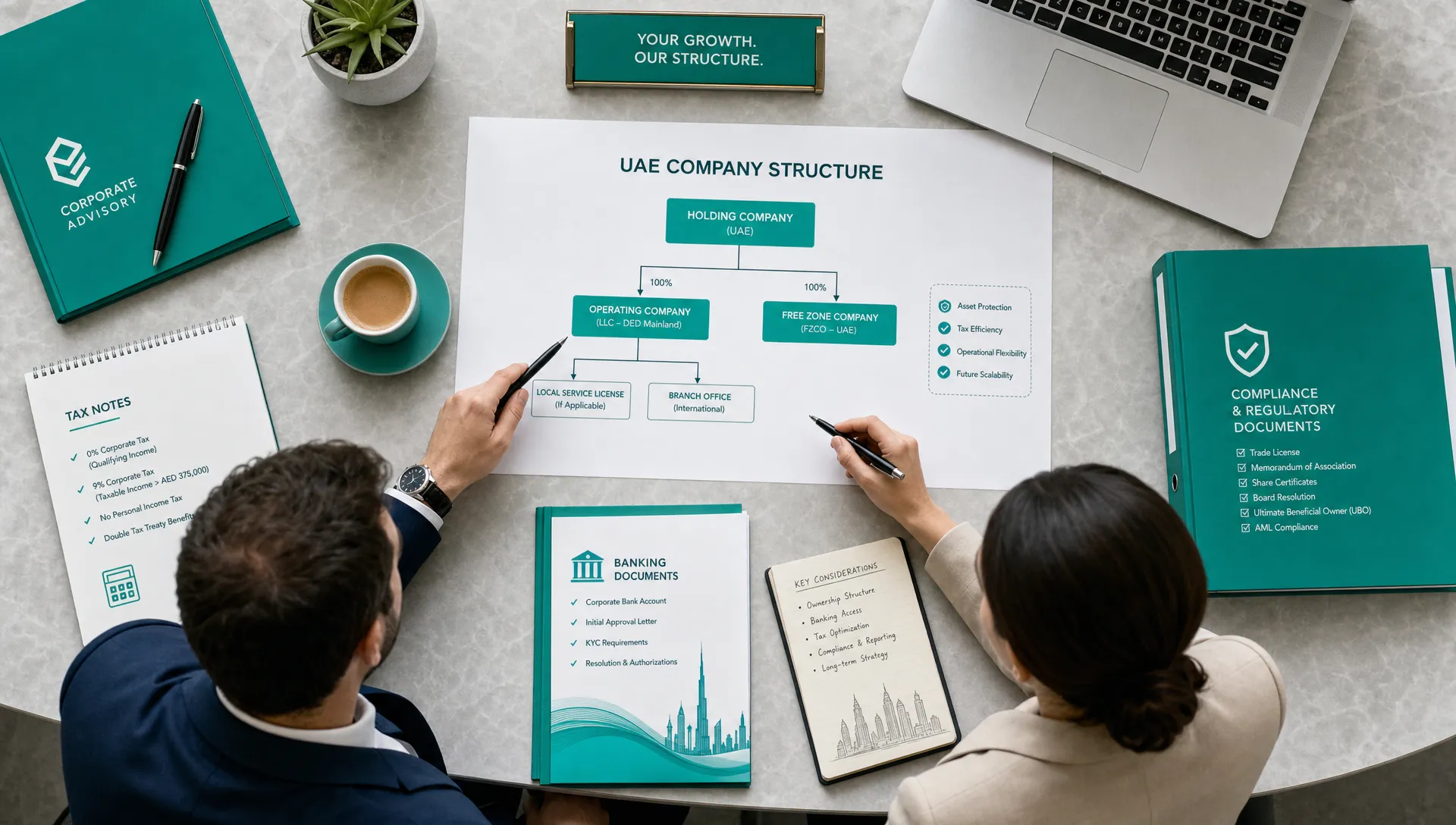
Compliance and governance also include ownership registers, board approvals, accounting records, renewal filings, and changes to directors or shareholders. These are not cosmetic formalities. They are the operating record of the company.
Governance is not just for large companies
Many founders associate corporate governance with listed companies or large groups. In practice, governance matters as soon as there is more than one stakeholder, a bank account, a nominee arrangement, a holding structure, or a plan to bring in investors.
Weak governance creates hidden risk because decisions may not be properly authorized. Who can sign contracts? Who can open accounts? Who approves related-party transactions? What happens if a shareholder exits? How are director changes documented? If these questions are not answered early, the company may operate informally until a bank, auditor, tax adviser, buyer, or regulator asks for formal evidence.
Nominee director services require particular care. They should never be treated as a vague convenience. The role, authority, limits, indemnities, reporting lines, and underlying beneficial ownership position should be properly documented and aligned with compliance expectations.
For founder-led businesses, good governance can be simple. It may involve clear constitutional documents, board resolutions, shareholder approvals, signing authorities, registers, and record-keeping procedures. The key is that the company can prove why decisions were made and who had authority to make them.
Use a pre-incorporation risk screen
A practical way to avoid hidden setup risks is to run a risk screen before choosing the final vehicle. This does not need to slow the project unnecessarily. It creates a clear decision path and reduces the chance of rework.
| Question to answer before setup | Why it matters |
|---|---|
| What will the company actually sell or hold? | Determines activity, jurisdiction, and licensing fit |
| Who are the shareholders and ultimate beneficial owners? | Affects compliance, banking, and governance records |
| Where will customers, suppliers, and funds be located? | Helps assess banking, VAT, and operational risk |
| Will the company need UAE visas or physical presence? | Influences free zone, facility, and cost decisions |
| What annual filings and renewals will apply? | Prevents underbudgeting and missed obligations |
| What documents will banks or authorities expect? | Improves readiness after incorporation |
The output should be a documented structure recommendation, not just a price quote. It should explain why a mainland, free zone, or offshore company UAE option is appropriate, what assumptions were used, what risks remain, and what will be required after formation.
For planning the practical sequence, Alldren’s guide to company setup timelines, costs, and steps is a useful companion because timing and cost only make sense once the structure has been properly defined.
Transparent pricing reduces structural risk
Hidden pricing and hidden setup risk often travel together. If a quote only shows the incorporation fee, founders may overlook immigration, establishment cards, office or facility requirements, bank support, tax registration, bookkeeping, governance documents, annual renewals, and amendment costs.
Transparent pricing does more than protect a budget. It forces the provider and client to discuss what is actually included. If compliance management, corporate governance services, bank account opening support, UAE residency visa processing, bookkeeping, tax registration, or ongoing advisory are likely to be needed, they should be visible early.
This is why upfront pricing is not just a commercial preference. It is a risk control. A founder who understands the first-year and recurring cost profile can make better choices about jurisdiction, license scope, visa allocation, and administrative support. Alldren explains this further in its article on why transparent pricing matters in UAE setup.
A reliable adviser should be willing to say when a low-cost option is unsuitable. The cheapest setup can become expensive if it blocks banking, creates tax uncertainty, or requires restructuring soon after formation.
Frequently Asked Questions
What are hidden setup risks in UAE company formation? Hidden setup risks are issues that are not addressed before incorporation but later create delays, costs, or compliance problems. Common examples include wrong license activity, weak ownership documentation, unclear tax obligations, unsuitable banking profile, and missing governance records.
Is a free zone company always the best option for a UAE startup? Not always. A free zone can be efficient for many businesses, but the right choice depends on the real activity, customer base, visa needs, banking requirements, tax position, and whether the company needs mainland access or specific regulatory approvals.
What is the difference between RAKEZ and RAK ICC? RAKEZ is a free zone used for licensed business activity within its framework, while RAK ICC is an international corporate registry often used for holding and structuring purposes. The right choice depends on whether the company needs to operate, hold assets, support visas, or form part of a broader ownership structure.
Can I open a UAE bank account immediately after company setup? Incorporation is only one part of the banking process. Banks carry out due diligence on ownership, activity, source of funds, expected transactions, and supporting documents. Preparing for banking before incorporation can reduce friction, but approval is never automatic.
When should tax planning start for a UAE company? Tax planning should start before incorporation. Corporate Tax, VAT, free zone conditions, bookkeeping, and record-keeping can all affect the right structure and the ongoing compliance plan.
Build with fewer surprises
A strong UAE company is not built by choosing the fastest package. It is built by aligning structure, licensing, banking, tax, governance, and ongoing administration before the first filing is made.
Alldren provides expert-led corporate services UAE clients can use to establish and manage companies with clear structure, upfront pricing, and direct access to senior experts. If you want to build without hidden setup risks, start with a structure that reflects the business you actually intend to run.
Speak with Alldren to plan your UAE company setup with transparency from the beginning.