
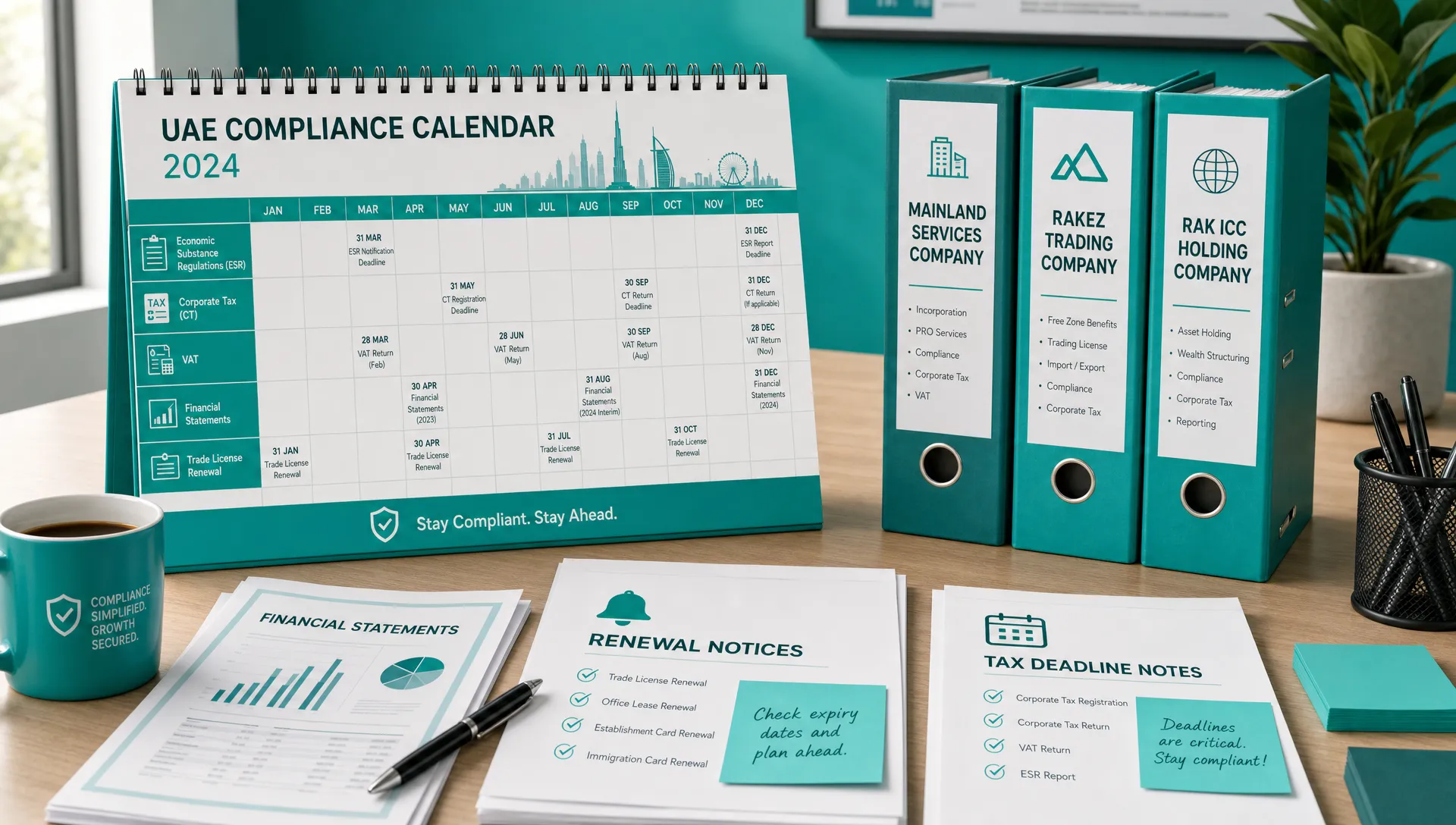
A UAE compliance calendar for a multi-entity group needs to do more than remind someone to renew a licence. It must show which legal entity owes each obligation, what information is needed before submission and who is accountable when several companies depend on the same finance or corporate services team.
That becomes more complicated when a group combines mainland operating companies, RAKEZ free zone entities and RAK ICC holding companies. Their renewal dates, financial years, tax positions and registry requirements may differ, even when they share owners and management.
The practical solution is one group-wide view supported by separate entity records. This guide explains how to build that structure, schedule the work behind each deadline and keep evidence that obligations were actually completed.
Build your UAE compliance calendar from an entity register
Start with a verified list of legal entities, not last year's reminders. A calendar copied forward without checking the underlying structure can miss an acquisition, retain a dissolved company or assign a filing to the wrong taxpayer.
For each entity, record its legal name, registration number, jurisdiction, licensing or registration authority, financial year-end and renewal date. Add its corporate tax registration details, VAT status, registered agent where applicable and the person responsible for maintaining its records.
Also distinguish legal entities from branches. A branch may need its own licence renewal without being a separate corporate tax taxpayer. Treating every registration as an independent company can create duplicate tasks or incorrect assumptions about filing obligations.
The register should identify whether an entity belongs to an approved corporate tax group or VAT group. Record the effective date of that treatment and the representative responsible for submissions.
Do not infer compliance obligations from an entity's commercial label. A holding company with little activity still needs an assessed tax position. An offshore company is not automatically outside UAE corporate tax, and free zone status does not by itself guarantee a 0% tax outcome.
When a new company joins the structure, use an initial UAE compliance checklist to identify its starting obligations before adding recurring dates to the group calendar.
Separate fixed deadlines from recurring checks and trigger events
Not every compliance task belongs on an annual calendar. Some obligations have statutory dates, others follow an expiry date and many arise only when something changes.
Use the following categories to avoid treating all work as a yearly renewal:
| Workstream | What determines the deadline | What the calendar should capture |
|---|---|---|
| Corporate tax return and payment | The relevant tax period | Filing date, payment date and supporting preparation milestones |
| VAT return and payment | The assigned VAT tax period | Period-end, submission deadline and payment confirmation |
| Licence or registry renewal | The relevant authority's renewal cycle | Expiry date, preparation date and required documents |
| Financial statements and audit | Applicable tax, registry, regulatory or constitutional requirements | Preparation, audit and approval milestones |
| Beneficial ownership and corporate records | Changes and applicable registry requirements | Trigger date, reporting deadline and evidence of submission |
| Bank KYC | Bank requests, review dates and relevant changes | Response deadline, document owner and bank acknowledgment |
| Immigration documents | Each document's expiry and applicable requirements | Expiry, preparation and renewal status |
| Related-party transactions | Transaction timing and tax reporting requirements | Reconciliations, agreements and documentation reviews |
For every entry, record both the external deadline and an earlier internal completion date. The external date is the authority's requirement. The internal date gives the group time to resolve missing documents, obtain signatures or correct rejected submissions.
Apply tax deadlines to the right taxpayer
Corporate tax: work backward from the tax period
Under the UAE's general corporate tax rules, the return and tax payment are due within nine months after the relevant tax period ends. The Federal Tax Authority's corporate tax resources provide the official guidance and applicable requirements.
For example, a tax period ending on 31 December 2026 generally produces a filing and payment deadline of 30 September 2027. A period ending on 30 June 2026 generally produces a deadline of 31 March 2027.
These are filing deadlines, not sensible dates to begin preparing the accounts. Build earlier milestones for closing the ledger, reconciling intercompany balances, assessing tax adjustments, completing any required audit and obtaining approval of the return.
Corporate tax registration is a separate obligation. Its deadline depends on the circumstances and applicable FTA rules, so it should not be calculated by copying the annual return deadline. Include registration checks when incorporating, acquiring or restructuring an entity.
VAT: use the assigned period, not the financial year
VAT returns and related payments are generally due within 28 days after the end of the assigned tax period. Confirm the entity's or VAT group's actual periods and deadlines in EmaraTax rather than assuming every company files quarterly.
The FTA's VAT guidance is the appropriate reference for filing and registration requirements.
VAT registration monitoring also needs its own task. For UAE-resident businesses, the mandatory threshold generally concerns taxable supplies and imports exceeding AED 375,000 over the previous 12 months, or an expectation of exceeding that amount in the next 30 days. Different rules can apply to non-resident businesses.
A monthly rolling-threshold review is therefore more useful than a single year-end reminder. Capture the review result even when no registration is required.
Distinguish tax groups from the corporate group
Common ownership does not automatically create a corporate tax group or a VAT group. Each regime has separate eligibility conditions and approval requirements.
A UAE compliance calendar should show the approved filing perimeter for each tax. The same collection of companies may have one corporate tax arrangement and a different VAT arrangement.
For an approved corporate tax group, link the group return to the preparation work required from each member. A late trial balance from one subsidiary can delay the entire submission, so member reporting deadlines should precede the central tax review.
For a VAT group, the representative member needs reliable reporting from every member included in the registration. Maintain entity-level transaction records and reconciliations even where the return is submitted at group level.
Do not assume tax grouping merges the companies' other obligations. Separate licences, registry records, bank KYC requests and governance duties may remain.
Changes in ownership, activities or eligibility should trigger a review of the relevant grouping arrangements. Record who will assess the change, whether an application or notification is needed and when any revised treatment becomes effective.
Worked example: three entities with different compliance clocks
Consider an illustrative group with a RAK ICC holding company, a RAKEZ trading company and a mainland services company. Assume each is a separate corporate tax taxpayer and that the financial periods shown below apply.
The dates are examples, not standard renewal dates for these jurisdictions.
| Entity | Illustrative tax period-end | General corporate tax filing and payment deadline | Separate renewal milestone |
|---|---|---|---|
| RAK ICC holding company | 31 December 2026 | 30 September 2027 | Confirm registry renewal requirements and coordinate with the registered agent |
| RAKEZ trading company | 31 December 2026 | 30 September 2027 | Track the entity's actual licence expiry and renewal requirements |
| Mainland services company | 30 June 2026 | 31 March 2027 | Track its licence expiry and authority-specific requirements |
Suppose the mainland company also has assigned quarterly VAT periods ending in March, June, September and December. Its VAT deadlines would generally fall on 28 April, 28 July, 28 October and 28 January respectively, subject to confirmation in the portal and any applicable authority-announced changes.
The group therefore has work throughout the year, not one annual compliance season. The March corporate tax deadline belongs to the mainland company, while September brings two separate corporate tax submissions.
This is why the calendar should be filterable by legal entity, obligation, owner and upcoming deadline. A single list sorted by date is helpful, but insufficient for checking whether every company is covered.
Schedule dependencies before the final submission
A deadline becomes manageable when the calendar shows the work needed to meet it.
For a corporate tax return, the sequence may include closing the accounts, reconciling related-party balances, reviewing tax adjustments, completing an applicable audit, approving the filing and arranging payment. Assign a date and owner to each material step.
Use internal lead times appropriate to the group's complexity. For example, beginning a renewal review 60 days before expiry may be sensible, but it is an internal control rather than a universal statutory requirement. A company undergoing restructuring may need longer.
Intercompany reconciliations deserve particular attention. If one entity records a management charge and another has not recorded the corresponding expense, group reporting and tax preparation can stall. Set a common cut-off for resolving differences, with an escalation route for disputed balances.
Approval rights also need to be clear. The person preparing a return may not be authorized to approve it or release payment. Connect calendar tasks to the group's governance and signing controls so submissions do not wait for an unavailable signatory.
Give every obligation an owner and a completion record
Shared responsibility often means nobody knows who must act next. Assign one accountable owner to each obligation, even when several people contribute.
A useful task record contains the entity, obligation, period covered, external deadline, internal deadline, accountable owner, approver, dependencies and evidence location. Keep the source of the deadline too, such as a portal record, licence or authority notice.
Use statuses that describe the actual work: preparing, awaiting documents, awaiting approval, submitted, accepted and closed. Submission alone may not be enough to close a task if payment remains outstanding or the authority has requested corrections.
For tax work, retain the submitted return, submission acknowledgment and payment evidence where applicable. For renewals, retain the renewed document rather than only the invoice. For bank KYC, save the request, response package and acknowledgment.
A group dashboard should highlight upcoming deadlines, overdue dependencies and unresolved rejections. It should not display a reassuring green status merely because someone uploaded a draft document.
Use a monthly, quarterly and annual operating rhythm
Monthly: review changes and the next 90 days
Review upcoming obligations across all entities, including the preparation steps due before the external deadlines. Check VAT registration exposure, expiring documents, outstanding bank requests and changes in ownership, directors, addresses or activities.
This meeting should produce decisions and named actions. If an audit is behind schedule or a signatory is unavailable, resolve the dependency while there is still time to act.
Quarterly: test the group's records
Reconcile intercompany balances, review related-party agreements and confirm that each entity's activities remain aligned with its registration and assessed tax position. Where qualifying free zone treatment is relevant, include a review of the applicable conditions and supporting evidence.
Check that the calendar still matches the legal structure. Acquisitions, disposals, branches and liquidations can change obligations before the next annual planning cycle.
Annually: rebuild the obligation map
Before rolling the calendar forward, verify financial year-ends, licence details, tax group membership and audit requirements. Confirm whether any changes in law or authority procedures affect the coming year.
Review access to filing portals and payment arrangements as well. A correct calendar cannot prevent delay if the only authorized user has left the business or the payment approval process is unclear.
Create an event-driven workflow alongside the calendar
Some of the highest-risk obligations arise between scheduled reviews. A share transfer, director appointment, new activity or office move should trigger an immediate assessment rather than wait for the next annual renewal.
Route relevant changes through a short process: identify the affected entities, assess registry and tax consequences, establish applicable reporting deadlines and assign owners. Beneficial ownership changes may require updates within specific time limits under the applicable framework, so record when the change became known and verify the relevant requirements promptly.
Include changes to banking signatories and authorized representatives. A completed corporate resolution does not mean every bank or authority has updated its records.
For acquisitions, carry out this assessment before assuming the seller's calendar is complete. Obtain outstanding notices, filing histories and evidence of compliance, not just a spreadsheet of future dates.
Remove obsolete reminders without losing historical obligations
A calendar can become unreliable when old requirements remain indefinitely or specialist obligations are omitted.
For example, UAE Economic Substance Regulations reporting was removed for financial years ending after 31 December 2022. Do not automatically carry forward annual ESR notifications and reports for later years. Historical obligations, records or unresolved matters may still need attention.
At the other end of the scale, large multinational groups should assess whether the UAE Domestic Minimum Top-up Tax creates a separate compliance workstream. Regulated businesses and designated non-financial businesses and professions may also require additional sector-specific or anti-money laundering controls.
Keep these obligations in the same group oversight system, but assign their technical assessment to the appropriate specialist. A standard corporate calendar is a starting structure, not a substitute for determining what applies to each entity.
Frequently asked questions
Can one calendar cover all UAE group companies? Yes. Use a central calendar with separate entity records and filters. Each obligation should identify the legal entity or approved tax group responsible, its deadline and the person accountable for completion.
Do all group companies have the same corporate tax deadline? No. The deadline generally follows the relevant tax period. Separate taxpayers with different financial year-ends can have different filing dates. An approved corporate tax group follows its applicable group tax period and filing requirements.
Should a RAK ICC company be included if it has no trading activity? Yes. Assess its registry renewal, registered agent coordination, corporate records, tax position and any banking requirements. Inactivity does not establish that the company has no compliance obligations.
Does outsourcing compliance remove the group's responsibility? No. A provider can coordinate and carry out agreed tasks, but the group still needs clear responsibilities for supplying information, approving submissions and meeting its legal obligations. Define that division of work in writing.
What proves that a calendar task is complete? Evidence appropriate to the obligation, such as an accepted filing acknowledgment, payment confirmation, renewed licence or updated registry document. A reminder marked complete is not sufficient evidence on its own.
Coordinate the calendar with ongoing support
A reliable UAE compliance calendar connects legal structure, tax obligations and operational responsibilities. Start by verifying the entity register, then assign deadlines, preparation milestones and completion evidence to each company.
For groups that need help coordinating this work, Alldren's corporate services include ongoing compliance management, corporate governance, bookkeeping and tax registration, with direct access to senior experts. Discuss your entities, existing arrangements and responsibility gaps so the support reflects the structure you actually operate.